
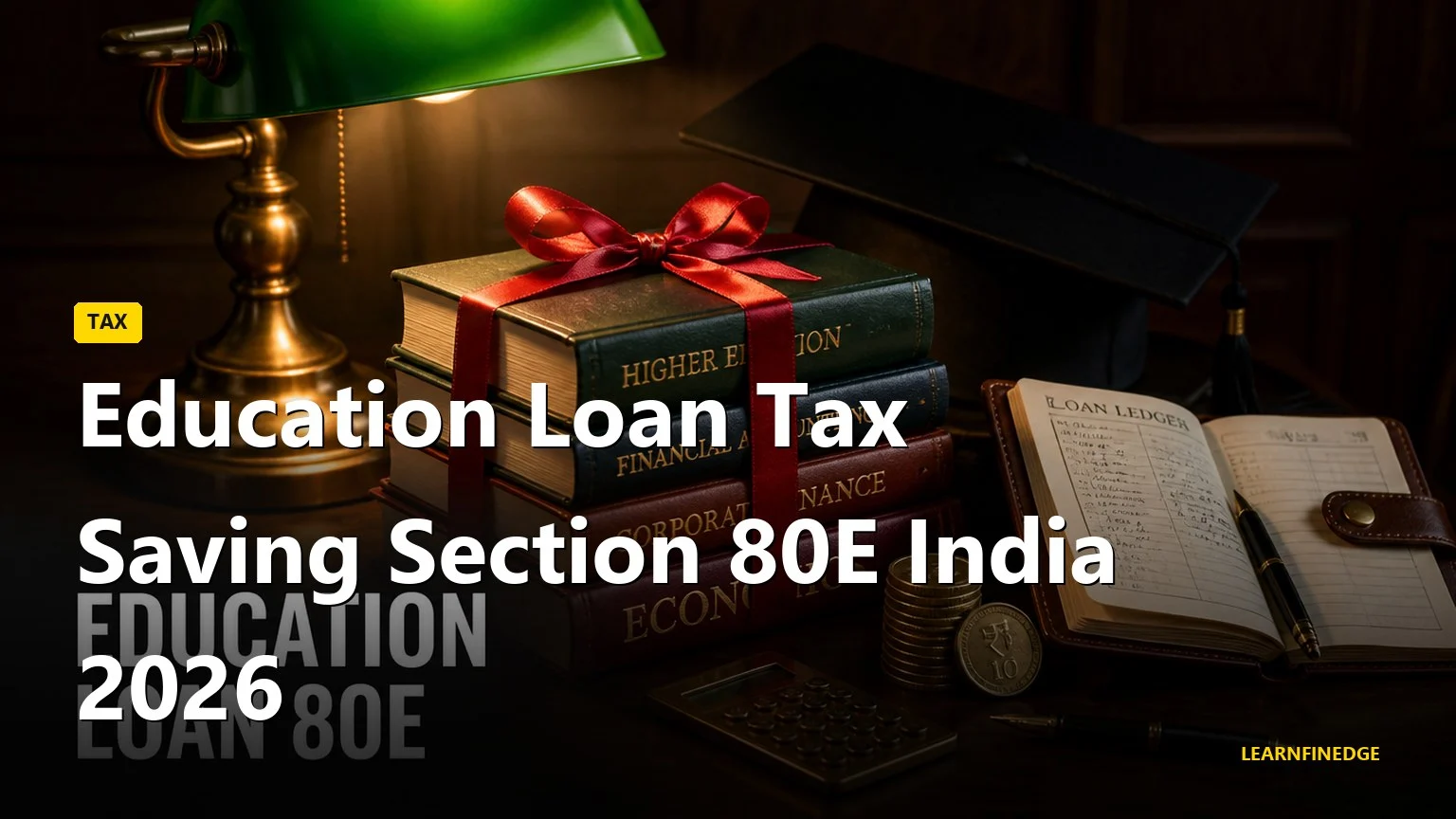
Sandeep took a Rs 30 lakh education loan in July 2025 to fund his daughter’s two-year MBA at a top private institute in India. The interest in year one alone is Rs 3.5 lakh. He is on the 30 percent tax slab. Sitting in front of his ITR utility in June 2026, he is one decision away from choosing between the old and new tax regime, and that single decision will determine whether he saves Rs 1.05 lakh on his tax bill or zero. This guide on education loan tax saving 80E India 2026 walks through exactly how Section 80E works, what counts as an approved institution, why the principal does not qualify, and the math that decides whether 80E is worth staying on the old regime for.

Education loan tax saving 80E India 2026: what Section 80E actually allows
The clean rule, in one paragraph
Section 80E of the Income-tax Act lets an individual taxpayer claim a deduction on the interest paid on an education loan taken for higher studies. The deduction is available for the assessment year in which the interest is paid, and for the seven years immediately following, or until the interest is fully paid, whichever comes earlier. The deduction has no upper rupee limit. It applies only to interest, not to principal repayment. It is available under the old tax regime only, not the new regime. It applies to loans taken for the assessee, the assessee’s spouse, the assessee’s children, or a student for whom the assessee is the legal guardian.
Why the no-upper-limit matters
Almost every other personal income tax deduction in India is capped. Section 80C is capped at Rs 1.5 lakh. Section 80D for self and family is capped at Rs 25,000. Section 24 on home loan interest is capped at Rs 2 lakh for self-occupied property. Section 80E is one of the few where the deduction is the full interest amount paid that year, no matter how large. For a Rs 50 lakh foreign education loan with year-one interest of Rs 6 lakh, the entire Rs 6 lakh is deductible. That is why 80E is structurally the most generous deduction in the Indian tax code for households that finance higher education.
The four eligibility filters most filers miss
Filter 1: The lender must be an approved financial institution
The loan must be from a scheduled bank, an NBFC notified by the central government, or an approved charitable institution. Family loans, loans from your parents, loans from a friend who happens to be a chartered accountant, none of these qualify. Get an interest certificate from the lender every March-April; it is the single piece of paper the assessing officer will ask for if the return is picked up for verification.
Filter 2: The course must qualify as higher studies
For 80E purposes, higher studies means any course pursued after passing the Senior Secondary Examination from a recognised board. This is wider than most people assume. Diploma programs, professional courses like CA, CMA, CS, vocational courses, post-graduate, MBA, MS, MD, all qualify. Coaching for entrance exams does not. Pre-university classes do not. A foreign degree at a foreign university qualifies as long as the loan is from an Indian approved lender.
Filter 3: The relationship link
You can claim 80E only if you took the loan and you are paying the interest. If the loan is in your name and your spouse is paying the EMIs from her account, neither of you may get a clean claim. Cleanest setup: loan in the parent’s name, EMI deducted from the parent’s salary account, child is the eventual student. Or loan in the student’s own name, after starting work, EMI from the student’s salary account. The student then claims 80E on their own return.
Filter 4: Regime selection at filing
This is the trap. The new tax regime under Section 115BAC, which is the default regime from FY 2023-24 onwards, does not allow Section 80E. If you file under the new regime, the entire interest deduction is lost. Selecting the old regime is the explicit, conscious move you need to make at filing. The full regime comparison sits in the old vs new tax regime walkthrough.

Principal does not qualify, and that is fine
A surprising number of borrowers assume that, like a home loan, the principal repayment on an education loan must qualify for some deduction. It does not. Unlike home loan principal under Section 80C, education loan principal is not deductible anywhere in the Indian tax code.
This is not as bad as it sounds, because education loan EMIs in the first few years are heavily interest-loaded. On a Rs 30 lakh, 10-year loan at 9.5 percent, the year-one EMI breakdown is roughly Rs 3.5 lakh interest and Rs 90,000 principal. So 80E captures the bulk of the early-year outgo, which is where the borrower needs the tax help the most. The principal-vs-interest split is the same logic that runs the wider tax saving beyond the obvious sections, summarised in the tax saving beyond 80C guide.
The eight-year window: how to read it
The 80E deduction is available starting from the year you begin repaying interest, and runs for seven assessment years after that, or until the interest is fully paid, whichever happens first. So the practical window is up to eight assessment years.
The moratorium does not eat the window
Most Indian education loans have a moratorium period during which only interest, or sometimes nothing, is paid. EMI repayment begins six months to one year after course completion. The 80E window starts when interest payment starts, not when EMI starts. If you have been paying simple interest during the moratorium, those years already count.
Pre-payment is rewarded
If you pre-pay the loan and finish all interest by year four, your 80E claim ends at year four. You do not lose anything because there is no interest left to claim. The 80E benefit is structurally pay-for-what-you-use; aggressive pre-payment does not penalise you.
Carry-forward is not allowed
Unused 80E in any year does not carry forward. If your gross income in a particular year is too low to fully use the deduction, the excess is simply lost. This rarely matters because if your income is low, your tax liability was already low.
The Rs 30 lakh worked example
Setup
Loan amount: Rs 30 lakh. Tenure: 10 years. Rate: 9.5 percent. Annual EMI: Rs 4.66 lakh. Year-one interest: Rs 3.5 lakh. Year-one principal: Rs 90,000. Tax slab: 30 percent plus 4 percent cess, so effective tax cost is 31.2 percent.
Year-one math, old regime with 80E
Gross total income before 80E: assume Rs 22 lakh for a senior salaried borrower. Deduction under 80E: Rs 3.5 lakh, full interest paid. Net taxable income post 80E: Rs 18.5 lakh. Tax saved versus filing without 80E: 31.2 percent of Rs 3.5 lakh, which is Rs 1.09 lakh. After rounding for slab transitions, the real saving lands around Rs 1.05 lakh.
Year-one math, new regime
Gross total income: Rs 22 lakh. 80E deduction: zero, not allowed under new regime. Net taxable income: Rs 22 lakh. Tax saved by claiming 80E: zero. The Rs 3.5 lakh of interest the household paid does not generate any tax relief.
The regime comparison the borrower must do
The new regime is structurally cheaper for filers without large deductions, because of the lower slab rates. For Sandeep, the new regime tax at Rs 22 lakh is roughly Rs 3.66 lakh. The old regime tax at Rs 22 lakh, before 80E, is roughly Rs 4.16 lakh. Without 80E, new regime is Rs 50,000 cheaper. With the Rs 3.5 lakh 80E deduction, old regime tax drops to Rs 3.07 lakh. Old regime now beats new regime by Rs 59,000.
So 80E does not just save Rs 1.05 lakh in absolute terms; it flips the regime decision. For households with significant education loan interest, the old regime is once again the right choice. The same regime logic also affects HRA, which the salaried borrower needs to keep in mind side-by-side; the cleaner comparison sits in the HRA in new vs old regime piece.

Co-borrower setups and who actually gets the deduction
Education loans are often taken jointly. The parent is usually the primary borrower and earner; the student is the co-borrower. Under 80E, only the person who actually pays the interest can claim the deduction. So if the parent pays the EMI through the moratorium and the first few years post-graduation, the parent claims 80E for those years. Once the child starts working and takes over the EMI, the child can claim 80E for the remaining window, subject to the eight-year cap counted from the date interest payment originally began.
The catch: the eight-year window is one window per loan, not one per borrower. The child does not get a fresh eight years just because the EMI payer changed.
Documentation that survives an assessing officer’s questions
Three pieces of paper need to be in your folder when you claim 80E. First, the loan sanction letter from the bank or NBFC, naming the borrower, the institution, the course, and the loan amount. Second, the annual interest certificate from the lender, showing exactly how much interest was paid in the financial year you are filing for. Third, the bank statement showing the EMI debits from your account, not anybody else’s.
If the institution is a foreign university and the loan is from an Indian bank, also keep the admission letter and the I-20 or equivalent visa-stage document. Some assessing officers ask for it specifically when the deduction is large.
The interaction with 80C, and why both can run together
80E is independent of the Rs 1.5 lakh ceiling under Section 80C. You can claim Rs 1.5 lakh under 80C through ELSS, PPF, EPF or life insurance premium, and additionally claim the full education-loan interest under 80E in the same year, on the same return, as long as you are on the old regime. The full mechanics of 80C inside the old regime are covered in the 80C deductions note. For a household running a home loan, an education loan, and a couple of insurance premiums, the old regime begins to make a lot of sense again precisely because these deductions stack.

Three traps to avoid
Trap 1: Switching regimes for one bad year
Once a salaried filer opts out of the new regime and into the old, the option is reversible year on year. But for business income filers, opting out is largely a one-time choice with strict rules to re-enter. If you run any side business income alongside salary, take regime selection seriously and read the rules carefully before flipping for a single tax year.
Trap 2: Paying off in year nine
If the loan tenure runs past the eighth assessment year of interest payment, the interest paid beyond year eight is no longer deductible. A 15-year tenure on a large foreign education loan ends up wasting the last six or seven years of interest from a tax-deduction standpoint. Borrowers who can pre-pay aggressively in the first eight years extract the maximum 80E value.
Trap 3: EMI debit from a non-claimant’s account
If the loan is in the father’s name but the EMI auto-debit is set up from the mother’s salary account, the deduction is on thin ice because neither has a clean claim. Fix the auto-debit to come from the borrower’s account, then claim cleanly.
The bigger picture for the household
For a household with Rs 25 to Rs 30 lakh of household income and a Rs 30 lakh education loan, the year-one tax saving under 80E covers roughly four to five EMIs entirely. Across the typical five-to-seven year repayment window during which you actually claim, total cumulative savings can be Rs 3 to Rs 5 lakh. That is real money that should be channelled straight into the long-term goals the loan was originally drawn against, retirement, the second child’s education, or rebuilding the contingency reserve. The full new-vs-old regime decision tree at this household scale lives in the new vs old tax regime note.
The mistake is to take the loan, claim the deduction quietly, and let the saving disappear into discretionary spend. The borrower who routes the 80E saving into a same-name SIP or PPF top-up is the one who actually wins the eight-year window, not just the one who fills the line on the return.
Frequently asked questions
Is the principal portion of an education loan EMI deductible under any section?
No. Unlike a home loan, where principal repayment qualifies for Section 80C up to Rs 1.5 lakh, education loan principal is not deductible under any section of the Income-tax Act. Only the interest portion qualifies, and only under Section 80E. The good news is that education loan EMIs are heavily interest-loaded in the early years, so 80E captures the bulk of the outgo when tax relief matters most. By the time the loan tilts toward principal-heavy EMIs, the borrower has usually crossed the eight-year window, leaving only a return-of-capital question.
Can I claim Section 80E under the new tax regime?
No. The new tax regime under Section 115BAC, which has been the default since FY 2023-24, does not permit Section 80E. To claim the education loan interest deduction, you must explicitly opt for the old tax regime when filing your return. For households with large education loan interest, this single choice often flips which regime is cheaper. Run both regime calculations side by side before selecting. If old-regime tax post-80E and other deductions is lower than new-regime tax, take the old regime. The selection has to be made at filing time, not after.
How many years can I claim 80E for?
Section 80E is available for a maximum of eight assessment years. The counter starts in the assessment year in which you first begin paying interest on the education loan, and runs for seven assessment years immediately following. If your loan is fully repaid earlier, the window closes earlier. Unused years cannot be carried forward, and the interest paid in year nine onwards is no longer deductible even if EMIs continue. Borrowers with long-tenure education loans, particularly large foreign-education loans, often try to pre-pay aggressively inside the eight-year window to maximise tax-adjusted cost of borrowing.
Who can claim Section 80E if both the parent and the student are paying EMIs in different years?
Only the person who actually pays the interest in a given year can claim 80E for that year. If the parent pays the EMI through the moratorium and the first few post-graduation years, the parent claims those years. Once the child starts working and the EMI is debited from the child’s account, the child claims the remaining years. There is no double claim by both parent and child on the same interest amount. Critically, the eight-year window is per loan, not per claimant, so the child does not get a fresh eight years simply because the payer changed.
Does Section 80E apply to a loan taken for a foreign university?
Yes, as long as the loan is from an approved Indian financial institution and the course qualifies as higher studies. The Income-tax Act does not restrict 80E to Indian universities. A Rs 50 lakh loan from an Indian bank, used for a master’s at a US, UK or Australian university, qualifies in full for the interest deduction. Keep the admission letter, the visa-stage I-20 or equivalent document, and the annual interest certificate from the Indian lender. Loans from foreign banks are a grey area; check with your tax professional first.