

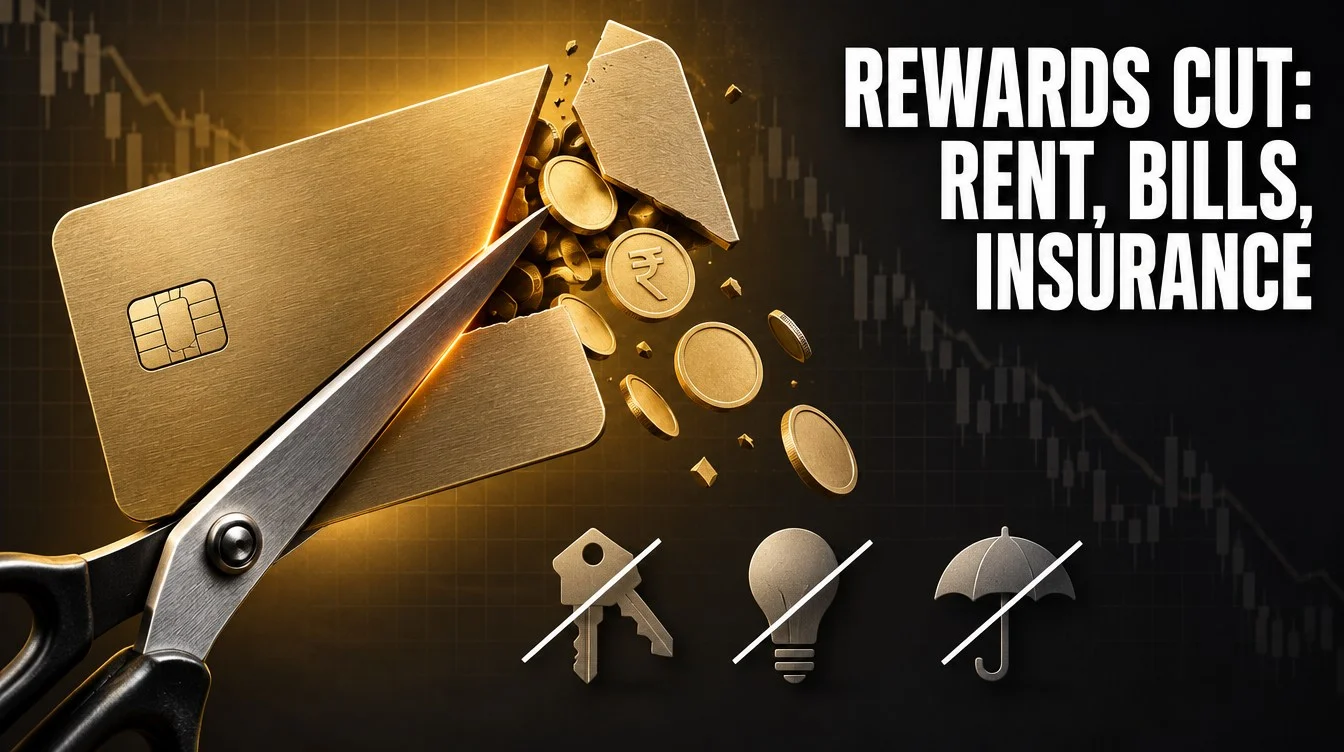
If your favourite card feels less rewarding in 2026, you are not imagining it. The wave of credit card rewards cut India announcements this year has trimmed earn rates and walled off entire spend categories that salaried users leaned on for years. Rent, utilities, insurance premiums, and fuel are the usual casualties, and the fine print often lands as a one-line email you may have skimmed.
This guide explains what changed, why issuers pulled back, and how a salaried cardholder should re-optimise. You will learn to recalculate a card’s real value in rupee terms, spot when a card has become a liability, and decide whether to switch, downgrade, or change where you swipe. The goal is practical: keep the value you are entitled to and stop paying a fee for benefits that no longer exist.

Why the credit card rewards cut india trend happened in 2026
Reward programmes are funded largely by interchange, the fee a merchant’s bank pays your issuer on each swipe. When interchange is capped or a category carries thin margins, issuers lose money paying rich rewards on it, and the response has been broad reward trimming.
Rent and utility payments are the clearest example. These high-value, low-margin transactions often route through apps that charge the issuer, so paying 1 to 2 percent back was a steady drain. Excluding them protects the programme without touching the headline rate.
Interchange pressure and thin-margin spends
Issuers rank categories by profitability. Dining, travel, and online shopping usually stay rewarded because those merchants accept higher interchange. Rent, wallet loads, and utility payments sit at the bottom, so they are first to be capped or zeroed.
Examples of 2026 earn-rate cuts you should know
Rather than name a single “worst” card, look at the patterns repeated across issuers this year, since the same moves recur under different brand names.
- Reward capping: a monthly ceiling on points, so heavy spenders earn nothing past a threshold like Rs.10,000 (10 thousand).
- Earn-rate halving: a category that paid 5 percent equivalent dropping to 2 or 2.5 per cent.
- Milestone dilution: annual-spend bonuses raised out of reach or swapped for lower-value vouchers.
- Redemption devaluation: the same points buying fewer rupees of statement credit or fewer air miles.
Only some of these touch the advertised earn rate. Milestone and redemption changes cut value without changing the headline number, which is why reading each card’s revised terms matters more than the brochure.
Category exclusions versus rate cuts
An exclusion removes a category entirely; a rate cut keeps it but pays less. Exclusions hurt more for anyone who concentrated and spends there, like a tenant charging rent.

Categories now excluded: rent, utilities, and insurance
The three categories most commonly stripped of rewards in 2026 are rent, utilities, and insurance premiums, popular because the amounts are large and recurring.
Rent payments
Rent routed through payment apps now earns little or nothing on most cards, and several issuers add a fee. For a tenant paying Rs.30,000 (30 thousand) monthly, a category that once returned roughly Rs.300 to Rs.600 can now return zero.
Utilities and insurance
Electricity, gas, broadband, and insurance premiums are increasingly excluded or capped. Insurance is a large annual outflow, so losing 1 to 2 percent removes a real chunk of a household’s rewards. Confirm a premium still earns before routing it; if not, an emergency-fund cushion beats an expensive card float, a trade-off explained in this comparison of emergency funds versus credit cards.
How to recalculate real value after the credit card rewards cut india
The headline earn rate is marketing; the effective rate is reality. Recalculating it in rupees takes about fifteen minutes with a bank statement and is the most useful move in 2026.
A simple step-by-step method
- List three months of spending by category: dining, groceries, fuel, rent, utilities, shopping, and travel.
- Mark each with its current earn rate under the revised terms, using zero for anything excluded.
- Multiply each category’s spend by its earn rate to get monthly reward value in rupees.
- Total these, then subtract the annual fee divided by twelve.
- Divide the net monthly reward by total monthly spend for your true effective rate.
A worked example
Suppose you spend Rs.50,000 (50 thousand) a month: Rs.20,000 on excluded rent and utilities and Rs.30,000 across rewarded categories at an average 2 percent. The rewarded value is Rs.600 a month, or Rs.7,200 a year. If the annual fee is Rs.5,000 (5 thousand), the net benefit is just Rs.2,200, an effective rate near 0.37 percent. That is the moment to act.
Run this before your annual fee posts, not after. Keeping the card current also protects your credit score; if that number needs work, this 90-day credit score action plan pairs well with a card review.
Best value credit card india picks: comparing on real returns
A best value credit card in India in 2026 is not the flashiest sign-up bonus but the highest effective rate on your actual spend, net of fees. The table shows how one person sees different outcomes across card profiles once exclusions apply.
| Card profile | Headline earn rate | Excluded categories | Effective rate on typical spend |
|---|---|---|---|
| Flat-rate cashback | 1.5 percent | Rent, world loads | 1.2 to 1.4 percent |
| Category rewards | Up to 5 percent | Rent, utilities, insurance | 0.8 to 2.5 percent |
| Fuel or travel co-brand | Up to 5 percent in-category | Non-category spends | 0.5 to 2 percent |
| Lifetime-free basic | 0.5 to 1 percent | Few | 0.5 to 1 percent |
A lifetime-free card with a modest rate can beat a fee-heavy category card once exclusions bite. These figures are illustrative ranges, not offers, and market-linked reward values such as airline miles can fluctuate, so treat any conversion as an estimate.
Match the card to the spender
A frequent diner benefits from a dining co-brand; someone paying mostly rent and utilities earns more from a plain lifetime-free card. There is no universal best card, only the best for your statement.
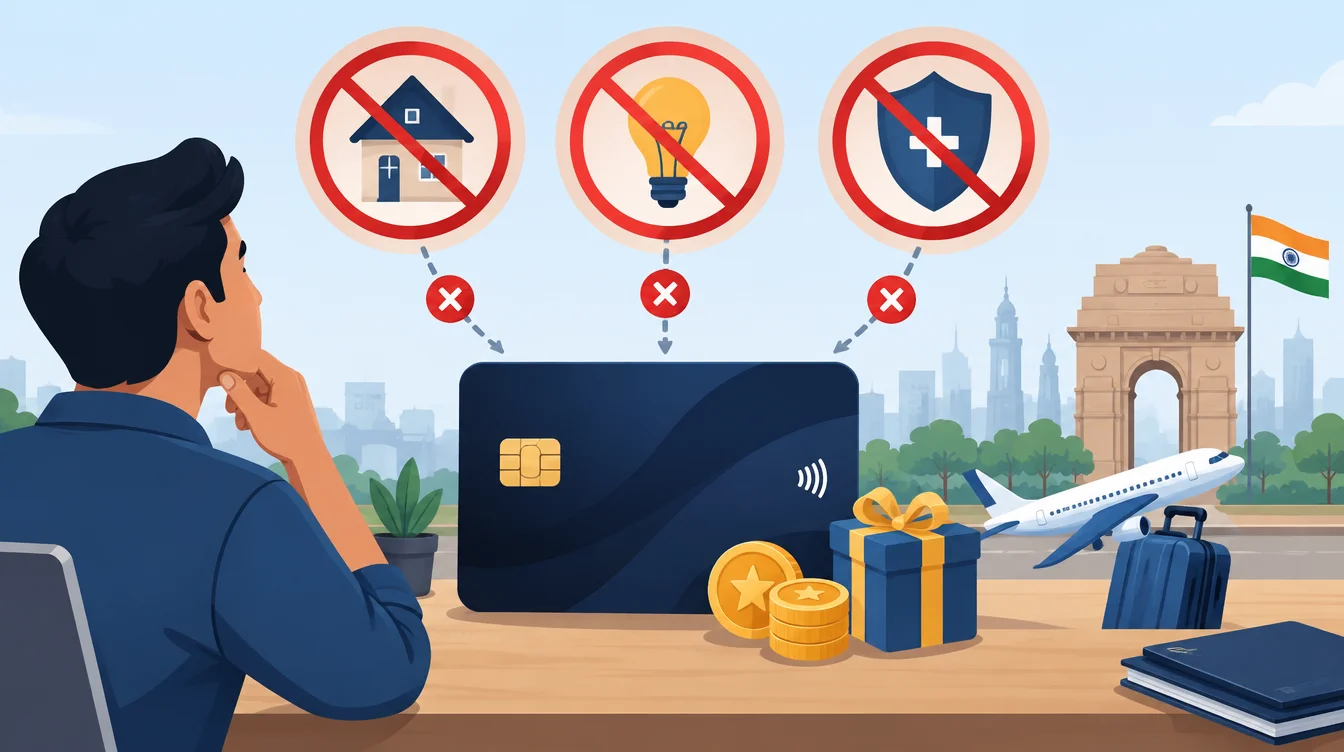
When to switch or downgrade a card in 2026
Is your annual fee still buying more than it costs? If the honest answer is no, you have three moves: keep, downgrade, or switch. This is a rupee decision, not an emotional one.
The keep, downgrade, or switch test
- Keep if net annual benefit comfortably exceeds the fee and you use the lounge or insurance perks.
- Downgrade to a lifetime-free variant if rewards no longer justify the fee but you want to preserve account age.
- Switch spend to a better-fit card if another product pays a higher effective rate on your real categories.
Protect your credit score while you adjust
Closing an old card can shorten credit history and raise utilisation, nudging your score down. Downgrading instead keeps the account open and the limit intact. Where closure is unavoidable, the true cost of carrying a balance is laid out in the credit card minimum payment trap explainer.
Common mistakes to avoid after the credit card rewards cut india
Reward changes trigger predictable errors, and avoiding them often beats chasing the next offer.
Chasing points into debt
Spending more to hit a milestone, or revolving a balance to keep a card active, destroys value fast. Interest at typical Indian card rates dwarfs any reward, so a card pays only if you clear the full statement each cycle.
Ignoring the fine print and the fee date
Many users spot an exclusion only when a reward fails to post. Set a reminder a month before your annual fee to run the value check, so a downgrade request reaches the issuer in time. Redirecting freed-up cash into a tax-efficient investment can beat any reward; a starting point is whether the new tax regime or the old one saves more in FY 2025-26.

Building a smarter card strategy for the year ahead
The winning approach in 2026 is a small, deliberate wallet. Two or three well-chosen cards, each strong in a category you actually spend on, beat one weakened “premium” card.
Right-size your wallet and review on a schedule
Pick one everyday card with no exclusions, add a co-brand only where spending concentrates, and route rent to whichever channel costs least. Re-run the effective-rate check every six months and on any terms change, keeping a clean repayment record with a disciplined full-statement payoff each cycle.
Frequently asked questions
Why did my credit card rewards get cut in 2026?
Issuers reduced rewards mainly because interchange income on rent, utilities, and insurance is thin or capped. Paying rich rewards there was unprofitable, so many cards excluded those categories, lowered earn rates, or devalued redemptions.
Are rent and utility payments still rewarded on any card?
A few cards still reward utilities, but rent is now excluded or fee-loaded on most. Confirm the revised terms before routing a large recurring payment, because an unrewarded transaction plus a convenience fee can cost more than paying by other means.
How do I calculate my card’s real value?
List three months of spends by category, apply each category’s current earn rate (zero for exclusions), total the rupee rewards, subtract the annual fee, and divide by your spend. That effective rate, not the headline, shows whether the card earns its keep.
Should I close a card that lost its rewards?
Not necessarily. Downgrading to a lifetime-free version preserves your account age and credit limit while removing the fee. Full closure can shorten credit history and raise utilisation, so weigh the score impact first.
Do reward cuts affect my credit score?
Reward changes do not affect your score, but your reaction can. Revolving balances to chase points raise utilisation and interest costs, while closing old cards shortens history. Paying in full and downgrading rather than closing keeps it healthy.