


If you are comparing flexi cap vs multi cap funds for your equity portfolio in 2026, the difference comes down to one rule from SEBI about how much each fund must hold in large, mid, and small companies. Both invest across market sizes, but they follow very different limits, and that changes how they behave.
This guide explains the SEBI definitions in plain terms, compares the risk and volatility, looks at how the fund manager uses freedom in each type, and covers taxation so you can decide which category fits your goals. This is educational only, not a recommendation.
What is the difference between flexi cap vs multi cap funds?
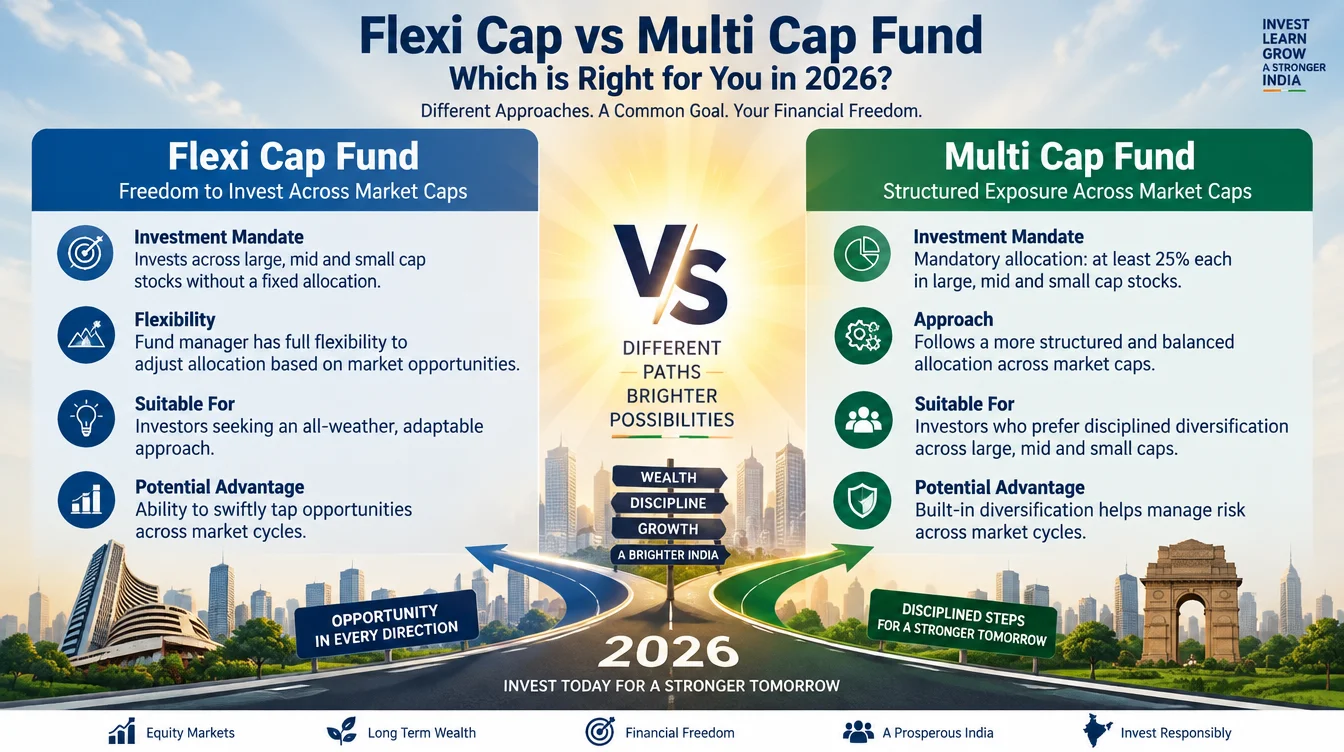
The core difference is the allocation floor. A multi cap fund must keep at least 25% each in large-cap, mid-cap, and small-cap stocks at all times, so a minimum of 75% sits in equity across all three sizes. A flexi cap fund has no such floor and can move freely between sizes, holding a minimum of 65% in equity overall.
Flexi cap fund meaning
A flexi cap fund is an open-ended equity scheme that invests across large, mid, and small-cap companies with no fixed limit for any size. The manager decides the mix based on valuations and outlook. This category was created by SEBI in November 2020, largely so managers could keep the flexibility that older diversified funds once had.
Multi cap fund 25 25 25 rule
In September 2020, SEBI set a clear rule for multi cap funds. Each of the three buckets, large-cap, mid-cap, and small-cap, must hold at least 25% of the corpus. That is the 25-25-25 structure. Because small and mid-caps carry more swings, this floor makes a multi cap fund structurally more exposed to those segments than a typical flexi cap fund.
How does risk and volatility compare?
Risk is where the two categories separate most clearly. A multi cap fund always carries a fixed dose of mid and small-cap exposure, so its returns can swing more in both directions. A flexi cap fund can raise large-cap weight when the manager turns cautious, which can soften the fall in a weak market but may also cap gains when smaller companies run ahead.
- Multi cap: minimum 25% each in large, mid, and small-cap, so higher built-in small and mid-cap risk.
- Flexi cap: flexible sizing, so risk depends on the manager’s current allocation and conviction.
- Common ground: both are equity funds and both carry full market risk over the short term.
Because a flexi cap manager can shift toward large-caps in stress, many investors see it as the steadier of the two. That is not guaranteed, though. A flexi cap fund that stays heavily in mid and small-caps can be just as volatile as a multi cap fund. If you are new to equity swings, understanding your own reactions helps, and our note on investment biases that cost you money is a useful starting point.
Fund-manager flexibility and strategy
The freedom given to the manager is the practical heart of the flexi cap vs multi cap debate. In a flexi cap fund, the manager can tilt the portfolio toward whichever size looks better value at the time. That freedom can help when large-caps are safer or when small-caps look expensive.
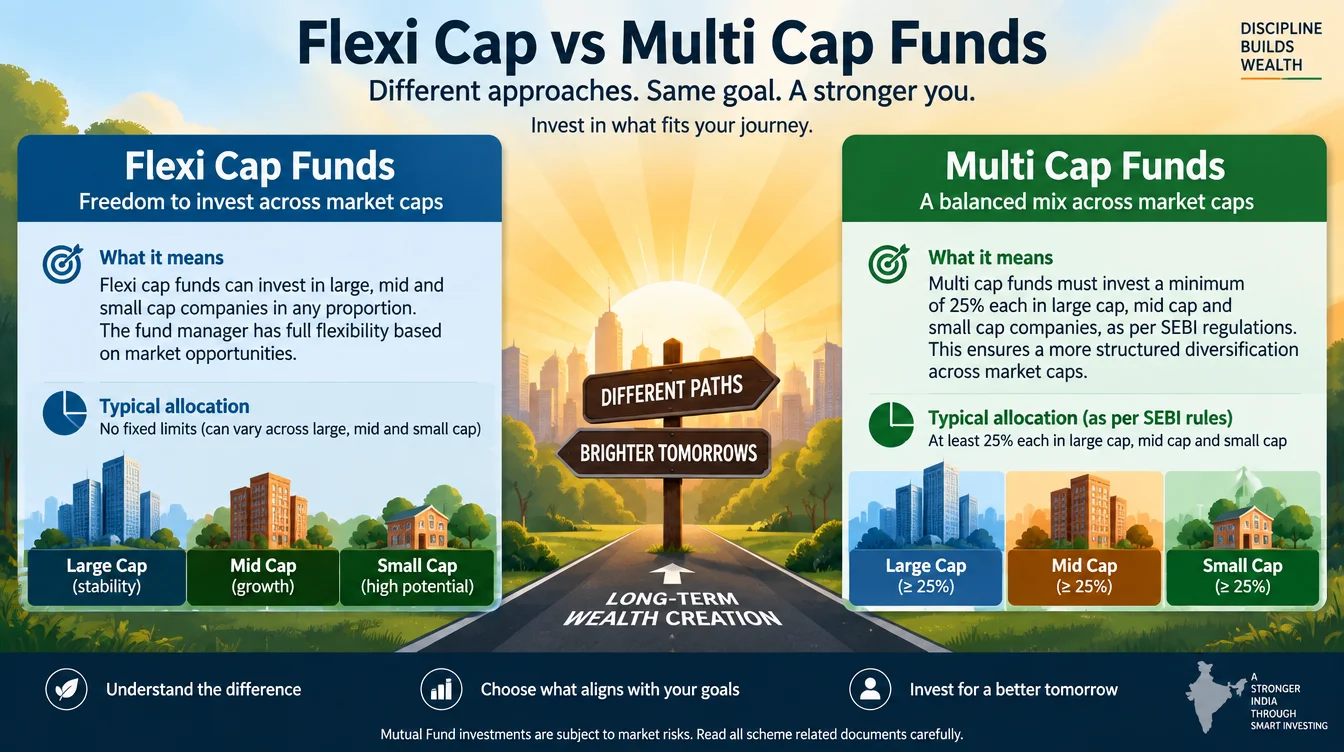
A multi cap manager has less room. Even if small-caps look stretched, the fund must still keep at least 25% there. This forces discipline and steady exposure to smaller, faster-growing companies, but it removes the option to hide in large-caps during a rough patch. Neither approach is better by default; each simply suits a different comfort level.
- Check the latest portfolio: read the monthly factsheet to see the real large, mid, and small-cap split, since two flexi cap funds can look very different.
- Match it to your horizon: higher small-cap weight usually needs a longer holding period to ride out volatility.
- Stay consistent: a systematic investment plan helps you keep investing through ups and downs instead of timing the market.
Whichever category you pick, avoid the common traps that hurt returns. Our guide to beginner investment mistakes covers errors like chasing last year’s top performer, which applies to both fund types.
How are flexi cap and multi cap funds taxed?
Both flexi cap and multi cap funds are treated as equity funds for tax, because both hold well above 65% in Indian equity. So the tax treatment is the same for both. Short-term capital gains, on units held for one year or less, are taxed at 20%. Long-term capital gains, on units held for more than a year, are taxed at 12.5% on gains above Rs. 1.25 lakh in a financial year.
Since taxation does not separate these two categories, your choice should rest on risk and strategy, not tax. If you also want to lower your tax outgo through investing, that sits in a different bucket, and our comparison of ELSS vs NPS tax-saving options explains those routes. For a wider view of blending index and active funds, see our take on index fund selection in India for 2026.
Who should consider each fund type?
There is no single winner in flexi cap vs multi cap. The right fit depends on how much volatility you can hold through and how much you trust the manager to move between sizes.
- A flexi cap fund may suit you if you want the manager to adjust the size mix, prefer a possibly smoother ride, and are comfortable that the fund can lean large-cap in weak markets.
- A multi cap fund may suit you if you want steady, rule-bound exposure to mid and small-caps, accept higher swings, and have a long horizon of seven years or more.
Many investors hold one broad diversified fund and add other assets around it for balance. Whatever you choose, size the position to your goals and review it once a year rather than reacting to every market headline.
For educational purposes only. This article is general information about personal finance and is not investment, tax, or legal advice. Past performance does not guarantee future returns. Mutual funds and market-linked instruments carry market risk; read the scheme-related documents carefully. Consult a SEBI-registered investment adviser or a qualified tax professional for guidance tailored to your situation.

Frequently Asked Questions
Is a flexi cap fund safer than a multi cap fund?
Not always. A flexi cap fund can raise its large-cap weight in weak markets, which may reduce swings. But a flexi cap fund that stays heavy in mid and small-caps can be just as volatile as a multi cap fund. Always check the current portfolio in the factsheet before assuming one is safer.
What is the 25-25-25 rule in multi cap funds?
It is the SEBI rule from September 2020 that requires a multi cap fund to hold at least 25% each in large-cap, mid-cap, and small-cap stocks. This means a minimum of 75% of the corpus stays in equity spread across all three company sizes at all times.
Are flexi cap vs multi cap returns very different?
Returns vary fund by fund, not just by category. Multi cap funds carry a fixed mid and small-cap floor, so they can outpace in strong markets and fall harder in weak ones. Flexi cap returns depend on the manager’s size choices, so past figures should be read alongside the risk taken.
Can I hold both a flexi cap and a multi cap fund?
Yes, but check for overlap. If both funds hold similar large-cap names, you may not gain much diversification. Compare the mid and small-cap portions and your total small-cap exposure across all your funds before adding a second scheme.
Which is better for a first-time equity investor?
There is no fixed answer. Many first-time investors prefer a flexi cap fund because the manager can lean toward steadier large-caps when needed. A multi cap fund suits those who accept more volatility for steady small and mid-cap exposure and have a long horizon.
Do flexi cap and multi cap funds have different tax rules?
No. Both are taxed as equity funds because both hold well above 65% in equity. Short-term gains within a year are taxed at 20%, and long-term gains above Rs. 1.25 lakh a year are taxed at 12.5%. Tax is not a reason to prefer one over the other.