

Anjali, a 32-year-old product manager in Pune, sat down on a Sunday in June to file her ITR. Her Form 16 showed a clean salary number. She opened the income tax portal, downloaded Form 26AS, eyeballed it, and clicked through to file. Two weeks later she got an SMS from the department flagging under-reported interest income of Rs 1.84 lakh. The interest was sitting in her annual information statement, not in the 26AS. This is the trap that the Form 26AS vs AIS India FY 2025-26 reconciliation workflow is built to catch, and this guide walks through it the way a careful filer should, before the return goes in, not after the notice arrives.

What Form 26AS still does and where it stops
Form 26AS used to be the single window into a taxpayer’s footprint. For FY 2025-26, that role has narrowed. Today, 26AS is essentially a tax credit and tax deduction statement. It tells you which tax has been deducted on your PAN, which tax has been collected at source, what advance tax or self-assessment tax you have paid, and what refund the department has issued to you in the year.
If your employer cut TDS on salary and deposited it against your PAN, it shows up in 26AS. If your bank deducted 10 percent TDS on fixed deposit interest above Rs 50,000 in a financial year, that deduction will show up in 26AS. If a buyer of property cut 1 percent TDS under Section 194-IA, that shows up too. What 26AS does not do anymore is tell you the underlying gross income that triggered those deductions. For interest that was below the TDS threshold, for dividends paid below the cut-off, for mutual fund redemptions, foreign remittances and high-value securities transactions, 26AS is silent.
What the AIS adds on top
The Annual Information Statement, or AIS, is the wider footprint the department now uses. It pulls reported data from banks, registrars, mutual fund houses, stock exchanges, sub-registrars, the GST network, foreign exchange dealers and a long tail of other reporting entities. Each reported line is tagged with a source, a value, and a status that the taxpayer can accept, partially accept, or dispute.
For a typical salaried investor, the categories that matter inside AIS are interest from savings accounts and FDs, dividend from listed shares and mutual funds, sale of listed securities, redemption of mutual fund units, sale of immovable property, foreign remittance under LRS, purchase of foreign currency or assets, rent receipts above thresholds, business receipts, and large credit card payments. The companion Taxpayer Information Summary, or TIS, sits next to AIS and groups the same data into a few headline numbers that prefill into the ITR utility. The mechanics of how AIS and TIS feed your return are covered separately in the AIS and TIS walkthrough.
The mental model: 26AS is the receipt, AIS is the ledger
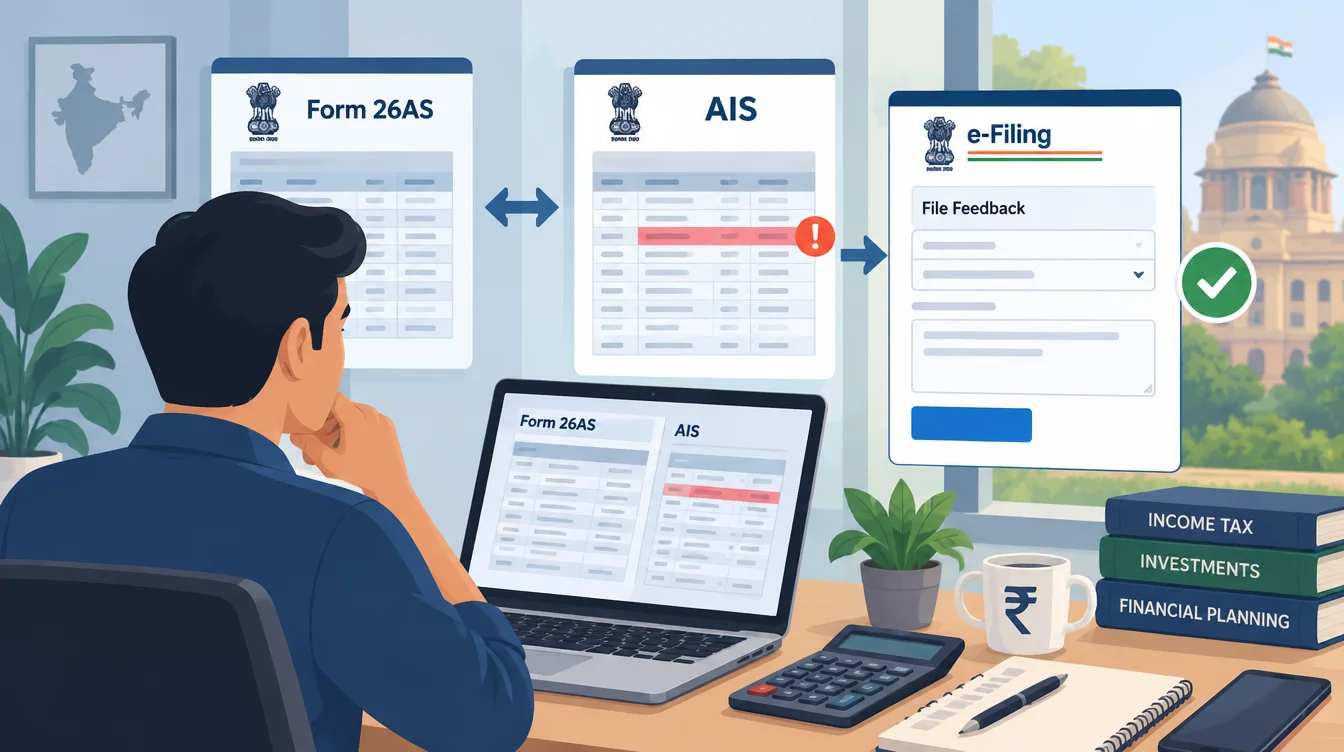
Think of 26AS as the receipt of taxes already paid on your behalf. AIS is the ledger of what financial activity the department has been told about. The two only partially overlap. A clean filer reads both, not one.
Where the two statements typically disagree
The mismatches between Form 26AS and AIS are not random. They follow a small set of repeating patterns. Recognising them in advance is half the job of the reconciliation.
FD interest below the TDS threshold
A bank cuts TDS on interest only if the aggregate interest on FDs at that bank crosses Rs 50,000 in a financial year for a non-senior. Below that, there is no TDS and no 26AS entry. But the bank still reports the interest figure to the department under SFT-016. So a Rs 32,000 interest credit on a single FD sits invisibly in 26AS and very visibly in AIS. Filers who lean on 26AS alone often miss it, then receive a Section 143(1)(a) proposed adjustment a few weeks after filing.
Dividends from shares and mutual funds
Dividend income has been fully taxable in the hands of the individual at slab rates since FY 2020-21. TDS at 10 percent applies only on amounts above Rs 5,000 per company per year. A retail portfolio with ten dividend-paying stocks of Rs 4,000 each will show no TDS at all in 26AS, but each of those Rs 4,000 lines is in AIS, reported by the registrar.
Mutual fund redemptions
When you redeem an equity mutual fund SIP after one year, the AMC does not cut TDS for resident investors. AIS, however, captures the sale value, the cost basis, where available, and the gain category, equity or debt, long-term or short-term. Filers who treat AIS as optional often miss small redemptions worth a few thousand rupees, which they still need to carry into Schedule CG.
Savings bank interest
The Rs 10,000 deduction under Section 80TTA for savings bank interest is one of the most underclaimed deductions in India, simply because filers do not know how much SB interest they have earned. AIS now lists it bank by bank.
High-value SFT entries
Buying or selling property above Rs 30 lakh, cash deposits above Rs 10 lakh in savings or Rs 50 lakh in current accounts, credit card spends above Rs 2 lakh in a year, foreign exchange purchases above Rs 10 lakh, and several similar markers flow as Statement of Financial Transactions, or SFT entries, into AIS. These are not income by themselves, but they are the bread crumbs the department uses to ask questions if your declared income does not justify the activity.
The seven-step reconciliation workflow before filing ITR
Step 1: Download both statements on the same day
Log in to incometax.gov.in. Under e-File, go to Income Tax Returns, then select View Form 26AS. Download the PDF for FY 2025-26, assessment year 2026-27. Return, then go to Services and select Annual Information Statement. Download both AIS and TIS as PDFs. Pull all three on the same date so that the snapshots are consistent.
Step 2: Cross-check salary TDS
Match the TDS in Part A of 26AS with the TDS shown on Form 16 issued by your employer. The two numbers should be identical, deductor by deductor, quarter by quarter. If your employer changed mid-year, both employer entries should be present. Any gap here is fixed by writing to the employer’s payroll team, not by the bank or the department.
Step 3: Cross-check non-salary TDS
Look at TDS sections like 194A on interest, 194 on dividends, 194-IA on property, 194-IB on rent above Rs 50,000 per month and 194-O on online sales. Each entry has a deductor TAN, a transaction date, an amount paid and tax deducted. Match each against your records, bank statements, broking statements, and AMC statements.
Step 4: Walk every AIS category
Open AIS. It is organised as Part A, basic information, and Part B, which contains more than twenty categories of financial transactions. Walk through every category that shows a value. For each line, decide whether it is correct in full, correct in part, or incorrect.
Step 5: Decide the feedback for each disputed line
AIS supports seven feedback options against any line: information is correct, information is not fully correct, information relates to other PANs, information is duplicate, information is denied, information relates to other years, and information is not taxable. Pick the most accurate label. The system keeps both your original and modified values until the source confirms.
Step 6: Build the consolidated income statement.
Open a one-page sheet. Five rows. Salary income from Form 16. Interest income and savings plus FDs are reconciled to AIS. Dividend income from AIS. Capital gains from broker and AMC statements, reconciled to AIS Schedule SFT lines. Any other income, including rent, business, or speculation. Total it up. That is the gross income figure that goes into your ITR, not the prefilled number from the portal.
Step 7: Pick the right ITR form
Once the income from work is final, choose the correct return form. A salaried filer with capital gains can no longer file ITR-1, and the cleanest reference for matching a profile to a form is the ITR form selection walkthrough. Please lock in the return form before importing prefilled data, as changing the form midway will clear the prefilled fields.
How to file feedback on an incorrect AIS entry
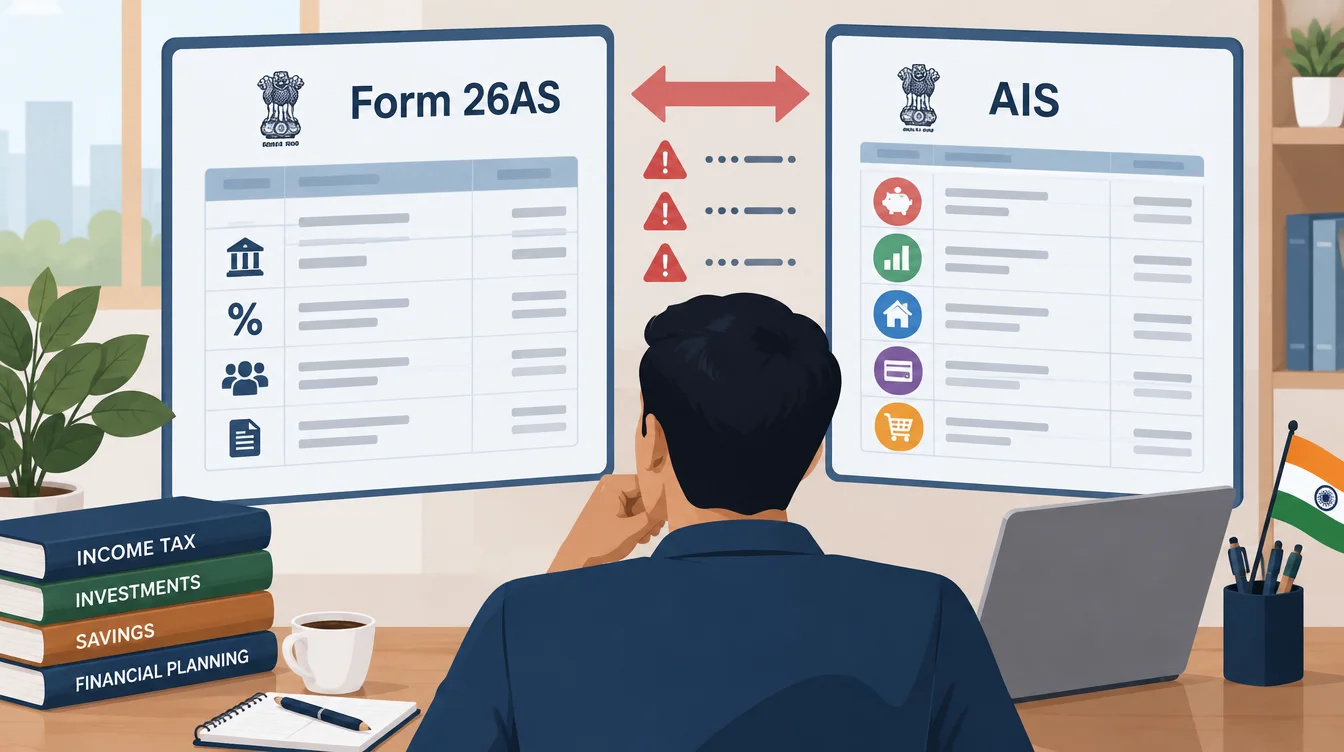
Open AIS, drill into the category, and click on the specific transaction row. The Optional column on the right shows a small pencil icon. Click it. Pick the feedback option. Enter the corrected value, the correct PAN if it is misallocated, or the correct year if it is timing-off. Save. The status changes from Active to Modified.
The source reporter, which can be your bank, AMC, or registrar, receives a notification. They have a window to confirm or contest. If they confirm, your modified value will be processed in TIS. If they contest, the system retains both, and you carry the supporting document, your statement, your contract note, and your sale deed into the return as backup. Please keep screenshots of every feedback submission with date and time stamps, as you may need them if a notice arrives later.
The salaried example: Anjali revisited
Anjali’s case, reconstructed cleanly, looks like her own. Her Form 16 shows a Rs 18 lakh CTC, a Rs 14.6 lakh taxable salary after standard deduction and exempt allowances, and a Rs 1.86 lakh TDS deposit. Her 26AS confirms the Rs 1.86 lakh TDS and shows another Rs 8,400 cut on bank FD interest under Section 194A.
Her AIS shows the salary line, the FD interest line, and four more lines that 26AS did not surface. Two AMC reports of equity mutual fund redemptions totalling Rs 1.32 lakh in sales value with a Rs 30,000 long-term capital gain. Two FD interest credits were from a second bank, where total interest was Rs 41,000, just below the TDS threshold. A dividend credit of Rs 12,500 across three companies. And SB interest of Rs 7,200.
Adding it up. FD interest from Bank One is Rs 84,000, from Bank Two is Rs 41,000, plus Rs 75,000 from a small NRO-style account she had forgotten about. Total FD interest is Rs 2 lakh. SB interest is Rs 7,200, fully covered by 80TTA, which is up to Rs 10,000. Dividend income is Rs 12,500. MF gain is Rs 30,000 long-term, which, after the Rs 1.25 lakh annual exemption on equity LTCG, is non-taxable for the year.
Her other real income for tax is Rs 2 lakh interest plus Rs 12,500 dividend, totalling Rs 2.12 lakh. At her 30 percent slab plus surcharge and cess, that is roughly Rs 66,000 of additional tax against the Rs 8,400 TDS already deposited. She owes about Rs 57,600 self-assessment tax before she can file a clean return. Filing first and paying later, the way she did, triggered interest under Sections 234B and 234C and an automated adjustment that took longer to close than the original return took to file.
The cost of skipping the reconciliation
If she had compared 26AS and AIS on day one, paid the self-assessment tax, and then filed, the only extra cost would have been the Rs 57,600 tax itself, plus a small Section 234C interest on the shortfall. By skipping reconciliation and filing on the lower number, she also picked up a 143(1)(a) intimation, six weeks of follow-up, and the small but real reputational hit of a mismatch flag on her PAN, which the next FY’s processing engine will remember. The capital gains information from her work can be reused for next year’s filing, and the capital gains tax guide for 2026 is worth bookmarking for that part.

A few habits that pay off every June
Please make a calendar entry for 15 June. Banks and AMCs finalise their reporting by 31 May, and they usually fully populate the AIS for the previous FY by the second week of June. Pulling it earlier means working with a half-filled statement.
Keep one folder per FY with Form 16, broker P&L, AMC capital gains statement, bank interest certificates, rent receipts and any property sale or purchase paperwork. The reconciliation goes from a three-evening project to a two-hour project once that folder exists. The wider list of avoidable filing errors is summarised well in the common ITR mistakes piece, and the year-on-year deadline calendar lives in the ITR filing deadlines note.
And if you do discover a missed income after filing, do not panic. The updated return window under Section 139(8A) provides a four-year cushion to file a corrected return at a higher cost, and the mechanics are spelt out in the ITR-U updated return guide. Reconciliation before filing is still cheaper. ITR-U is the safety net, not the plan.
Frequently asked questions
Is Form 26AS still needed if AIS already covers everything?
Yes, both serve different purposes. Form 26AS is the record of taxes credited to your PAN and the document the assessing officer uses to validate tax credits. AIS is the wider ledger of reported financial transactions, including income that did not attract TDS. For FY 2025-26, a clean filer downloads and reads both on the same day. 26AS confirms what was deposited as tax. AIS tells you what income or transaction triggered, or should have triggered, tax. Filing with only one open is the most common cause of mismatch notices.
Why does my FD interest appear in AIS but not in Form 26AS?
A bank cuts TDS on FD interest only when the aggregate interest at that bank crosses Rs 50,000 in a financial year for a non-senior or Rs 1 lakh for a senior citizen. Below that threshold, no TDS is deducted, so nothing appears in 26AS. The bank, however, still reports the interest figure to the income tax department under the SFT framework, which is why the same amount appears in AIS. The interest is fully taxable at your slab rate even when TDS was not deducted. You add it to your other-source income in your ITR and pay self-assessment tax on it.
How do I file feedback on a wrong AIS entry?
Log in to incometax.gov.in. Go to Services and open the Annual Information Statement. Drill into the relevant category and the specific transaction row. Click the pencil icon under the Optional column. Choose the appropriate feedback label, such as ‘information is not fully correct’, ‘relates to other PANs’, ‘is a duplicate’, ‘relates to other years’, or ‘is not taxable’. Enter the corrected value and save. The source reporter is notified, and your modified value is reflected in the next refresh of TIS. Keep screenshots of every feedback action you submit.
What if there is a mismatch between AIS and TIS while filing?
AIS shows the raw reported value. TIS shows the processed value, which is what the ITR utility prefills. If AIS and TIS disagree, TIS reflects the value after deduplication and after your feedback has been applied. Treat TIS as the pre-fill source, but verify each line against your own bank statement, broker P&L, and AMC capital gains report before accepting the prefilled return. If you have evidence that the reported number is incorrect, please file AIS feedback, wait for the refresh, and then submit the return. Please refrain from filing using the prefilled number if you can demonstrate that it is incorrect.
I already filed without checking AIS and got a Section 143(1) notice. What now?
Please open the notice, identify the flagged line, and compare it against your AIS. If the income was genuinely missed, file a revised return under Section 139(5) within the allowed window, paying the differential tax plus interest under Sections 234B and 234C. If the original return window has closed, use the updated return route under Section 139(8A) within the four-year window. If you believe the AIS entry is incorrect, please file AIS feedback first, then respond to the 143(1)(a) intimation with the necessary supporting documents. Please be sure to respond to the intimation, as the response deadline is typically 30 days.