

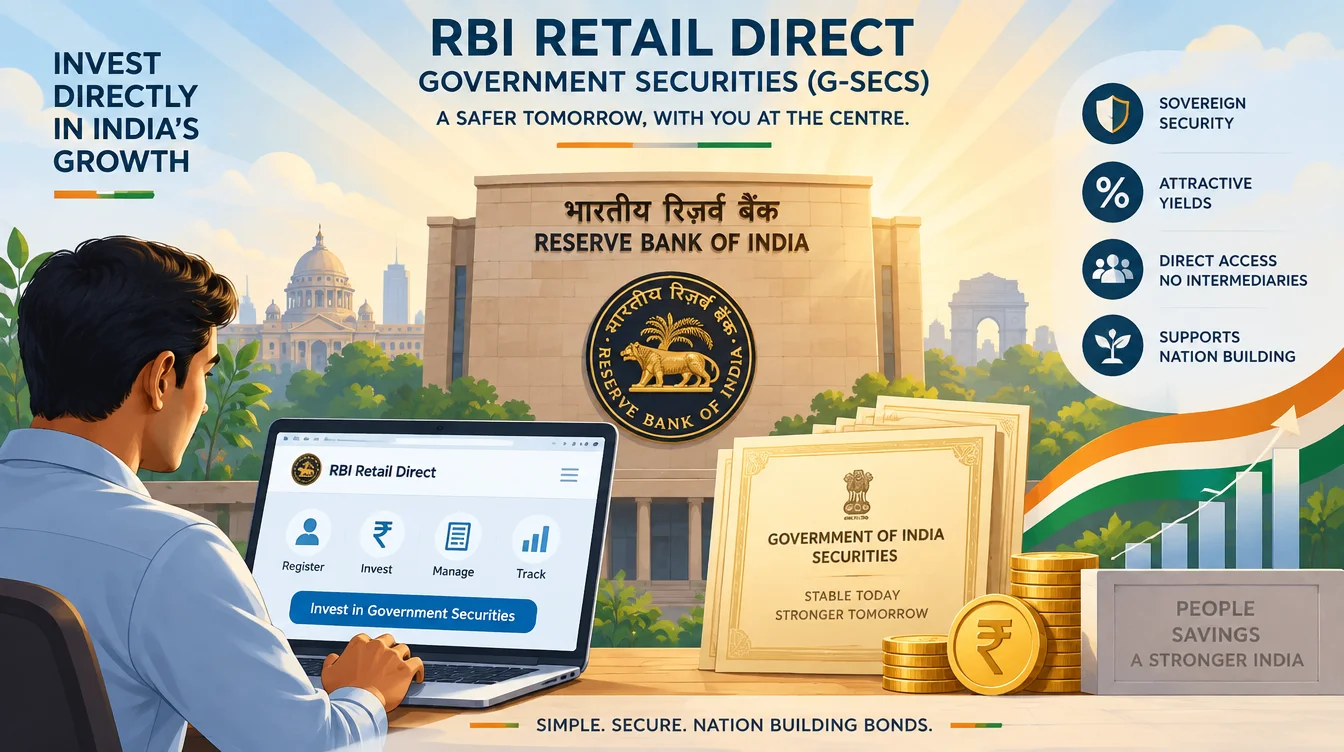
RBI Retail Direct bonds give ordinary Indian investors a direct line to government securities, with no broker in the middle and no commission on the buy. Through a single free account, you can hold G-secs, Treasury bills, sovereign gold bonds and state development loans that were once reserved mostly for banks and large institutions.
If you have parked money in fixed deposits and wondered whether there is a safer, longer, and often better-yielding option backed directly by the Government of India, this guide is for you. We will walk through how the platform works, how to open your account, taxation, liquidity, and how these instruments stack up against FDs and debt funds.
What Are RBI Retail Direct Bonds?
The RBI Retail Direct scheme, launched by the Reserve Bank of India in November 2021, is an online platform that lets individuals buy and hold government securities directly with the central bank. There is no fund manager, no distributor, and no annual maintenance charge for the account. You deal straight with the sovereign issuer.
Under this scheme, you can access four broad types of instruments:
- G-Secs (dated government securities): long-tenor bonds, typically 5 to 40 years, that pay a fixed coupon twice a year.
- Treasury Bills (T-bills): short-term paper of 91, 182 or 364 days, sold at a discount and redeemed at face value.
- Sovereign Gold Bonds (SGBs): gold-linked bonds that pay interest and track the gold price, available on the secondary market through the platform.
- State Development Loans (SDLs): bonds issued by state governments, usually offering a slightly higher yield than central G-Secs.
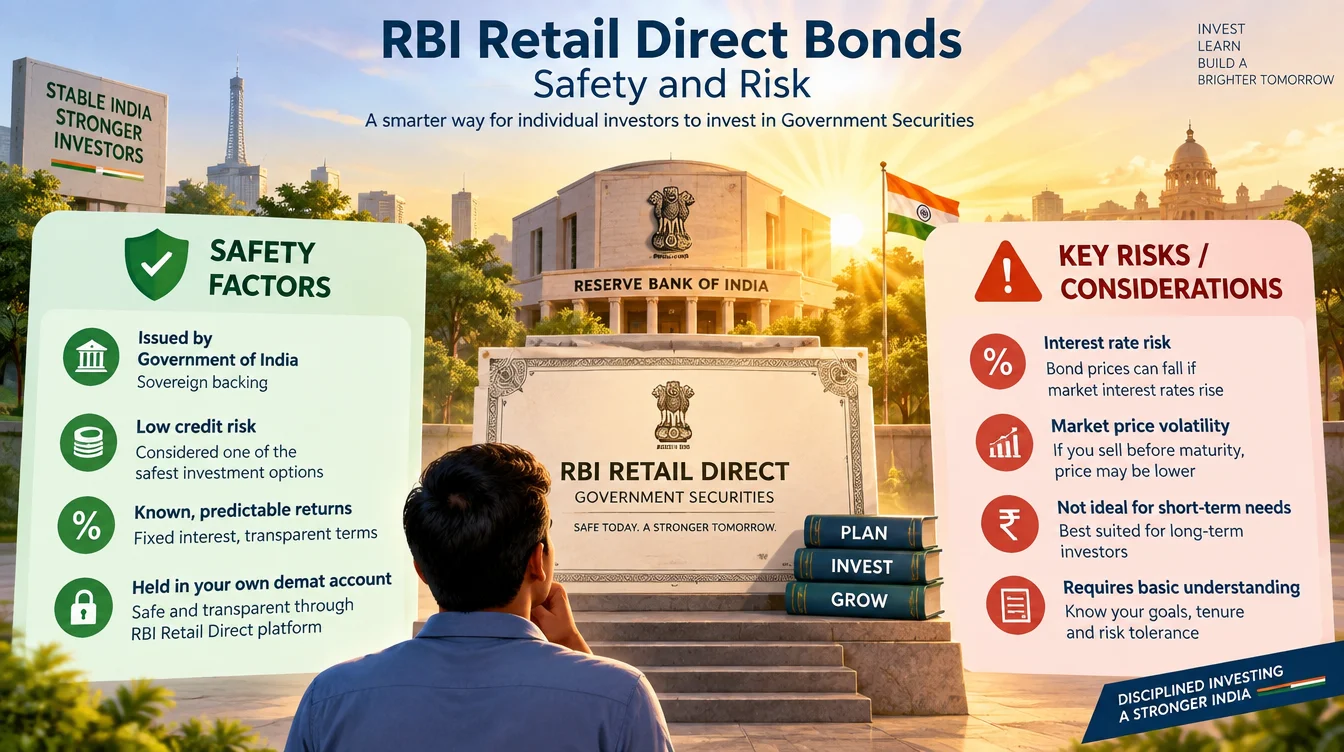
Because the borrower is the government, credit risk is effectively nil. That sovereign backing is the single biggest reason many salaried savers now treat RBI Retail Direct bonds as a serious fixed-income option rather than a niche curiosity. If you are still building your foundations, our note on the investment mistakes beginners make is a useful companion read.
How to Open an RBI Retail Direct Account
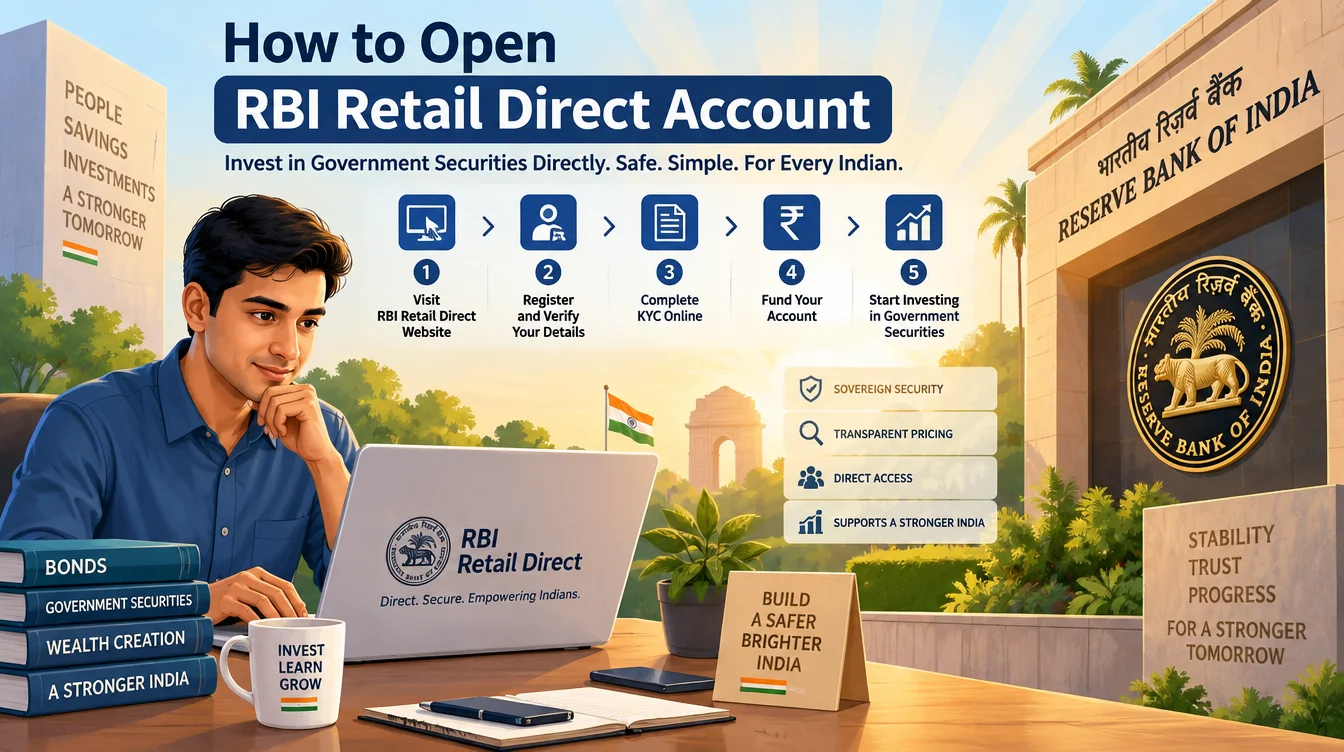
Opening an account is fully online and takes most people 15 to 20 minutes. You need a PAN, an Aadhaar-linked mobile number, a savings bank account, and an email ID. The account itself is called a Retail Direct Gilt (RDG) account.
- Visit the official RBI Retail Direct portal and choose to register.
- Enter your PAN, name, mobile and email, then verify with the OTP sent to your phone.
- Complete KYC using Aadhaar-based verification.
- Add your bank account details and set up a nominee.
- Once your RDG account is active, you can fund purchases directly from your linked bank account using net banking or UPI.
What does it cost to use the platform?
The account is genuinely free. RBI does not charge for opening the RDG account, for holding securities, or for participating in primary auctions. You only bear the standard payment gateway charges that your bank may apply on UPI or net banking. For a long-term holder, this zero-commission structure is a meaningful edge over regular distributor-led products.
Primary Auctions Versus the Secondary Market
There are two ways to buy through the platform, and understanding both helps you plan entries better.
Buying in primary auctions
The government issues fresh securities through weekly auctions conducted by RBI. Retail investors participate using a non-competitive bidding route, which means you do not have to guess the yield. You state the amount you want, and you are allotted at the cut-off price decided by large institutional bidders. This keeps the process simple and fair for individuals. The minimum investment is usually Rs 10,000, with the same amount as the step-up unit.
In the secondary market you buy or sell already-issued securities from other participants through the platform’s odd-lot and request-for-quote segments. This is where liquidity matters, and it is also where you can pick up SGBs. Just as with any asset, discipline beats timing, a theme we cover in our piece on investment psychology and money biases.
Taxation and Liquidity of RBI Retail Direct Bonds
Taxation often confuses many first-time buyers, so let us keep it clear. The interest, or coupon, you earn on G-Secs and SDLs is fully taxable at your income-tax slab rate, just like FD interest. There is no TDS on the coupon paid through Retail Direct, but you must still declare it in your return.
Capital gains apply if you sell a bond on the secondary market above your purchase price. Holding periods and gain treatment differ across instruments, and the rules interact with the broader system of levies we explain in our guide to direct versus indirect taxes. Sovereign Gold Bonds carry their own tax feature: if you hold an SGB to maturity, the capital gain on redemption has historically been exempt for individuals, which is why gold-focused savers compare them closely with physical metal, as discussed in our overview of gold as an investment in India.

On liquidity, be realistic. Long-dated G-Secs can be held to maturity for predictable cash flows, but if you need to exit early, the secondary market for retail lots is still thinning out, and prices move with interest rates. RBI Retail Direct bonds suit money you can commit to for the medium to long term, not your emergency fund.
RBI Retail Direct Bonds Versus FDs and Debt Funds
How do sovereign bonds compare with the fixed deposit most Indian households default to? Government securities can lock in a fixed coupon for far longer than any bank FD, carry zero credit risk, and charge no commission. FDs, by contrast, offer easier premature withdrawal and simpler compounding, but rates reset when you renew and bank credit risk, while low, is never zero.
The trade-off is different for debt mutual funds. Debt funds offer professional management, daily liquidity and easy diversification, but they charge an expense ratio, and their returns are not guaranteed. Direct G-Secs eliminate the fee layer and provide certainty of the coupon if held to maturity, but require you to do the legwork yourself. For readers who like the discipline of regular investing, pairing bonds with a systematic investment plan in equity can balance safety and growth.
A quick way to frame the choice:
- Want the highest possible safety with a long fixed coupon: lean toward G-Secs or SDLs.
- Want quick access and short tenure: an FD or T-bill may fit better.
- Want inflation protection or income diversification: weigh sovereign bonds alongside other real and market-linked assets before committing all your fixed-income money to one basket.
For educational purposes only. This article is general information about personal finance and is not investment, tax, or legal advice. Past performance does not guarantee future returns. Mutual funds and market-linked instruments carry market risk; read the scheme-related documents carefully. Consult a SEBI-registered investment adviser or a qualified tax professional for guidance tailored to your situation.
Frequently Asked Questions
Is the RBI Retail Direct platform safe?
Yes. The Reserve Bank of India runs the platform, and the government issues or backs the securities you buy. Your holdings sit in an RDG account with RBI, not with a broker, so there is no intermediary credit risk on the instruments themselves.
What is the minimum amount to invest?
For most G-Secs and T-bills in the primary auction, the minimum is Rs. 10,000, and you can add in multiples of that amount. Sovereign Gold Bonds and secondary-market lots may have different minimums depending on the security and available quotes.
Can NRIs use RBI Retail Direct?
Eligibility has been expanding, and certain categories of non-resident investors are now permitted to invest in specified government securities through the scheme, subject to FEMA rules. Please check the current terms on the official portal, as eligibility and permitted instruments are updated periodically.
How is the interest paid to me?
Coupon payments on G-Secs and SDLs are credited automatically to your linked bank account, usually twice a year. For T-bills, you earn the difference between the discounted purchase price and the face value paid at maturity, so there is no periodic coupon.
Are RBI Retail Direct bonds better than fixed deposits?
Neither is universally better. Sovereign bonds win on credit safety, tenure and zero commission, while FDs win on simplicity and easier early exit. The right pick depends on your time horizon, liquidity needs and tax slab, so match the instrument to your specific goal rather than chasing headline yield.