
Ray Dalio Principles Investing: The 5 Rules That Built Bridgewater
Ray Dalio published his book “Principles” in 2017, distilling 40 years of building Bridgewater Associates – the world’s largest hedge fund – into a systematic framework for life and work decision-making. The investment community reacted in divided ways: some found the framework transformative, while others found it too abstract for practical use. This article cuts through that debate to identify the five Ray Dalio principles for investing applications that have direct, measurable relevance for Indian investors managing equity portfolios in 2026.
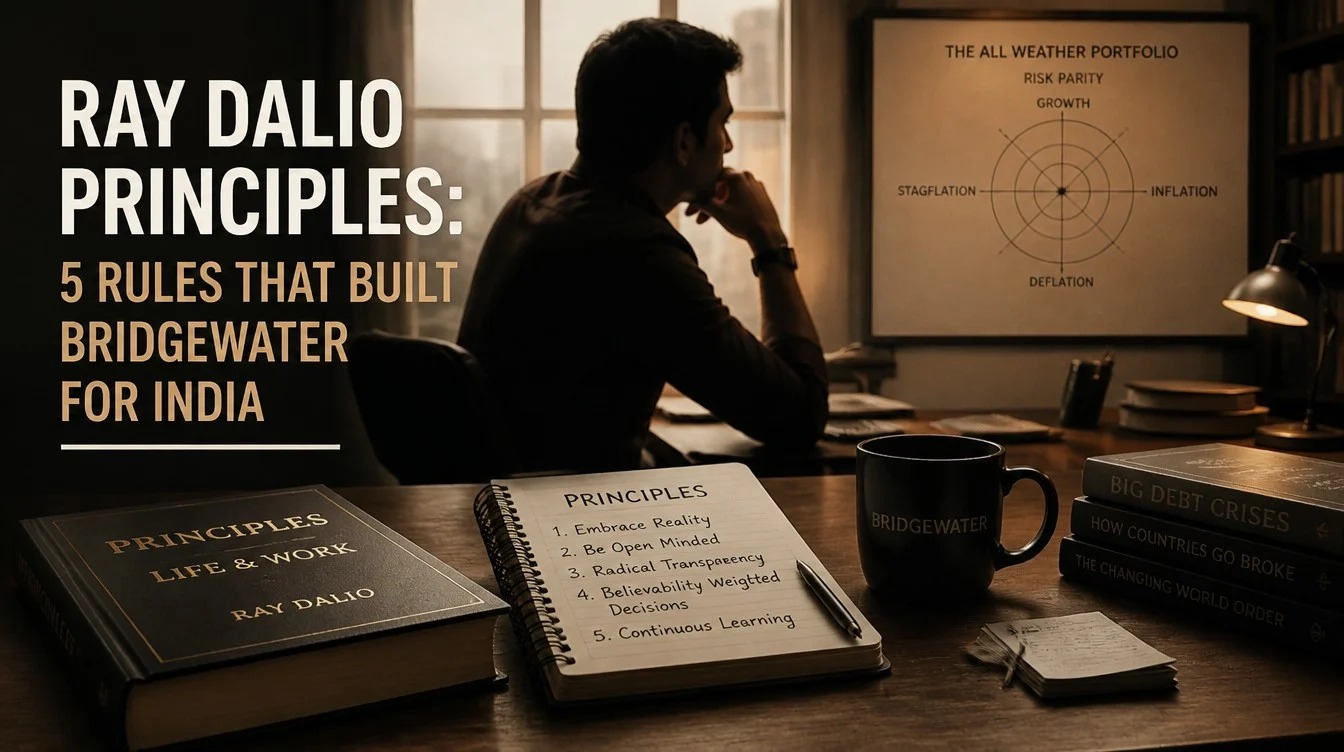
Principle 1: Embrace Reality and Deal with It
Dalio’s first and foundational principle is radical acceptance of reality: the commitment to see things as they are, not as you wish. In investment terms, this principle has a specific application that most investors find deeply uncomfortable: the requirement to mark your portfolio and your theses to market honestly at all times.
Most investors hold losing positions while telling themselves a story about why the position will recover. The story may be true, or it may be a rationalization of loss aversion. Dalio’s first principle demands that you distinguish between these two cases with intellectual honesty. Is this stock down 40% because the market is wrong about a fundamentally unchanged business? Or is it because the business has deteriorated in ways that your original thesis did not anticipate? Only by confronting this question honestly without the emotional distortion that comes from being down 40% can you make a rational decision about whether to hold, add, or exit.
Applied practically: when a holding in your portfolio has underperformed significantly, write a fresh analysis of the business from scratch, as if you had no position and were evaluating it for the first time. If that fresh analysis does not produce a buy recommendation at the current price, you are holding for psychological rather than analytical reasons. The sunk cost fallacy is the cognitive mechanism Dalio’s first principle is designed to counter.
Principle 2: Use a Five-Step Process to Get What You Want
Dalio’s decision process has five steps: set clear goals, identify the problems that are standing in the way, accurately diagnose those problems, design plans to address them, and do what is needed to push those plans through to results. The key innovation is the emphasis on accurate diagnosis before designing solutions.
Most investors jump directly from identifying a problem (my portfolio is underperforming the Nifty 50) to designing solutions (I should buy more large-cap stocks or use a momentum screen). Dalio’s framework insists on accurate diagnosis first: why is the portfolio underperforming? Is it sector allocation? Stock selection within sectors? Too many positions dilute the impact of excellent ideas? High-cost instruments eating returns? Is excessive trading generating short-term capital gains tax? Each diagnosis implies an alternative. Treating the symptom (underperformance) rather than the root cause (specific diagnosis) produces temporary improvement at best.
For Indian investors reviewing their portfolio performance annually, the five-step process is a structured audit framework. Step 1 (goal): beat the Nifty 50 by 3-4 percentage points annually over a 10-year period. Step 2 (problems): The last three years have seen 2% underperformance. Step 3 (diagnosis): The underperformance is concentrated in two sectors where I have high conviction but poor timing. Step 4 (design): Develop entry price criteria rather than purely thesis-based entry and reduce position sizes until price conditions are met. Step 5 (execute): Implement systematically with pre-committed rules to prevent emotional override.

Principle 3: Be Radically Open-Minded
Dalio’s third principle is what he calls ‘radical open-mindedness’: the willingness to genuinely consider that you might be wrong and the discipline to update your views when the evidence warrants. He distinguishes this concept from the appearance of open-mindedness (listening politely to counterarguments while privately dismissing them), which characterizes most intellectual interactions.
The investment application of radical open-mindedness is the willingness to seek out the most credible critics of your investment thesis and engage seriously with their arguments. If you are long on India’s private banking sector, what is the strongest argument for why the sector will underperform over the next five years? Not a straw-man version of the bear case, but the most rigorous version of the argument that an intelligent, well-informed analyst on the other side of the trade would actually make.
Bridgewater’s internal culture enforces this principle through what Dalio calls a “believability-weighted” decision process: different opinions are weighted by the track record of the people holding them, not by seniority or confidence. In a personal portfolio context, the equivalent is weighting your own analytical views by your actual track record in similar decisions rather than your confidence level. The all-weather portfolio construction is itself an expression of radical open-mindedness; it assumes that no one can reliably predict which economic environment will prevail and builds a portfolio that works across all environments rather than concentrating on the most likely scenario.

Principle 4: Understand That People Are Wired Very Differently
Dalio’s fourth principle is about understanding cognitive and personality differences between people, particularly in investment teams. He argues that most disagreements about investment decisions are not about the facts but about different cognitive styles interpreting those same facts differently. Understanding these differences and building processes that exploit them rather than suppress them is what allows Bridgewater to maintain intellectual diversity at scale.
For individual investors, this principle has a more personal application. Most investors have a cognitive style that is either more intuitive or more analytical, either more risk-seeking or more loss-averse, or either more patient or more active that creates systematic biases in their decision-making. Dalio’s principle demands that you understand your style with precision and build rules and processes that compensate for your style’s specific failure modes.
A highly analytical investor who tends toward paralysis in the face of uncertainty needs pre-committed decision rules that force him or her to act when specific criteria are met. A highly intuitive investor who acts too quickly on incomplete information needs a systematic checklist that slows the decision process and forces explicit documentation of the analytical basis for each investment. Neither style is superior; both require specific compensating disciplines. Understanding which style you have is the necessary precondition for building the right compensating process.
Principle 5: Learn How to Make Decisions Effectively
Dalio’s fifth principle is explicitly about decision quality under uncertainty. His framework distinguishes between two types of decisions: expected value decisions (where you can assign meaningful probabilities to outcomes and calculate the highest expected value choice) and recognition-based decisions (where experience allows pattern recognition that generates good judgements without explicit probability calculation).
For investment decisions, Dalio argues that most consequential choices involve genuine uncertainty about outcomes; no one knows exactly what the next two years hold for any specific business. The decision process should therefore focus on reducing uncertainty where possible (doing more analytical work, consulting more sources, testing more assumptions) and on making it as robust as possible against the irreducible uncertainty that remains.
His specific tools for robust decision-making include diversification across uncorrelated bets (the foundation of the all-weather portfolio); pre-committed decision rules that remove emotion from execution; a systematic tracking of decision quality that allows calibration over time; and the “two-minute test”: if you cannot explain your investment thesis and the conditions under which it would be wrong in two minutes, you do not understand it well enough to own it. The debt cycle framework is an example of Dalio’s decision-making principles applied to macro timing. It provides a structured way to consider economic conditions rather than reacting to each data point in isolation.

The Bridgewater Culture and What Individual Investors Can Extract
Dalio built Bridgewater around what he calls “radical transparency,” the principle that all important decisions and their rationale should be visible to everyone in the organization and that dissent should be encouraged rather than suppressed. This produces a culture of rigorous intellectual challenge that most organizations perceive as threatening but that Bridgewater argues produces consistently better decisions.
Individual investors cannot replicate an institutional culture, but they can replicate the intellectual habits that underlie it. Keeping an investment journal – documenting the thesis for each investment, the conditions under which the thesis would be invalidated, and the actual outcomes versus expectations – is the closest personal equivalent to Bridgewater’s systematic decision tracking. Over time, this journal reveals your actual decision quality in ways that memory alone cannot, because memory is retrospectively shaped to make your past decisions look better than they were.
The investment journal also implements radical transparency with yourself: the written record prevents you from pretending to have held a thesis you did not hold or from claiming to have anticipated a risk you actually missed. This honest accounting of your decision quality is the foundation for genuine improvement. Building long-term financial independence requires exactly this kind of systematic self-improvement in decision quality, because the compounding of sound decisions over decades is what separates exceptional investment outcomes from average ones.
Applying Dalio’s Principles to Indian Market Investing
The five principles translate into specific behaviors for Indian retail investors:
- Mark positions to reality: do a fresh thesis assessment for every holding that has underperformed by more than 20% to distinguish genuine thesis continuation from rationalized loss aversion.
- Diagnose before designing solutions: when portfolio performance is poor, complete a structured root cause analysis before changing strategy.
- Seek credible critics: for your highest-conviction holdings, read the most credible bear case available in institutional research reports from analysts who have downgraded their recommendations on the stock.
- Know your cognitive style: identify whether you are an over-trader or an under-actor and build rules that compensate for your specific style’s failure modes.
- Keep an investment journal: document the thesis, entry rationale, invalidation conditions, and actual outcomes for every position. Review annually. Systematic investing practices, such as journaling and structured review cycles, become more effective over time, similar to how capital compounds; therefore, an investor who has maintained a rigorous journal for 10 years gains a decision-quality advantage that cannot be quickly replicated.
Frequently Asked Questions
What are Ray Dalio’s main investment principles?
Dalio’s core investment principles from his book are the following: embrace reality honestly (including about your performance and biases); use a systematic five-step process for setting goals and solving problems; maintain radical open-mindedness about your own possible errors; understand your cognitive style and compensate for its failure modes; and build decision processes that are robust to irreducible uncertainty. These are process principles rather than market-timing rules; they govern how to think and decide, rather than what to buy.
How does Dalio’s radical transparency apply to individual investing?
For individual investors, radical transparency translates into maintaining honest records of decision quality, documenting theses, outcomes, and the gap between expected and actual results. The transparency is with yourself rather than with an organization, but the principle is the same: honest accounting of past decisions is the foundation for genuine improvement in future decisions.
Is Dalio’s framework applicable to emerging market investing?
Completely. Dalio’s debt cycle framework and his all-weather portfolio principles were developed through analysis of dozens of economies across multiple decades, including many emerging markets. His emphasis on diversification across uncorrelated assets and on understanding macro cycles is arguably more important for emerging market investors, who face higher macro volatility than developed market investors and therefore have more to gain from a systematic macro framework.
What is the connection between Dalio’s Principles book and his investment framework?
The Principles book describes the personal and organizational decision-making system that underlies Bridgewater’s investment process. The investment framework (all-weather portfolio, debt cycle analysis, and risk parity) is the specific application of those principles to market decisions. The book is more foundational – it explains the cognitive and process infrastructure from which the investment framework emerges.
Does Dalio’s framework recommend specific Indian stocks or sectors?
No. Dalio’s principles are process frameworks, not sector recommendations. Applied to Indian markets, they would direct an investor to understand which phase of the debt cycle India is in; build a portfolio balanced across economic environments rather than concentrated in the most-recently performing assets; maintain radical open-mindedness about consensus investment views; and document and track the quality of specific investment decisions over time. The specific securities that satisfy these criteria change over time and depend on individual analysis.
Related Articles
- Ray Dalio All Weather Portfolio: Build a Recession-Proof Portfolio for India
- Ray Dalio Debt Cycle Explained: How It Applies to India’s Economy
- 10 Investment Biases That Cost Indian Investors Money