

Michael Burry Big Short Explained: How He Shorted the 2008 Housing Market
The Michael Burry Big Short explained has been told in Michael Lewis’s book “The Big Short” and the Oscar-winning film adaptation, but most retellings focus on the drama rather than the analytical process. For investors, the more valuable story is not that Michael Burry made a billion-dollar bet against the housing market—it is the specific research methodology he used to identify that the bet was worth making when virtually every other market participant was on the opposite side of the trade. That methodology, applied with appropriate adaptation, is directly usable in Indian financial markets today.
The Setup: Why the Housing Market Was Mispriced
By 2005, the US mortgage market had undergone a structural transformation that most market participants overlooked. The traditional model—where banks lent to homebuyers, kept the mortgages on their own balance sheets, and therefore had a direct financial interest in the creditworthiness of borrowers—had been replaced by an originate-to-distribute model. Banks originated mortgages and immediately sold them into securitization structures (mortgage-backed securities, or MBS), passing the credit risk to investors while retaining origination fees. This model destroyed the incentive for rigorous credit underwriting because the originator’s financial interest ended at the point of sale.
The result was a dramatic deterioration in mortgage credit quality that was invisible in headline statistics. Default rates were low because house prices were rising – even poorly underwritten borrowers could refinance rather than default when their collateral was appreciating. However, the increase in house prices was partly a result of the expansion of easy credit. When house prices stopped rising and the marginal borrower could no longer refinance, the deterioration in credit quality would become visible simultaneously across a large portion of the mortgage book.
What Burry Actually Did: The Research Process
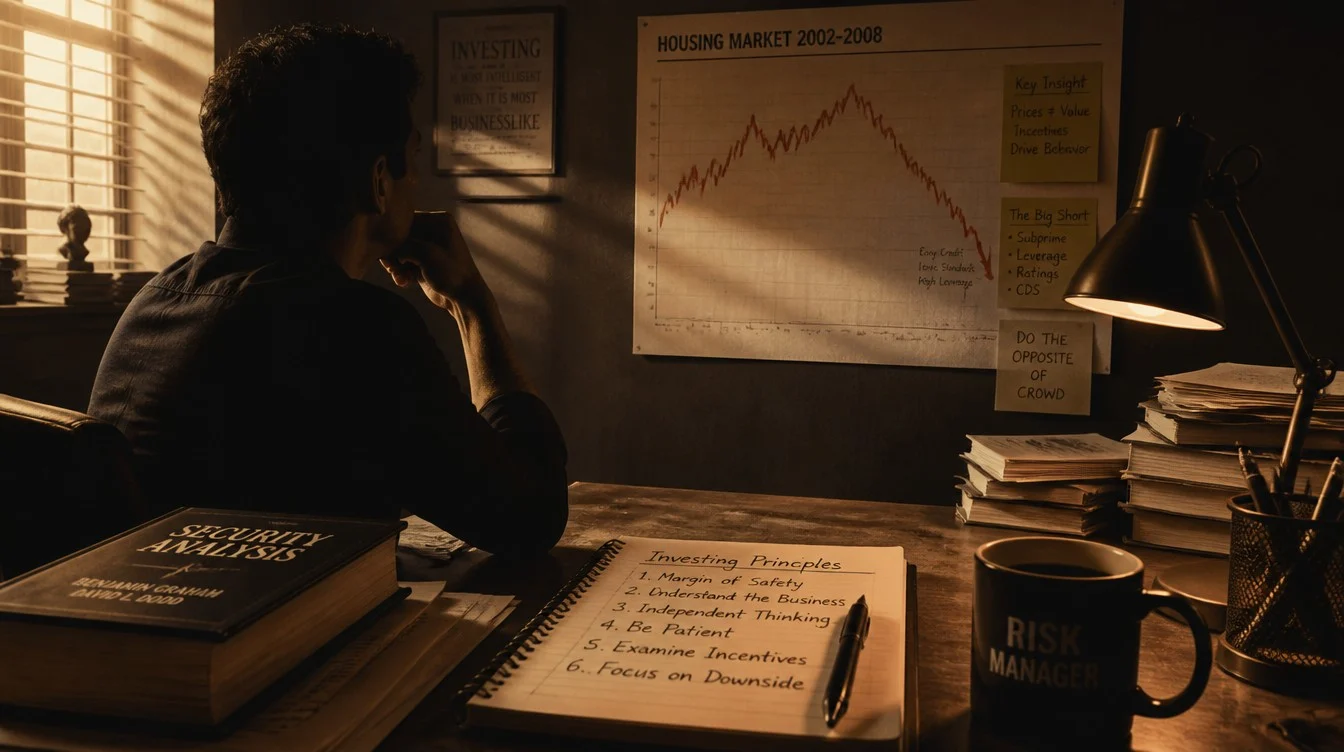
Michael Burry’s discovery of this mispricing was not the product of a macro prediction about house prices. It was the product of a security-level forensic analysis of the mortgage bonds themselves—reading the actual loan prospectuses, not the rating agency summaries.
Step 1: Reading the Prospectuses
Burry and his small research team at Scion Capital read the actual loan-level data in mortgage bond prospectuses—thousands of pages of disclosures that institutional investors typically ignored in favor of the rating agency opinions. In those prospectuses, he found the specific terms of the mortgages being packaged: adjustable-rate loans with 2-year teaser periods after which rates would reset dramatically higher; loans with debt-to-income ratios that assumed continuous house price appreciation; “stated income” loans (also called “liar loans”) where borrower income was not independently verified; and loans with 100% loan-to-value ratios that provided no equity cushion against price declines.
These were not edge cases – they represented a growing proportion of mortgage origination. And they were being packaged into bonds rated AAA by the major rating agencies, which had calibrated their models on historical mortgage default rates from periods when these specific loan structures did not exist.
Step 2: Understanding the Structure of the Bet
Once Burry had identified that the underlying mortgage quality was far worse than the rating suggested, he needed a vehicle that would allow him to profit from the eventual defaults. He found it in credit default swaps (CDS) on mortgage-backed securities—instruments that functioned like insurance policies, paying out when the referenced bonds defaulted. By buying CDS on the worst-quality MBS tranches he could identify, he constructed a bet that would pay off when default rates on those specific loan pools exceeded the levels the market was pricing.
The structure of the trade had highly asymmetric payoffs: the cost of holding the CDS (the insurance premium) was bounded at a few percent of notional value annually, while the potential payoff if the referenced bonds defaulted completely was 100% of notional value. This asymmetry—limited downside, large upside—is the defining characteristic of a superior speculative trade. Burry’s full investment framework consistently exploits this kind of asymmetric payoff structure.

The Psychological Challenge: Being Right Too Early
One of the most instructive elements of the Big Short story is what happened between when Burry identified the trade in 2005 and when it paid off in 2007-2008. For most of that period, nothing happened. The housing market continued to rise, default rates remained low (because house prices were still allowing refinancing), and the CDS Burry had bought continued to cost money as the premiums accrued.
His investors were furious. Some demanded redemptions. The fund’s performance lagged significantly during 2006 as the insurance premiums reduced returns while the thesis had not yet played out. Bury himself was under enormous pressure—he had complete analytical conviction that he was right, but the market was not moving in his direction, and the capital at risk was real.
This period illustrates one of the hardest challenges in contrarian investing: being right about a thesis but facing a timing problem. Markets can remain mispriced longer than most investors can remain solvent, patient, or psychologically intact. Burry survived this period by maintaining conviction in the underlying analysis, understanding exactly what market development would trigger the thesis (house price appreciation slowing, then stopping), and accepting that the timing could not be precisely controlled. Managing the psychology of holding an unpopular position while waiting for a thesis to play out is a skill most investors are never tested on—Burry’s experience provides one of the most documented case studies of what that challenge looks like in practice.
The Payoff: When the Market Broke
In 2006-2007, US house prices stopped rising in many markets. The 2-year teaser rate periods on the worst adjustable-rate mortgages began expiring, and borrowers who could no longer refinance found themselves facing dramatically higher monthly payments on loans they could not afford at the reset rate. Default rates began rising, first in subprime loans, then spreading into Alt-A and eventually prime mortgage segments. The mortgage bond market, which had been pricing in virtually zero losses on even the riskiest tranches, began to reprice rapidly.
Burry’s CDS positions, which had been costing the fund premium payments for 18 months, suddenly became worth multiples of their cost. Scion Capital made approximately $700 million for its investors on the trade, and Burry personally made approximately $100 million. Total Bridgewater performance across the crisis put Scion’s cumulative returns from inception to winding down at roughly 489% net of fees against the S&P 500’s 3% over the same period.
What Burry’s Process Teaches About Research Methodology
The Big Short trade is not replicable as a specific trade—the instruments and market structures are different, and the specific mispricing Burry identified has been priced out of the US mortgage market by subsequent regulatory reform. But the research methodology is directly applicable.
Go to Primary Sources
Burry read prospectuses when everyone else was reading rating agency summaries. The equivalent in Indian equity investing is reading the actual annual report rather than the analyst note that summarizes it; reading the complete related-party transactions disclosure rather than skimming past it; and reading the actual covenant terms on a company’s debt rather than accepting that the credit is “investment grade.”
The primary sources contain information that the secondary summaries exclude—usually information that is unflattering, complex, or requires effort to interpret. The market-level mispricing that Burry exploited existed because no one else was willing to do the primary source work. Similar dislocations exist in Indian markets, concentrated in small and mid-cap companies where analyst coverage is thin and institutional ownership is low. Primary source research skills are among the most differentiating analytical capabilities available to serious equity investors.
Look for Structural Mispricing, Not Just Cheap Valuations
Burry was not just looking for cheap mortgages or cheap bonds. He was identifying a structural mispricing: a situation where the rating assigned to the bonds was based on a model that did not capture the actual credit quality of the underlying loans. The model was wrong in a specific, identifiable way, not just conservative or optimistic. This distinction matters because structural mispricings tend to be persistent—they exist because the analytical consensus is based on a flawed framework, not just on pessimistic assumptions—and they tend to resolve sharply when the flaw becomes visible to the market.
In Indian equity markets, structural mispricings most often appear in businesses undergoing sector transitions that existing valuation frameworks do not capture: an insurance company in the early stages of a transition from traditional products to protection products, where the embedded value accounting understates future profitability; a hospital network in the early stages of transitioning from volume-led to premium specialty care, where revenue per bed metrics miss the margin implications; a financial technology company building a platform business whose value accrues in network effects rather than current year revenue. Structural transitions in real estate created similar mispricings in the early years of REIT adoption in India.
The Big Short Methodology Applied to Indian Credit Markets
India’s credit markets have structural features that create periodic mispricing opportunities analogous to what Burry found in the US mortgage market. The most significant is the rating agency reliance problem: Indian institutional investors are heavily dependent on domestic credit rating agency ratings for their investment mandates, and domestic rating agencies have historically been slow to downgrade issuers in financial distress, sometimes maintaining investment-grade ratings until default is imminent.
An investor applying Burry’s primary-source methodology to Indian corporate bonds would focus on the actual terms of debt covenants rather than the headline interest coverage ratio; the refinancing schedule relative to cash generation capacity; related-party lending patterns that suggest the company may be acting as a financing vehicle for the promoter group rather than as an independent business; and the actual business performance metrics underlying the financial statements, rather than the auditor-certified summary figures.
This type of analysis identified Yes Bank, DHFL, and IL&FS vulnerabilities before rating agencies formally downgraded them. Investors who conducted primary source analysis of these entities’ actual financial condition, rather than relying on rating agency assessments, had the information needed to avoid losses or to structure positions that would profit from the eventual credit event.

Frequently Asked Questions
How did Michael Burry predict the 2008 financial crisis?
Burry did not predict the financial crisis from a macro perspective. He identified a specific mispricing in the US mortgage bond market by reading actual loan prospectuses and discovering that mortgage credit quality had deteriorated far beyond what the rating agencies’ models captured. He then bought credit default swaps on the worst-quality mortgage bonds, which paid off when the mortgages defaulted at rates far higher than the market had priced.
What is a credit default swap (CDS), and how did Burry use it?
A credit default swap is a financial contract that functions like insurance on a bond: the buyer pays periodic premiums to the seller, and the seller pays out a large sum if the referenced bond defaults. Burry bought CDS on specific mortgage-backed securities, paying annual premiums of 1-2% of the notional value while holding the position. When the referenced bonds defaulted, the CDS paid out 100% of the notional value—a return of 50-100 times the premium cost for the contracts that paid out fully.
How long did it take for Burry’s Big Short to pay off?
Burry began buying CDS on mortgage bonds in 2005. The trade did not pay off substantially until 2007, when house price declines triggered mortgage defaults at scale. For approximately 18 months, the trade cost the fund premium payments while showing no positive return—a period during which Burry faced significant investor pressure and considered closing the fund.
Can individual investors in India replicate the Big Short strategy?
The specific instruments (CDS on mortgage bonds) are not available to Indian retail investors, and India does not have an equivalent residential mortgage securitization market. But the analytical methodology – reading primary financial documents rather than secondary summaries, identifying structural mispricings in credit markets, and positioning for asymmetric payoffs when mispricing is identified – is applicable. The closest Indian retail equivalent involves identifying Indian corporate bonds or stocks that rating agencies misprice due to their slowness in capturing financial deterioration.
What did Michael Burry do after the Big Short?
After the Big Short trade, Burry closed Scion Capital to outside investors and managed his own personal capital. He re-emerged in approximately 2013 with a new investment vehicle and continued applying his deep value methodology to individual stocks. In subsequent years, he became known for positions in water rights, agricultural land, Japanese stocks, and large put options on equity index ETFs, each reflecting his continuing methodology of identifying structural mispricings through primary source research.
Related Articles
- Michael Burry Investment Strategy: Deep Value Investing Explained for Indian Markets
- 10 Investment Biases That Cost Indian Investors Money
- Investing 101: The Basics Every Indian Investor Needs