
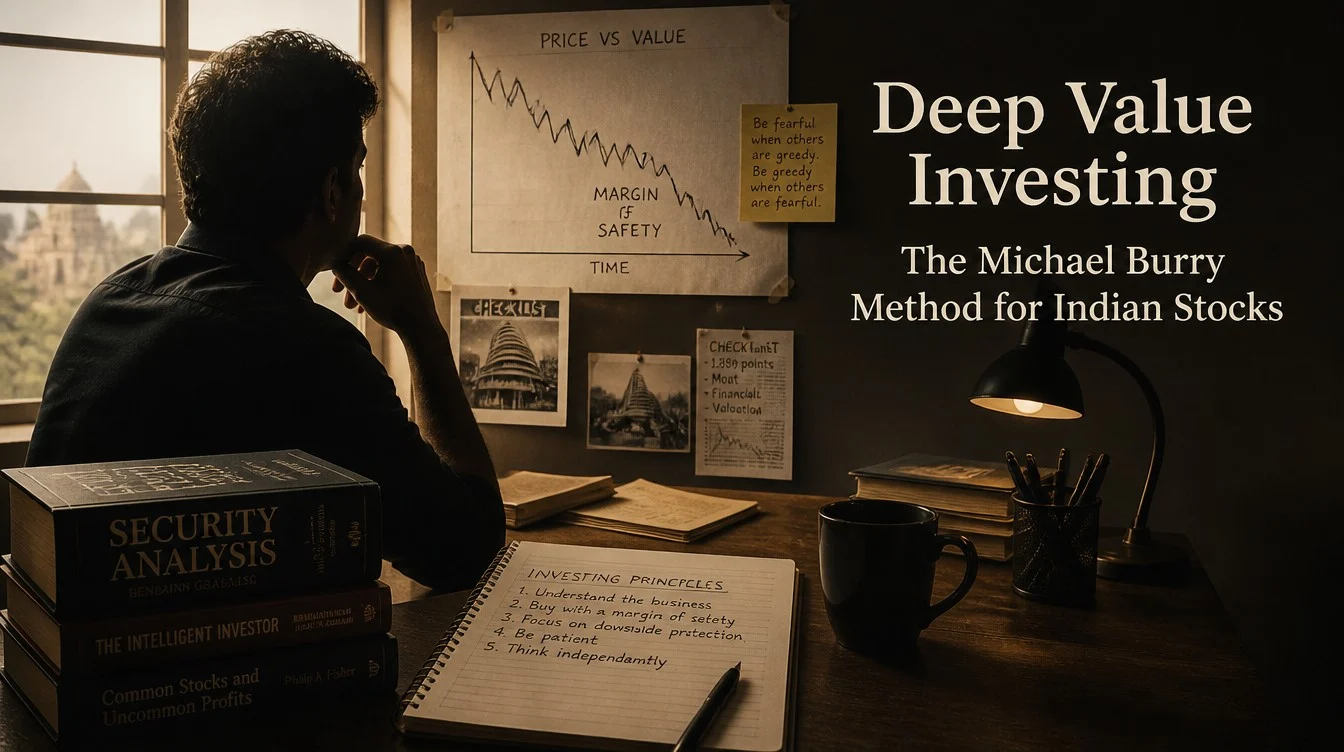
Deep Value Investing: The Michael Burry Method Applied to Indian Stocks
Deep value investing in Indian stocks, an application of Michael Burry’s methodology, requires understanding what separates deep value from other value disciplines. Barry is not a traditional value investor in the Buffett mould – he does not primarily look for great businesses at fair prices. He looks for statistically cheap securities with specific, identifiable catalysts for value realisation – businesses trading so far below their net asset value or earnings power that the discount alone provides the return potential, even if the business never becomes truly excellent. This approach, created at Burry’s Scion Capital and kept in his personal account, can be used in the Indian equity market with specific changes for the accounting, governance, and liquidity features of the Indian small and mid-cap universe.
What Deep Value Investing Indian Stocks Screening Actually Means
Deep value investing is the systematic search for securities whose market price is dramatically below an objective measure of intrinsic value, typically 50% or more below net asset value, earnings power value, or replacement cost. The word “deep” distinguishes this strategy from conventional value investing, which seeks a 20-30% margin of safety on quality businesses. Deep value investors accept lower business quality in exchange for a much larger price discount.
The theoretical foundation comes from Benjamin Graham’s “net-net” stock concept: stocks trading below their net current asset value (current assets minus all liabilities) are selling for less than the cash and liquid assets the business holds, effectively giving away the operating business for free. Graham found that a diversified portfolio of these stocks consistently outperformed the market in the data he analysed from the 1930s to the 1950s. Burry extended this framework beyond net-nets to include stocks that are deeply discounted to normalised earnings power, to private market transaction values for comparable businesses, and to the asset value of resource or real estate holdings.
Burry’s Specific Screening Criteria
Based on Burry’s documented investment history and his descriptions of his process, his deep value screen has several specific criteria:
Price-to-Book Below 0.7x
Burry primarily focused on stocks trading at very low price-to-book multiples – typically below 0.7x and often as low as 0.3-0.4x. A stock at 0.4x book value means the market is valuing the business at 40% of the net assets on its balance sheet. For this discount to be rational (rather than reflecting genuine asset impairment), the assets must be real and the business must not be destroying value at a rate that will consume the asset discount over the holding period.
Applied to India: BSE small and mid-cap stocks frequently trade below book value during market corrections and sector downturns. The key analytical question is whether the book value is reliable (do the assets actually exist and are they properly valued?) and whether the business is consuming or preserving that book value (is return on equity positive or negative?). A stock at 0.4x book with 8% ROE is a genuine deep value opportunity; a stock at 0.4x book with -5% ROE is burning through the asset base that makes the book value appear attractive.
Low Enterprise Value to EBITDA
Burry also used enterprise value to EBITDA multiples to identify businesses trading at significant discounts to operating cash flow generation. His historical screens targeted EV/EBITDA below 4x, which in most market environments represents a significant discount to private market transaction values for even mediocre businesses in India. At 4x EBITDA, the business would theoretically repay its entire acquisition cost from operating cash flows in four years, ignoring tax, maintenance capex, and working capital requirements.
In Indian markets, this screen filters out most large and mid-cap companies (which trade at higher multiples) and identifies deep value opportunities primarily in cyclically depressed sectors – commodity businesses at trough earnings, infrastructure companies with project execution delays that have depressed near-term EBITDA, and financial companies in post-credit-cycle recovery mode. Burry’s full analytical framework applies these quantitative screens as the first filter, then conducts qualitative analysis on the businesses that pass the screens.

Applying the Screen to Indian Markets: What to Look For
Running a Burry-style deep value screen on Indian equities requires specific adaptations for the Indian accounting and governance environment:
Adjusting for Indian Accounting Quality
Indian financial statements, particularly for smaller companies, require significant adjustment before applying deep value metrics. Common adjustments include capitalised expenses that should be operating costs (some Indian companies capitalise software development costs, marketing costs, or even training costs to inflate reported profits); aggressive revenue recognition policies that front-load revenue from long-term contracts; inventory valuation practices that understate the cost of goods sold in inflationary environments; and related-party transactions that shift income or assets to promoter-controlled entities off the public company’s balance sheet.
Before relying on reported book value for deep value analysis in India, investors must conduct substantially more due diligence than in US markets. Burry would apply the same forensic accounting scrutiny to Indian balance sheets that he applied to US mortgage bond prospectuses – reading the actual notes to accounts, the related-party disclosure, and the auditor’s qualification language rather than relying on the headline numbers.
Governance Filters as Deep Value Qualifiers
In India’s small-cap universe, many stocks that appear cheap on quantitative screens are cheap because of governance problems rather than temporary market mispricing. Promoter pledging above 30-40%, historical instances of fund transfers to promoter entities, auditor changes (particularly from Big 4 to unknown regional firms), and circular trading patterns in the stock (where volume is high but delivery percentage is low) are all signals that the apparent cheapness reflects real governance risk rather than an investment opportunity.
Burry’s framework accepts this risk in US markets, where disclosure standards and legal enforcement make governance fraud less common and more detectable. In Indian markets, the governance filter must be applied more stringently before acting on quantitative cheapness signals. The practical rule is simple: if a stock looks extraordinarily cheap on every quantitative metric and you cannot find a clear explanation for why, governance risk is the most likely explanation. Confirmation bias makes investors who want to find cheap stocks dangerous here – the desire to find a value opportunity can cause them to discount governance red flags that should be disqualifying.

Deep Value Opportunities in Indian Small-Caps: Sector Patterns
Specific sectors in India have historically generated deep value opportunities at identifiable cyclical inflection points:
Metals and Mining at Cycle Troughs
Indian metal companies – steel, aluminium, and copper – trade at very low price-to-book multiples during commodity price troughs. At the trough of the 2015-2016 steel cycle, Indian primary steel producers traded at 0.3-0.5x book value. The assets (blast furnaces, captive mines, distribution networks) had a genuine replacement value far above market capitalisation. Investors who bought at these levels with a 3-5 year view captured significant returns as the commodity cycle normalised. The Burry screen would have identified these stocks; the catalyst was commodity price normalisation rather than business transformation.
PSU Banks Post-NPA Recognition
Indian public sector banks traded below 0.3x book value at the peak of the NPA recognition cycle from 2018 to2020. The book values were impaired (NPAs consumed capital, requiring government recapitalisation), but the post-recapitalisation book values of the surviving banks represented real assets – branch networks, loan books, and government deposits – that the market was pricing at extreme discounts. The deep value case relied on the government’s willingness to recapitalise and on the normalisation of credit costs as the IBC process resolved large NPAs. Both catalysts materialised.
Infrastructure and Power Companies with Project Delays
Indian infrastructure and power companies with delayed project completions frequently trade at deep discounts to their project asset values because the delay creates near-term earnings uncertainty. Once projects are commissioned, earnings reflect the underlying asset value. The deep value screen identifies these stocks; the catalyst analysis requires understanding the specific project delay cause and probability of resolution. Infrastructure asset valuation requires specific frameworks for projects at different stages of completion that differ from standard equity valuation approaches.
The Catalyst Requirement: What Converts Cheap to Returns
The most important practical adaptation of Burry’s framework is the explicit catalyst requirement. A stock can be cheap forever if there is no mechanism by which the market discount to intrinsic value narrows. Successful deep-value investing requires identifying not just the discount, but also the specific catalyst that will cause the market to recognise the value.
Burry’s catalysts in his documented investments included credit cycle normalisation (his Big Short trade paid off when mortgage defaults rose to market-recognised levels); management changes (he targeted companies where new management was actively monetising undervalued assets); and acquisition activity (companies trading at large discounts to private market values attracted acquirers who saw the same discount Burry saw).
Applied to Indian deep value situations, common catalysts include commodity cycle recovery (for cyclically depressed businesses); promoter buyback activity at discounted prices (a signal that insiders believe the discount is excessive); government policy intervention (for PSU banks, infrastructure companies, or import-competing businesses where regulatory support can be anticipated); and earnings inflection (where temporarily depressed earnings are about to recover to normalised levels, making the current PE look high but the forward PE at normalised earnings look very low). Patience in holding deep value positions through the period between identification and catalyst materialisation is the primary psychological challenge of this approach.
Frequently Asked Questions
What is deep value investing?
Deep value investing is the strategy of buying securities that are trading at very large discounts to objective measures of intrinsic value – typically 50% or more below net asset value, normalised earnings power value, or private market transaction value for comparable businesses. It differs from conventional value investing by accepting lower business quality in exchange for a much larger initial price discount and by requiring specific catalysts for value realisation rather than relying on business quality improvement to generate returns.
How does Burry’s deep value approach differ from Buffett’s value investing?
Buffett seeks great businesses at fair prices – businesses with durable competitive advantages that will compound their earnings per share over long periods. Burry seeks statistically cheap businesses at deep discounts to asset value or earnings power – businesses that may be mediocre but are priced so far below intrinsic value that the discount alone drives the return. Buffett focuses on business quality; Burry focuses on price discounts. Both are valuable approaches but with fundamentally different emphases.
What quantitative screens identify deep value stocks in India?
The primary screens are price-to-book below 0.7x (with governance and accounting quality filters applied before trusting the book value), enterprise value to EBITDA below 4-5x, and price-to-earnings below 8-10x on normalised (cycle-average) rather than current earnings. These screens must be applied with awareness that Indian small-cap stocks can be cheap because of governance problems rather than market mispricing, requiring additional qualitative filtering.
Is deep value investing appropriate for all Indian investors?
Deep value investing requires a higher risk tolerance than quality growth investing, a longer time horizon (3-5 years minimum) for catalysts to materialise, and the psychological ability to hold positions through periods where the discount widens further before it narrows. It is most appropriate for experienced investors who have sufficient knowledge to distinguish genuine value from value traps and who can maintain conviction through the inevitable periods of underperformance that precede catalyst realisation.
What is the biggest risk in deep value investing in India?
The biggest risk is the value trap: a stock that appears cheap because it is genuinely impaired – its assets are not worth what the balance sheet says, the business is destroying value faster than the apparent discount can cushion, or governance problems mean that realised value will flow to insiders rather than minority shareholders. In India, governance-driven value traps are more common than in most developed markets, making the governance due diligence step as important as the quantitative screening.
Related Articles
- Michael Burry Investment Strategy: Deep Value Investing for Indian Markets
- How Michael Burry Shorted the 2008 Housing Market: The Big Short Explained
- Warren Buffett Investment Strategy: Value Investing Guide for India