
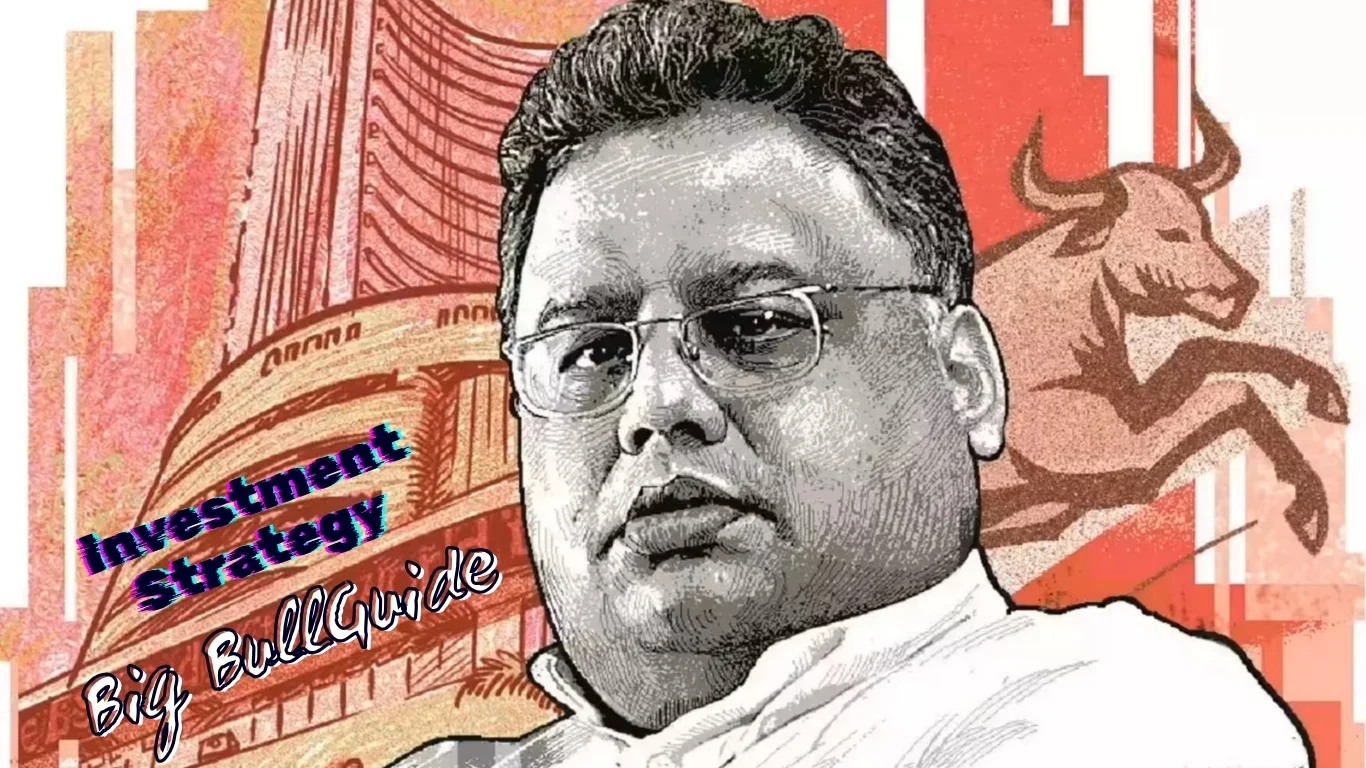
Rakesh Jhunjhunwala Investment Strategy: How India’s Big Bull Built His Fortune
Rakesh Jhunjhunwala started investing in 1985 with Rs 5,000 borrowed from his brother. He died in August 2022 with a net worth of approximately Rs 46,000 crore, one of the largest equity fortunes ever built by a single individual in India through the stock market. The rakesh jhunjhunwala investment strategy was not built on inside information, borrowed money, or a single spectacular trade. It was built on a rigorous, contrarian framework for identifying India’s structural growth themes before they became consensus, combined with the psychological courage to hold through brutal multi-year drawdowns.
This guide covers every dimension of Jhunjhunwala’s investment philosophy: how he picked stocks, how he sized positions, what he believed about India, why he held Titan for over two decades, and what retail investors can extract from his approach today.
Who Was Rakesh Jhunjhunwala? The Big Bull of Dalal Street
Rakesh Jhunjhunwala was born in 1960 in Mumbai, the son of an income tax officer. He studied commerce at Sydenham College and then chartered accountancy at the Institute of Chartered Accountants of India. His father’s dinner table conversations were often about the stock market, planting an early fascination that never left him.
The Early Years: Learning the Market from Scratch
When Jhunjhunwala began investing in 1985, Sensex stood at approximately 150. He had no institutional backing, no Bloomberg terminal, and no sophisticated research infrastructure. His father refused to fund his stock market ambitions, which is why he borrowed Rs 5,000 from his brother. His first significant trade was buying 5,000 shares of Tata Tea at Rs 43 each. He sold them at Rs 143, tripling his money. This early success was instructive not because of the return, but because it taught him to think about Indian consumer stories; the Tata Tea purchase was based on his view that branded tea would grow rapidly as India’s middle class expanded.
The Harshad Mehta Bull Run and What He Learned
The 1992 Harshad Mehta-driven market bubble gave Jhunjhunwala his first experience of a speculative mania. He made substantial profits during the bull run, but, crucially, he was also observing what was happening: a market driven entirely by circular trading and bank-funded stock price manipulation, completely disconnected from business fundamentals. The crash that followed when Mehta’s scheme unravelled gave him a lifelong aversion to leverage-driven speculation and a deep respect for fundamental value as the only durable anchor for equity investment.
The 2003-2008 Bull Run: Building the Core Portfolio
The period from 2003 to 2008 was when Jhunjhunwala built his foundational positions. The Sensex rose from roughly 3,000 to 21,000. His Titan position, which he initiated in 2002-2003 when the stock was deeply depressed, became one of the most profitable long-term equity holdings in Indian market history. His Crisil, Praj Industries, and Lupin positions from this era all produced multibagger returns over the following decade. The common thread: businesses with strong brand equity or intellectual property, tied to India’s domestic consumption growth, held with patience through short-term volatility.

The Core Rakesh Jhunjhunwala Investment Philosophy
Jhunjhunwala’s investment philosophy was neither pure value nor pure growth. It was a synthesis he described as “growth at the right ‘price,'” seeking businesses with visible, structural growth drivers and buying them when the market had temporarily depressed their valuation due to cyclical headwinds, temporary setbacks, or simple neglect.
India as the Investment Thesis
The most important element of Jhunjhunwala’s investment framework was his unwavering conviction in India’s long-run growth trajectory. He believed from the early 1990s that India was at the beginning of a multi-decade consumption and economic development story similar to what Japan experienced from the 1950s and China from the 1980s. This macro conviction informed every stock-level decision: he prioritized businesses that were structurally positioned to benefit from India’s rising middle class, increasing urbanization, financial inclusion, and infrastructure development.
His public speeches were consistently and almost uniquely bullish on India at times when global investors were deeply skeptical. In 2008, when FIIs were fleeing Indian markets, he was buying. In 2013, when the rupee was in freefall and India was being called part of the “Fragile Five,” he was publicly arguing that India’s structural story was intact. This contrarian macro conviction – derived from genuine analytical conviction rather than promotional optimism – has been a consistent alpha generator. Building long-term wealth in Indian equities requires exactly this kind of conviction in the underlying macro story, not just stock-level analysis.
The Business Quality Filter
Jhunjhunwala looked for businesses with four specific characteristics:
- A large and growing total addressable market. He was not interested in businesses operating in mature, slow-growth markets. He wanted sectors where India’s demographic and economic growth would expand the market itself, not just the company’s market share.
- A sustainable competitive advantage. Brand strength, distribution depth, regulatory moats, or first-mover advantages in underpenetrated categories. Titan’s watch and jewelry businesses had all of these in the Indian context.
- Demonstrated management quality. He studied management teams carefully their track record of capital allocation, their transparency with shareholders, and their strategic vision over long periods. He particularly valued founder-promoters who had built businesses from nothing and maintained majority ownership.
- There is a clear path to earnings growth. He wanted to see a specific, credible mechanism by which the business would earn significantly more per share in five years than it was earning today, not a general expectation of growth but a specific articulation of the growth driver.
The Price Discipline
Despite his growth orientation, Jhunjhunwala was rigorous about not overpaying. He would wait, sometimes for years, for the right entry price. His Titan position was initiated when the stock was deeply depressed due to concerns about the jewelry business’s gold inventory carrying costs and regulatory uncertainty. He bought aggressively when institutional investors were avoiding the stock. The combination of business quality conviction and price discipline produced entry prices that gave him both downside protection and enormous upside potential.
The Titan Position: India’s Greatest Long-Term Stock Investment
Rakesh Jhunjhunwala’s Titan investment is the most studied long-term equity position in Indian market history. Understanding how he built, held, and expanded it provides the clearest lens into his investment methodology.
Why He Bought Titan
Jhunjhunwala began accumulating Titan Company shares in 2002-2003 at prices between Rs 3 and Rs 6 per share (adjusted for splits). At the time, Titan was a Tata Group company with a dominant position in the watch market but was struggling with its jewelry division, Tanishq, which was bleeding cash due to operational challenges and competition from unorganized local jewelers.
His thesis had three parts. First, Titan’s watch business had a genuine moat: brand recognition built over 15 years that no new entrant could replicate quickly. Second, Tanishq had a structural opportunity: India’s jewelry market was one of the world’s largest and was almost entirely unorganized. A branded, trusted retailer that solved the purity and hallmarking problem for Indian consumers had an enormous addressable market and zero serious competition. Third, the Tata Group’s parentage ensured governance quality: Titan would not extract value from minority shareholders through related-party transactions or promoter pledging.
How He Held Through Adversity
Between 2002 and 2022, Titan’s stock price experienced multiple 30-50% drawdowns due to gold price volatility, SEBI’s jewelry hallmarking regulations, COVID shutdowns, and periodic concerns about competition from e-commerce. Jhunjhunwala held and added through every one of these drawdowns, stating publicly that the business quality had not changed and that he had no reason to sell.
By 2022, his Titan holding was worth approximately Rs 11,000 crore, a return of roughly 2,000x on his cost basis over two decades. This is the mathematical proof of his investment thesis: buy a great business with a structural growth driver at a reasonable price and hold with conviction through every temporary setback. The compounding mathematics of patient investing produces results that dwarf any short-term trading strategy when applied to genuinely exceptional businesses.
What Titan Teaches Indian Retail Investors
The Titan story has three practical lessons. First, the opportunity was visible; Tanishq stores were opening in India’s cities, jewelry purchasing patterns were shifting toward branded, and Tata’s governance quality was demonstrable. No insider information was required. Second, the holding period was a discipline. Investors who bought Titan in 2002 but sold on a 5x return in 2008 captured perhaps 1% of the total available gain. The 2,000x came entirely from holding through 20 years of volatility. Third, the position size mattered. Jhunjhunwala held a meaningful percentage of his total portfolio in Titan throughout; small positions in great businesses produce small returns, regardless of how right the thesis proves to be.

Other Major Jhunjhunwala Positions and What They Reveal
Beyond Titan, Jhunjhunwala built significant positions in a range of Indian businesses that illuminate his sector themes and stock selection criteria.
Crisil: The Financial Services Structural Theme
Jhunjhunwala held Crisil, India’s leading credit rating agency, for many years. His thesis was straightforward: as Indian capital markets deepened, the volume of debt issuances would grow dramatically, and a duopoly of rating agencies (Crisil and ICRA) would capture the economics of that growth with minimal incremental capital. Crisil’s credibility, built over decades, protected its market position in a way that a new entrant could not replicate. This approach is classic moat investing, applied specifically to the Indian financial services context.
Lupin: The Healthcare Consumption Theme
His pharmaceutical holdings, including Lupin, reflected his view that India’s rising incomes would drive significant growth in branded generic drug consumption domestically, while Indian generics manufacturers would capture significant share of the global off-patent drug market. The thesis was correct directionally, though the US generics’ pricing headwinds that emerged from 2016 to 2019 created a prolonged period of underperformance that tested holders’ conviction.
Tata Motors: The Cyclical Conviction Play
Jhunjhunwala made a large bet on Tata Motors at its cyclical trough, when the market was pricing in a permanent impairment of the Jaguar Land Rover business. His thesis was that JLR’s brand had not been permanently impaired, that China’s luxury auto market was a genuine growth engine for the brand, and that the Tata Group’s management would stabilize the business. This was his most explicitly contrarian, catalyst-driven investment, more Burry than Buffett in its logic. It worked, producing large gains as JLR recovered.
Star Health and Akasa Air: The Late-Career Conviction Calls
In the final years of his career, Jhunjhunwala made two high-profile investments that illustrated his continued willingness to back structural themes: Star Health Insurance, where he backed an IPO in India’s fast-growing health insurance market, and Akasa Air, a new budget airline he co-founded on the thesis that India’s aviation market was chronically under-penetrated relative to its population and income levels. Both were conviction calls based on structural market opportunity, not current-period cheapness.
Jhunjhunwala’s Investment Process: How He Actually Worked
Unlike many famous investors, Jhunjhunwala was candid in interviews about his actual investment process. Indian retail investors can directly replicate several elements.
Reading Management, Not Just Financials
Jhunjhunwala placed extreme weight on the assessment of management quality. He met management teams personally before making significant investments and continued meeting them throughout holding periods. He evaluated whether management had integrity (were they honest about problems as well as opportunities?), capital allocation skill (were they investing excess cash in high-return projects or destroying it through empire-building acquisitions?), and strategic clarity (did they understand their own competitive advantage and how to extend it?).
For retail investors without access to management meetings, the equivalent is reading every earnings call transcript for at least 5 years, both the presentation and the Q&A, to develop a sense of whether management is candid or evasive and strategic or reactive. Confirmation bias is the primary enemy here: reading earnings calls to confirm your existing view rather than genuinely assessing management quality.
The Macro-Micro Integration
Jhunjhunwala worked simultaneously at the macro level (India’s long-term growth trajectory, global risk appetite, and RBI policy cycle) and the micro level (individual business analysis). His macro view provided the context for sector selection; his micro work identified the specific businesses best positioned to capture the macro opportunity. He would not invest in a structurally great business in a sector he believed was facing macro headwinds, no matter how cheap the individual company appeared.
Position Sizing and Portfolio Concentration
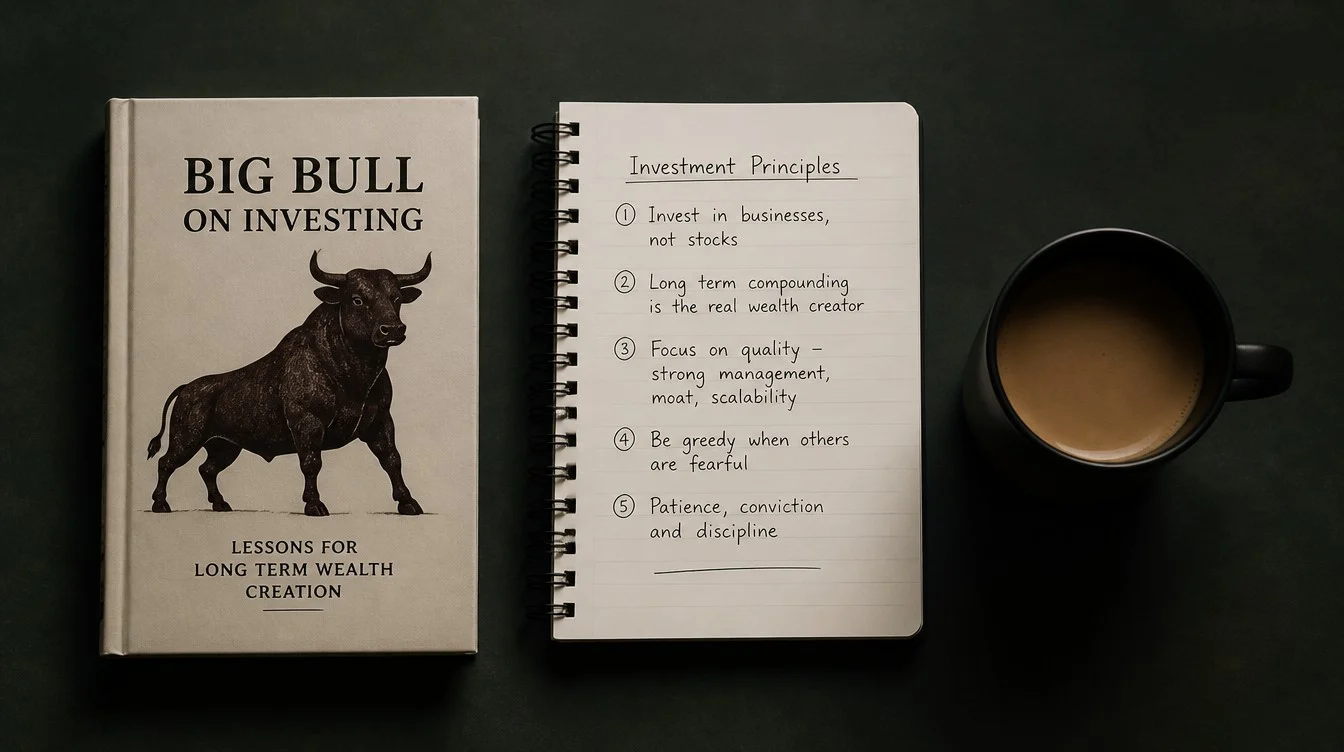
Jhunjhunwala ran a concentrated portfolio. At various points, his top 5 holdings represented 70-80% of his total equity value. He was explicit that over-diversification was a mistake for investors with genuine analytical conviction; spreading 30 positions across a portfolio means no single insight materially moves the needle. His view: If you are going to do the work to understand a business deeply, take a position large enough that being right matters.
His portfolio at the time of his death in 2022 included approximately 30 listed equity holdings, but 80% of the value was concentrated in 5-6 names. This structure, a core of high-conviction large positions plus a tail of smaller exploratory bets, is a practical template for Indian investors managing a significant equity portfolio.
What Retail Investors Can Apply from Jhunjhunwala’s Framework
Not everything about Jhunjhunwala’s approach is replicable. He had access to management that retail investors lack, a trader’s income that allowed him to weather multi-year drawdowns, and a risk tolerance forged by decades of market cycles. But several elements translate directly.
Build a Long-Term India View
The most replicable element is the macro framework. India’s demographic dividend, financial inclusion drive, infrastructure investment, and manufacturing sector growth represent genuine structural tailwinds for the next two decades. Investors who stay confident in this macro story during the inevitable short-term crises, currency stress, inflation spikes, and political uncertainty will build wealth over time, while those who leave at each scare will lose money. The mathematics of financial independence in India work precisely because Indian equity’s long-term return trajectory is among the world’s highest for a large, stable economy.
Find Your Own Titan
The Titan investment was available to every retail investor in India during 2002-2003. The research required was not complex: Tata Group brand quality, organized jewelry market potential, and basic valuation work on a temporarily depressed stock. What was rare was the conviction to hold through 20 years of volatility. The equivalent opportunities exist in India today in sectors that are undergoing structural transitions: financial services penetration in rural India, healthcare delivery and insurance, domestic defense manufacturing, and data infrastructure. The analytical work required is the same; the holding discipline is what most investors lack.
Accept Concentration as a Feature, Not a Bug
Jhunjhunwala’s returns came from concentration. A portfolio of 30 equally weighted positions will never produce the kind of wealth he built, regardless of how exceptional the individual stock picks are. The practical implication: identify your 4-5 highest-conviction ideas, size them meaningfully (10-20% each), and accept that the portfolio will be volatile. The volatility is the price of the return. Diversifying into asset classes like REITs makes sense as a portion of a total portfolio, but within the equity sleeve, concentration in the best ideas is what generates wealth.
Jhunjhunwala’s Views on Common Investor Mistakes
Over three decades of public interviews and speeches, Jhunjhunwala was consistently candid about the mistakes he saw Indian retail investors making. His observations are as relevant today as when he first made them.
Trading Instead of Investing
He was vocally critical of the Indian retail investor’s tendency to trade actively, buying on tips, selling on short-term moves, and confusing market activity with investment insight. His view: trading income goes to brokers and the taxman. Investment returns compound for shareholders. The distinction is not philosophical; it is mathematical.
Panic Selling in Bear Markets
Jhunjhunwala described India’s periodic bear markets as “gift “”shops”—opportunities to buy great businesses at temporarily reduced prices. His 2008-2009 purchases and his 2013 contrarian calls were both expressions of this view. He argued that investors who sold during corrections were not protecting capital – they were transferring it to buyers with longer time horizons and stronger conviction.
Not Trusting India’s Growth Story
His most repeated criticism of Indian retail investors was their tendency to underestimate India’s long-term growth potential. He believed most Indian investors were too ready to believe pessimistic forecasts about India’s prospects and too slow to recognize the genuine structural improvements in governance, infrastructure, and business environment that accumulated over decades.
Jhunjhunwala’s Approach to Risk Management and Portfolio Sizing
Risk management is the least-discussed dimension of Rakesh Jhunjhunwala’s strategy, yet it was fundamental to his ability to survive and compound through India’s most violent market cycles. He operated without the institutional safety net that professional fund managers take for granted: no compliance department, no redemption pressure, and no benchmarking obligation. His risk management was entirely self-imposed, which made it both more disciplined and more revealing.
The Leverage Question
Jhunjhunwala was explicitly opposed to using borrowed money for long-term equity investment. His views on leverage were shaped by his early observation of the Harshad Mehta episode and reinforced through every subsequent market cycle. Leverage forces selling at exactly the wrong moment when markets are most distressed and prices are most attractive because margin calls are indifferent to whether the selling is strategically sound. His core capital was always unleveraged equity, held without the threat of forced liquidation.
He did engage in derivatives trading as a short-term activity, but he kept that capital mentally and practically separate from his long-term equity portfolio. This distinction – active trading as one activity and long-term compounding as another, with clearly separated capital – is a practical structure that serious retail investors can adopt. Mixing trading and investing capital in a single account is a structural mistake that guarantees behavioral interference between the two activities.
Cash Allocation as a Risk Tool
Jhunjhunwala maintained significant cash positions during periods when he found valuations stretched across the broad market. He was not a fully invested, always-allocated investor. During the frothy late stages of bull markets 2007-2008 and parts of 2021, he publicly stated that he found it difficult to deploy fresh capital because his return criteria could not be met at prevailing prices. This willingness to hold cash rather than invest at poor prices is a form of capital preservation that most retail investors find psychologically difficult but that meaningfully reduces drawdown depth in subsequent corrections.
The Stop-Loss Question for Long-Term Investors
One of his most counterintuitive views was on stop-losses in a long-term context. He argued that mechanical stop-losses, selling when the price drops 15%, for example, are appropriate for traders but actively harmful for long-term equity investors. The reason: a 30% decline in the price of a fundamentally strong business is not a signal that the investment thesis is wrong. It is almost always a signal that the market is temporarily wrong. Selling because a price level has been breached destroys the holding discipline that produces long-term returns.
His equivalent of a stop-loss was thesis deterioration, not price movement. He sold a position when the underlying business quality deteriorated – when management proved dishonest, when a structural competitive advantage was genuinely eroded, when the total addressable market shrank unexpectedly, or when capital allocation decisions suggested that management was no longer acting in shareholders’ interests. None of those triggers are price-based. Loss aversion bias makes price-based selling feel rational but is one of the primary reasons individual investors systematically underperform the market indices they are invested in.
Portfolio Review Cadence
Jhunjhunwala reviewed his long-term portfolio positions annually, not quarterly. He explicitly stated that quarterly earnings provided too granular a view for the businesses he owned on 5-10 year theses. He used annual reviews to ask a simple question: has anything changed in the past 12 months that materially undermines the thesis I bought this business on? If the answer was no, the position was held regardless of its price performance over the period.
This annual review cadence dramatically reduces the noise-to-signal ratio in the investment decision process. Most retail investors review their portfolios too frequently, weekly or even daily, which means they are constantly reacting to price movements rather than business developments. Matching your review cadence to your investment horizon is a structural discipline improvement that requires no analytical skill and produces measurable behavioral benefits.
Applying the Jhunjhunwala Framework to Indian Stocks in 2026
Jhunjhunwala built his fortune in the Indian equity market through cycles that spanned from a Sensex level of 150 in 1985 to over 70,000 by the time of his death. The specific stocks and sectors have changed, but the analytical framework he used remains directly applicable to the Indian equity market of 2026.
Identifying Structural Growth Sectors Today
Jhunjhunwala’s method began with sector selection based on structural themes rather than cyclical momentum. The equivalent exercise for 2026 means identifying sectors where India’s domestic structural drivers – not global tailwinds – will expand the total addressable market over the next decade regardless of global economic conditions. Sectors that meet this criterion in 2026 include organized healthcare and diagnostics (India’s healthcare spend as a percentage of GDP remains well below the global average), domestic defense manufacturing (the government’s Make in India defense initiative represents a multi-decade import substitution program), rural financial services (credit and insurance penetration in semi-urban and rural India remains structurally low), and data center infrastructure (India’s digital economy is generating server and storage demand growing at 30%+ annually with no domestic supply base yet established).
The Business Quality Checklist Applied to Small-Caps
Jhunjhunwala’s most fertile ground in the early years was Indian small- and mid-cap companies, where institutional research coverage was thin and pricing inefficiencies were largest. The same opportunity exists today. His four-point quality checklist, a large addressable market, a sustainable competitive advantage, proven management integrity, and a specific earnings growth mechanism, can be applied systematically to BSE small-cap stocks with market capitalization below Rs 5,000 crore.
The most common disqualifying factor at the small-cap level is management quality. Promoter pledging levels above 30-40% of the promoter’s holding, repeated related-party transactions at non-arm’s-length prices, auditor changes without clear explanation, and working capital cycles that expand without revenue growth are all red flags that Jhunjhunwala would have used as instant disqualifiers. Building a multi-asset portfolio for long-term financial security requires this kind of rigorous quality screening as the foundation of the equity selection process.
Valuation Discipline in an Expensive Market
One of the most relevant applications of Jhunjhunwala’s framework to 2026 is his approach to valuation discipline when broad market valuations are elevated. India’s market has traded at premium valuations relative to historical averages through much of 2024-2025 as domestic mutual fund inflows sustained prices despite earnings growth that lagged expectations in some sectors. His response to such conditions was to concentrate on the stocks where individual business quality was so demonstrably superior that a reasonable valuation premium was justified, while keeping cash ready for the inevitable correction that would bring prices back toward intrinsic value.
For 2026 investors, the practical implication is to resist the momentum chase of buying whatever has gone up most recently because it has gone up and instead apply the earnings growth rate vs. PE multiple discipline. His rough rule: a stock’s PE ratio should not exceed twice its earnings growth rate in percentage terms. A business growing earnings at 20% annually can justify a PE of 40. At 25x PE on 10% earnings growth, even a good business represents poor expected return. Understanding the tax implications of your investment decisions is the final piece of the value-creation equation: pre-tax returns that are systematically eroded by short-term capital gains tax on frequent trading underperform the compounded after-tax returns of patient, long-term holding.
The Comparison Table: Jhunjhunwala Criteria vs. Typical Retail Investor Behaviour
| Dimension | Jhunjhunwala Approach | Typical Retail Investor Behaviour |
|---|---|---|
| Holding period | 5-20 years for core positions | 6-18 months before selling on tips or fear |
| Portfolio concentration | Top 5 holdings = 70-80% of equity value | 20-40 holdings with no position above 5% |
| Sell trigger | Business deterioration, not price decline | A price decline of 15-20% triggers panic selling |
| Macro view | Structural India bull with 20-year horizon | Changes every 6-12 months based on news flow |
| Leverage usage | None in long-term equity portfolio | Margin and F&O positions mixed with equity |
| Portfolio review frequency | Annual for long-term positions | Daily checking, weekly repositioning |
| Entry price discipline | Wait years for the right price | Chase price breakouts and momentum |
| Management assessment | Qualitative, multi-year track record | Most recent quarter’s EPS vs. estimate |
Frequently Asked Questions
What was Rakesh Jhunjhunwala’s investment strategy?
Jhunjhunwala’s strategy combined strong macro conviction in India’s long-run growth with rigorous bottoms-up stock analysis. He looked for businesses with large addressable markets, sustainable competitive advantages, and demonstrated management quality, and bought them at prices that provided a margin of safety relative to his estimate of intrinsic value. He held positions for years or decades, added during drawdowns, and ran a concentrated portfolio where his best ideas represented the majority of his capital.
Which was Rakesh Jhunjhunwala’s best investment?
Titan Company is widely considered his best investment. He began accumulating shares around 2002-2003 at prices adjusted to roughly Rs 3-6 per share and held the position for approximately 20 years. By the time of his death in August 2022, the position was worth approximately Rs 11,000 crore, representing a return of roughly 2,000x on his cost basis, one of the most profitable long-term equity positions in Indian market history.
How did Rakesh Jhunjhunwala start investing?
He started investing in 1985 with Rs 5,000 borrowed from his brother while working as a chartered accountant. His first trades were in individual stocks based on his own fundamental analysis. He did not have institutional backing, a large capital base, or access to professional research tools. He built his position over many years through his own trading income (he was an active trader in addition to a long-term investor) and early investment profits that he reinvested into his equity portfolio.
What sectors did Rakesh Jhunjhunwala favor?
He favored sectors tied to India’s domestic consumption and economic development story: consumer branded goods, financial services, pharmaceuticals, infrastructure, and eventually aviation. He was skeptical of highly capital-intensive businesses with thin margins and commodity businesses where pricing power was absent. His portfolio was consistently tilted toward businesses with strong brands, pricing power, and long runways of domestic market growth.
What can retail investors learn from Rakesh Jhunjhunwala?
The most important lessons are to maintain conviction in India’s long-run growth story through short-term volatility; find businesses with structural competitive advantages in large, growing markets; hold positions with patience through drawdowns when the underlying thesis is intact; accept concentration as necessary to generate meaningful returns; and treat market corrections as opportunities rather than threats. His career demonstrated that ordinary capital, applied with extraordinary discipline and conviction over long periods, can build extraordinary wealth in Indian equity markets.
Related Articles
- Warren Buffett Investment Strategy: Value Investing for India
- SIP vs Lumpsum: What Rs 10,000 Looks Like After 20 Years
- FIRE Movement India: Retire by 45