

Index Funds India: Complete Beginner to Advanced Guide (2025)
This guide covers index funds india from first principles to advanced strategy. Index funds are mutual fund schemes that track a market index – Nifty 50, Sensex, Nifty Next 50, Nifty Midcap 150 – by holding the same stocks in the same proportions. They don’t try to beat the market; they try to match it at the lowest possible cost. For Indian retail investors, this simple strategy has outperformed most actively managed funds over 10-20 year periods. This guide explains how index funds work, why they win over time, how to select the right index, how to compare tracking error, and how to build a complete portfolio using only index funds.
What Are Index Funds and How Do Index Funds Work?
An index fund is a mutual fund or ETF that replicates a specific market index. The fund manager’s job is not to pick stocks – it is to hold every stock in the index at the index’s specified weight, buy more when stocks enter the index, sell when stocks exit, and minimize costs. The Nifty 50 index, for example, contains 50 large-cap Indian companies weighted by free-float market capitalization. A Nifty 50 index fund buys all 50 stocks in the same proportions and rebalances whenever the index changes its composition (typically every six months).
This passive approach has structural advantages over active fund management. Active fund managers must: research stocks, make buy/sell decisions, manage portfolio risk, and generate enough alpha to cover their higher fees. Most fail to consistently outperform a simple index fund after accounting for their expense ratios, which range from 0.5% to 2.5% annually. Index funds charge 0.05-0.20% annually, leaving more returns for investors.
Index Fund vs ETF: The Practical Difference
Index funds and ETFs both track indices, but they differ in how you buy and sell them. An index fund (mutual fund form) is bought and redeemed at end-of-day NAV directly from the AMC or through a mutual fund distributor/platform. No demat account needed, SIP is available, and transactions happen at NAV regardless of intraday price movements. An ETF trades on a stock exchange like a share – price fluctuates during market hours, you need a demat account, and you pay brokerage on each transaction. For long-term systematic investors, index funds (mutual fund form) are typically more practical than ETFs. For investors who want intraday flexibility or already manage a demat account, ETFs offer slightly lower expense ratios.
Why Index Funds Outperform Active Funds in India
The evidence for passive investing in India has strengthened significantly over the past decade. Multiple SPIVA (S&P Indices Versus Active) India scorecards show that 70-85% of large-cap active funds underperform their benchmark index over 5-10 year periods after fees. Why does this happen?
- The arithmetic of active management: All investors together hold the entire market. For every active fund that outperforms the index, another active fund must underperform by the same amount. After fees, the average active fund must underperform the index by the amount of its fees. This is a mathematical certainty, not an opinion.
- Market efficiency has improved: Indian large-cap stocks are now well-researched by thousands of analysts, institutional investors, and algorithms. Finding consistently mispriced stocks in this segment is harder than it was 15-20 years ago. The alpha opportunity has shrunk as the market has matured.
- Survivorship bias understates underperformance: When you look at 10-year active fund returns, you only see funds that survived. Funds that performed poorly were merged or shut down. The true underperformance of the average active fund is worse than published data suggests.
- Expense ratio compounding: A 1.5% higher annual expense ratio (typical active vs index) on a Rs 10 lakh investment compounding for 20 years means approximately Rs 4.7 lakh less wealth at the end, assuming identical gross returns.

Major Indices for Index Funds in India
Understanding which index to track is the first decision in index fund investing. The major options:
Nifty 50: The Core Large-Cap Index
The Nifty 50 represents the 50 largest companies by free-float market capitalization listed on the National Stock Exchange. Together, these 50 companies represent approximately 65-70% of the total market capitalization of all NSE-listed companies. The index is diversified across sectors – financials, IT, consumer goods, energy, automobiles. For any investor building an India equity portfolio, a Nifty 50 index fund is the starting point. It is the most liquid, most replicated index in India with the lowest tracking error.
Sensex: The BSE Equivalent
The Sensex (S&P BSE Sensex) tracks 30 large-cap companies on the Bombay Stock Exchange. It has very high overlap with the Nifty 50 – approximately 25-27 of the 30 Sensex stocks are also in the Nifty 50. There is no meaningful diversification benefit to holding both a Nifty 50 and a Sensex index fund. Choose one. Most investors prefer Nifty 50 index funds due to higher fund sizes and more competition between AMCs (which drives down expense ratios).
Nifty Next 50: The Large-Cap Expansion
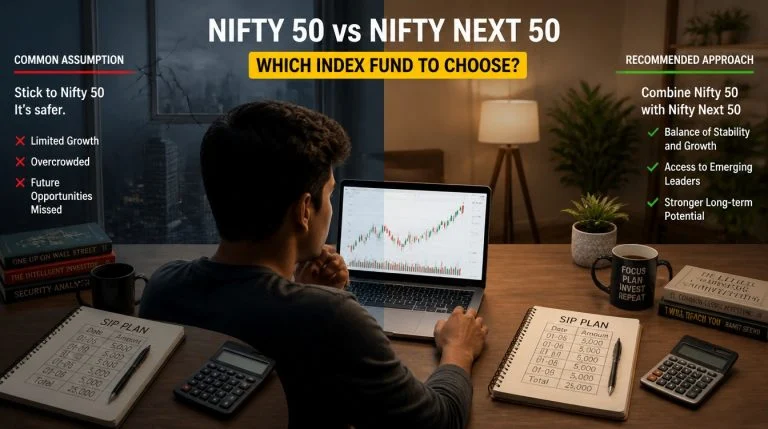
The Nifty Next 50 tracks stocks ranked 51-100 by market cap on NSE. These are the companies just outside the Nifty 50 – large companies but not the very largest. The Nifty Next 50 has historically been more volatile than the Nifty 50 but has delivered higher long-term returns (though with larger drawdowns). It is a complement to Nifty 50, not a replacement. A common allocation is Nifty 50 (core position) + Nifty Next 50 (satellite position for higher growth potential).
Nifty Midcap 150: The Mid-Cap Index
The Nifty Midcap 150 tracks stocks ranked 101-250 by market cap. Midcap companies are smaller than large-caps, with higher growth potential and higher volatility. Over 15-20 year horizons, midcap indices have often outperformed large-cap indices in India (though the path is much bumpier). Midcap index funds are suitable as a satellite allocation for investors with 10+ year horizons who can tolerate larger drawdowns (40-50% declines during bear markets versus 30-35% for large-cap indices).
Nifty Smallcap 250: The Small-Cap Index
The Nifty Smallcap 250 tracks stocks ranked 251-500 by market cap. Smallcap indices have the highest historical return potential but also the highest volatility. Liquidity during market stress periods can be poor – small companies may see large price swings on limited trading. Smallcap index funds are suitable only for investors with 15+ year horizons who fully understand that 50-60% drawdowns are possible.
Nifty 500: The Broad Market Index
The Nifty 500 tracks the top 500 companies by market cap and provides the broadest representation of the Indian equity market. A Nifty 500 index fund in one fund gives you exposure to large, mid, and small caps proportional to their market weights. This is the simplest “one-fund” equity solution for investors who want complete market exposure without building a multi-fund portfolio.
How to Compare and Select Index Funds
Multiple AMCs offer index funds tracking the same index. How do you choose between Nifty 50 funds from SBI, HDFC, Nippon, UTI, ICICI, Axis? These three metrics matter:
| Metric | What It Measures | What to Look For |
|---|---|---|
| Expense Ratio | Annual cost as % of AUM | Lower is better; aim below 0.15% for large-cap |
| Tracking Error | How much the fund’s daily return deviates from the index | Lower is better; below 0.10% annually is excellent |
| Tracking Difference | Annual gap between index return and fund return | Should be close to (but may be less than) expense ratio |
| AUM Size | Total assets managed | Larger AUM usually means better trading efficiency and lower costs |
Tracking error and tracking difference are the most important metrics because a fund can have a low expense ratio but still have high tracking error (causing you to miss index returns) or high tracking difference (meaning your actual return is much below the index). Always check both. A fund with 0.20% expense ratio but 0.05% tracking difference is often better than a fund with 0.10% expense ratio but 0.35% tracking difference.

Building an Index Fund Portfolio: Allocation Strategies
Index fund investing works best when combined into a deliberate portfolio allocation. Three common approaches for Indian investors:
The Single-Fund Portfolio
Invest 100% in a Nifty 500 or Nifty 50 index fund. This is the simplest approach – one fund, one SIP, one allocation to track. The entire India equity market in a single instrument. Most appropriate for early investors just starting out, investors who want maximum simplicity, or investors with smaller portfolios where the benefit of diversifying across multiple index funds is minimal.
The Two-Fund Portfolio
Combine a Nifty 50 index fund (70-80%) with a Nifty Next 50 or Nifty Midcap 150 fund (20-30%). This adds exposure to faster-growing but more volatile companies while keeping the large-cap core stable. Systematic investment across these two funds captures the long-run premium of mid and smaller-cap companies while the large-cap core limits volatility.
The Three-Fund Portfolio
Large-cap index fund (60%) + Midcap index fund (25%) + International index fund (15%). This is the most diversified approach – covers Indian large-caps, Indian mid-caps, and global markets. The international component adds currency diversification and exposure to companies and sectors not well-represented in India (US tech, European consumer goods, Japanese manufacturing). For investors also considering real estate, replacing or reducing the midcap allocation with a REIT can further diversify beyond equities.
Index Funds and Tax Treatment in India
Index funds (mutual fund form) are taxed as equity mutual funds:
- Short-term capital gains (less than 1 year): Taxed at 20% (post-Budget 2024 rate increase from 15%).
- Long-term capital gains (1+ year): Taxed at 12.5% on gains above Rs 1.25 lakh per financial year (exemption raised from Rs 1 lakh). Long-term gains up to Rs 1.25 lakh per year are completely tax-free.
- Dividend option: Dividends added to income, taxed at slab rate. Always choose growth option for long-term investing.
- SIP taxation: Each SIP installment is treated as a separate investment. For LTCG purposes, each installment becomes eligible for LTCG treatment one year after its purchase date, not from the start of the SIP.
The Rs 1.25 lakh annual LTCG exemption can be used strategically. Each financial year, you can sell enough index fund units to realize up to Rs 1.25 lakh in gains, then immediately reinvest (a process sometimes called “harvesting”). This resets your cost basis higher, reducing future LTCG tax. This is best done in March before the financial year ends. Under both new and old tax regimes, the LTCG rate on equity funds is 12.5%, so this tax harvesting strategy applies regardless of which regime you follow.
Common Mistakes in Index Fund Investing
Index fund investing appears simple but investors still make systematic errors:
- Switching funds after underperformance: Index funds tracking the same index have nearly identical returns. There is rarely a good reason to switch. Transaction costs and tax events from switching typically outweigh any benefit.
- Adding too many index funds: Buying 5 different large-cap index funds does not diversify you further – they track the same index with 90%+ overlap. One Nifty 50 fund is sufficient for large-cap exposure. Adding more large-cap funds is redundant.
- Pausing SIP during market downturns: Market falls are exactly when SIP averaging is most beneficial. Pausing a SIP during a crash means missing the opportunity to buy more units at lower prices. Historical data shows that SIP investors who continue through downturns outperform those who pause.
- Chasing past performance across fund categories: If midcap indices outperformed last year, many investors shift allocation heavily to midcap. This typically means buying after the run-up, at higher valuations. Maintain your target allocation and rebalance, rather than chasing recent winners.
- Ignoring international diversification: India is one equity market. A global portfolio that includes international exposure is more diversified. The US technology sector (Nasdaq 100, S&P 500) has limited representation in Indian indices but significant global relevance.

Index Funds for Long-Term Wealth Creation
The compounding mathematics of index funds over long horizons is powerful. Consider a monthly SIP of Rs 10,000 in a Nifty 50 index fund starting at age 25:
- At 12% annual return (approximate Nifty 50 historical CAGR), Rs 10,000/month over 35 years (to age 60) = total invested Rs 42 lakh, final corpus approximately Rs 6.4 crore.
- At the same 12% return with an active fund charging 1.5% more = approximately Rs 4.1 crore final corpus.
- The cost difference = Rs 2.3 crore on the same underlying market return. This is the price of trying to beat the index and failing.
These numbers illustrate why Warren Buffett recommended low-cost index funds for most investors in his will (directing that 90% of his wife’s inheritance be invested in a low-cost S&P 500 index fund). The Indian equivalent recommendation for an Indian retail investor is exactly the same: a low-cost Nifty 50 or Nifty 500 index fund, held for decades, with SIP running through all market cycles.
Getting Started: Practical Steps to Buy Index Funds India
Starting index fund investing in India takes under 30 minutes:
- Choose a platform: Direct plans are available on each AMC’s own website, or through aggregators like MF Central, Coin by Zerodha, Groww, Paytm Money, or ET Money. Direct plans have no distributor commission and are cheaper than regular plans.
- Complete KYC: PAN card and Aadhaar required. Most platforms support eKYC via video or OTP. Takes 5-15 minutes if you have digital documents ready.
- Choose your fund: Start with one Nifty 50 or Nifty 500 index fund. Check expense ratio (below 0.15% for Nifty 50 direct plans) and AUM size (prefer funds above Rs 5,000 crore for large-cap indices).
- Set up SIP: Choose a monthly SIP amount. Rs 500 minimum is available on most platforms. Set the SIP date to a few days after your salary credit date. Authorize the NACH mandate through your bank. Done.
- Monitor annually, not daily: Index fund investing works through time, not through frequent adjustments. Check your portfolio once a year, rebalance if allocations have drifted more than 5% from target, then leave it alone.
Index Funds and Market Cycles: Staying Invested Through Volatility
The most common failure mode in index fund investing is behavioral, not analytical. Investors understand intellectually that markets recover, but they sell during sharp drawdowns out of fear. Understanding historical market cycles helps build the conviction to stay invested.
The Nifty 50 has experienced several major drawdowns since its inception: the dot-com crash (2000-2002, approximately 55% peak-to-trough decline), the global financial crisis (2008, approximately 60% decline), the COVID crash (March 2020, approximately 38% decline in weeks). In every instance, the index eventually recovered and reached new highs. The 2008 crash, which felt catastrophic, was fully recovered within 2 years. Investors who stayed invested through the COVID crash recovered all losses within 6 months and then earned additional gains as markets rallied strongly through 2021.
The mathematical reality: a 40% drawdown requires a 67% recovery to break even. A 50% drawdown requires a 100% recovery. This means drawdowns hurt more on the way down than the same percentage gain helps on the way up. However, for long-term investors, this asymmetry works in your favor when you stay invested: you own more units after buying at lower prices during the drawdown, and the eventual recovery applies to those additional units as well. This is the core mechanism through which SIP investing through market cycles creates outperformance.
Sector-Specific Index Funds: When to Use Them
Beyond broad market indices, SEBI-regulated thematic and sector index funds track specific sectors: Nifty Bank, Nifty IT, Nifty Pharma, Nifty PSU Bank, Nifty FMCG. These concentrated sector funds are appropriate only for investors who:
- Have a specific, informed view on a sector’s multi-year growth trajectory.
- Already hold a broad Nifty 50/500 core position and are adding a sector satellite.
- Understand that sector funds can and do underperform for extended periods (Nifty Bank underperformed the broader market significantly during stress periods; Nifty IT was extremely volatile during global tech corrections).
Sector index funds are not recommended as primary holdings. They concentrate risk in one sector and can underperform the broader market for 3-5 years at a stretch. If you have no specific reason to overweight a sector, a broad-market Nifty 50 or Nifty 500 fund provides better diversification at lower conceptual complexity.
Factor Index Funds: Smart Beta Investing
Factor index funds (also called smart beta funds) track indices that select or weight stocks based on specific factors rather than pure market capitalization. Common factor indices in India include:
- Nifty 50 Value 20: Selects 20 value stocks from the Nifty 50 based on price-to-earnings, price-to-book, and dividend yield.
- Nifty 100 Quality 30: Selects 30 stocks with high return on equity, low debt, and stable earnings.
- Nifty Alpha 50: Selects stocks with the highest 1-year price appreciation (momentum).
- Nifty Low Volatility 50: Selects 50 stocks with the lowest historical price volatility.
Factor investing has academic support – value, quality, and low-volatility factors have historically generated returns above the market-cap weighted index over long periods. However, factors also have extended periods of underperformance versus the broad market (the value factor underperformed growth for most of the 2010s globally). Factor index funds are appropriate for investors who understand the specific factor’s historical behavior and can tolerate multi-year underperformance periods. For most beginning investors, starting with broad-market Nifty 50 or Nifty 500 is more appropriate than immediately allocating to factor index funds.
International Index Funds from India
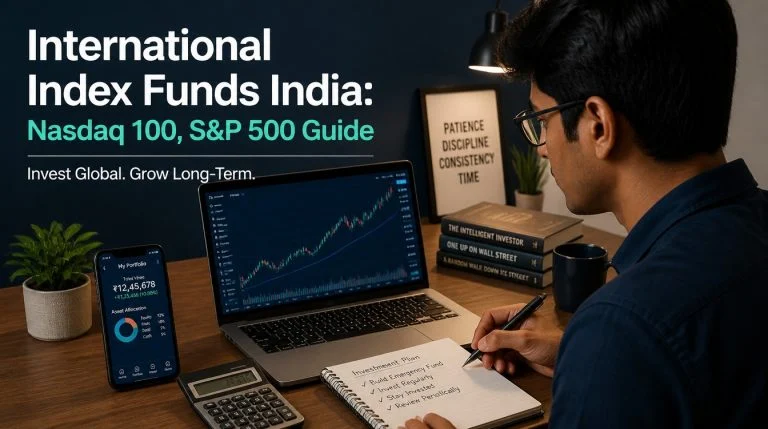
International index funds track indices from other markets – the Nasdaq 100, S&P 500, MSCI World, MSCI Emerging Markets, Nikkei 225. Available as funds-of-funds investing in a US or global ETF, or as direct international ETFs on Indian exchanges.
The key benefit is diversification beyond India. Indian large-cap indices are heavily weighted toward financials (banks, insurance), IT services, energy, and consumer goods. They have minimal exposure to global technology (semiconductor companies, AI-focused companies, global ecommerce), healthcare biotechnology, and consumer brands with global reach. Adding 10-20% international index fund exposure complements the India-centric allocation.
SEBI has placed limits on overseas investments by mutual funds (a cumulative industry-wide limit). When this limit is approached, some international fund of funds temporarily stop accepting new investments. Investors should check current availability before planning significant international allocations. For investors exploring all alternative asset classes beyond equity, understanding each asset’s tax treatment and regulatory status is essential.
Direct Plans vs Regular Plans for Index Funds
Every index fund in India is available in two variants: direct plan and regular plan. The difference is significant for long-term wealth.
Regular plan: Purchased through a distributor (bank, advisor, mutual fund agent). Includes a commission paid to the distributor, embedded in the expense ratio. The total expense ratio (TER) for a regular plan index fund is typically 0.30-0.50% higher than the direct plan of the same fund.
Direct plan: Purchased directly from the AMC, through MF Central, or through direct-plan platforms like Zerodha Coin, Paytm Money, or the AMC’s own website. No distributor commission. Lower TER by 0.30-0.50% per year.
For index funds, this distinction is especially important. An index fund’s entire advantage over active funds is its low cost. If you buy a Nifty 50 index fund in the regular plan at 0.40% TER instead of the direct plan at 0.10% TER, you are paying 4 times the cost for the same index exposure. Over 20 years, on Rs 50 lakh corpus, the 0.30% annual difference in TER compounds to approximately Rs 3.5-4 lakh in additional wealth. Always buy index funds through direct plans. The only reason to use a regular plan index fund is if you are getting genuine financial planning advice from the distributor that justifies the higher cost – for most investors, this is not the case for index funds specifically.
Direct plan investing requires a small one-time effort to set up – completing KYC on a direct platform, linking your bank account, setting up the NACH mandate for SIP. Once set up, the process runs automatically with no ongoing action needed.
Index Fund Investing for Different Financial Goals
Index funds are suitable for multiple financial goals depending on time horizon and risk tolerance:
- Retirement corpus (20-35 year horizon): Core equity allocation through Nifty 50 or Nifty 500 index fund SIP. The longest horizon allows maximum equity exposure and the compounding effect is greatest. Reduce equity allocation gradually as retirement approaches.
- Child’s education fund (10-15 year horizon): Index fund SIP from birth (or from when you start planning) gives 10-15 years for equity to work. Start with high equity allocation (80%), shift toward debt as the goal date approaches. Do not invest education funds in equity for goals less than 5 years away.
- House down payment (5-10 year horizon): Partial index fund allocation (40-50%) with remainder in debt. Equity helps build corpus faster but maintaining liquidity is important. Shift more to debt as the purchase date becomes certain and near.
- Emergency fund: Index funds are not appropriate for emergency funds – equity can be down 30-40% exactly when you need emergency money. Use liquid debt funds or high-yield savings accounts for emergency reserves.
Index Fund Rebalancing: Annual Portfolio Review Process
Index fund portfolios require periodic rebalancing to maintain target allocations. The process:
- Annual review date: Choose a fixed date each year (example: every January 1, or after filing your ITR in July). Review your full portfolio allocation across equity, debt, and gold.
- Calculate drift: If your target is 70% equity index funds and equity has risen to 80% due to market gains, you have drifted 10 percentage points above target.
- Decision threshold: Only rebalance if drift exceeds 5 percentage points from target. Minor drifts do not justify transaction costs and tax events.
- Rebalance using new flows first: Direct new SIP and lumpsum investments into underweight assets to restore balance without selling. This avoids tax events.
- Sell to rebalance only if necessary: If cash flows cannot restore balance within a reasonable period, sell the overweight asset. This triggers capital gains tax, so calculate the net benefit before selling.
Annual rebalancing combined with the tax harvesting strategy (realizing up to Rs 1.25 lakh LTCG each year tax-free) makes index fund portfolio management systematic and tax-efficient. Both processes can be completed in under 2 hours once a year. For investors with NPS or long-term retirement accounts, coordinating index fund rebalancing with retirement account contributions ensures the overall portfolio stays on target.
Frequently Asked Questions
Are index funds safe for beginners in India?
Index funds are equity investments and will decline during market downturns – they are not “safe” in the way a bank FD is safe. However, they are appropriate for beginners because they require no stock-picking knowledge, have minimal fees, track the market transparently, and have historically delivered strong returns over 10+ year horizons. The risk is equity market risk (the entire index can fall 30-50% during bear markets), which is the same risk you take with any equity mutual fund. The right question is not “are index funds safe?” but “can I stay invested through a 40% drawdown without panic-selling?” If yes, index funds are appropriate.
What is the minimum SIP for index funds in India?
Most index funds allow SIPs starting at Rs 100-500 per month. Nifty 50 index funds from SBI, HDFC, UTI, and Nippon all allow Rs 100/month minimum SIP in direct plans. There is no maximum limit. For optimal compounding results, invest as much as you can consistently each month, but starting with even Rs 500/month builds the habit and starts the compounding clock.
Which is better: Nifty 50 or Nifty 500 index fund?
For most investors, a Nifty 500 index fund provides better diversification as it includes mid and small-cap companies alongside large-caps. However, Nifty 50 funds typically have lower expense ratios (more competition, larger AUMs) and lower tracking error. A practical approach: use a Nifty 50 fund as the primary holding (70-80% of equity allocation) and add a separate midcap index fund for the remaining 20-30%, which gives you more control over the large vs mid allocation than a Nifty 500 fund provides.
How do I check tracking error of an index fund?
Tracking error data is published monthly in the fund’s factsheet (available on the AMC website). Many platforms like Value Research, Morningstar India, and Groww also display tracking error and tracking difference in the fund analysis section. For a Nifty 50 index fund, annual tracking error below 0.10% is excellent, 0.10-0.20% is acceptable, and above 0.20% suggests the fund is not managing its passive mandate efficiently. Check tracking difference (total annual underperformance vs index) in addition to tracking error.
Can I build wealth with only index funds?
Yes. A well-constructed index fund portfolio – Nifty 50 or Nifty 500 for core India equity, with some international exposure – is sufficient for long-term wealth creation for most retail investors. Many successful investors globally (and increasingly in India) build their entire equity portfolio using only index funds. The simplicity is a feature: fewer decisions, fewer opportunities to make behavioral mistakes, and systematically lower costs versus trying to select active funds. Add debt allocation (for stability) and gold (for inflation hedge) to complete a full portfolio.
Related Articles
- SIP vs Lumpsum: 20-Year Backtest
- New Tax Regime vs Old Tax Regime 2026
- REIT Investment India: Complete Guide