
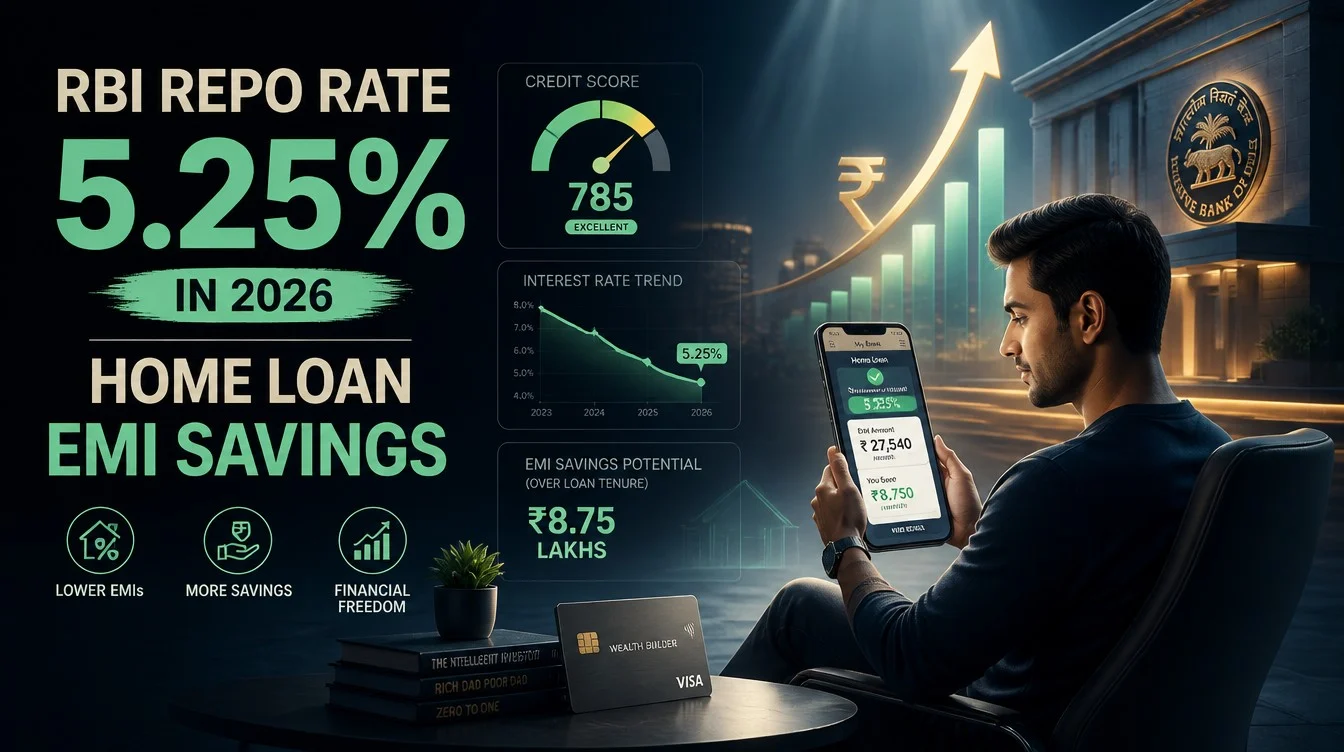
The April 2026 Monetary Policy Committee meeting did something quietly powerful for Indian home loan borrowers. The RBI repo rate home loan emi 2026 story is no longer about waiting for the next cut. The Reserve Bank of India held the repo rate at 5.25% with a neutral stance, locking in a cumulative reduction of 125 basis points delivered since February 2025. For floating-rate borrowers on the External Benchmark Lending Rate (EBLR) framework, that cycle is still being absorbed into EMIs and tenures.
This pillar guide walks through what the current repo rate means for monthly EMIs, how the EBLR mechanism actually transmits a cut to your loan account, and what to do if your bank has dragged its feet on the reset. Worked examples cover loans of Rs. 50 lakh, Rs. 75 lakh, and Rs. 1 crore over 20 years. The aim is plain English, India-first context, and concrete next steps for FY 2025-26 homeowners.

RBI repo rate home loan EMI 2026: what 5.25% means for borrowers
The repo rate is the rate at which the RBI lends overnight money to commercial banks against government securities. When this rate falls, banks’ cost of funds falls, and the cheaper funding is supposed to flow through to floating-rate retail loans. When it stays flat, borrowers get predictability instead of relief.
At 5.25%, the policy rate is the lowest it has been since the post-pandemic normalisation began. The Standing Deposit Facility (SDF) sits at 5.00% and the Marginal Standing Facility (MSF) at 5.50%, framing a narrow corridor that signals stability rather than active easing. The MPC’s neutral stance is a deliberate pause to watch inflation and growth data before committing to either direction.
Headline numbers a borrower should track
- Repo rate: 5.25% (held in April 2026).
- Cumulative cut since Feb 2025: 125 basis points.
- SDF / MSF corridor: 5.00% to 5.50%.
- Typical EBLR home loan rate range in 2026: 7.50% to 8.90% across major lenders.
Why the pause still favours floating-rate borrowers
Borrowers who took a loan in 2023 or early 2024 entered at a repo rate of 6.50%. Today’s 5.25% is a real change in their cost of capital. A pause at the new floor lets banks complete their EBLR resets and gives household budgets time to plan around lower outflows. In practice, the saving shows up as either a smaller EMI or a shorter tenure, depending on what the borrower chooses.
What the neutral stance signals
A neutral stance is RBI shorthand for two-way risk. Rates can move up or down depending on incoming data on inflation, the rupee, monsoon, and global oil. Borrowers should not budget on the assumption of further cuts. Instead, the planning anchor for FY 2025-26 should be: rates may stay around current levels, with a small bias either way.
How EBLR works and the 90-day reset rule explained
Since October 2019, the RBI has required all new floating-rate retail home loans from banks to be linked to an External Benchmark Lending Rate. Most lenders use the RBI repo rate as that benchmark. The final rate a borrower pays is built up as: Repo Rate + Bank Spread (which includes operating cost, credit risk premium, and any concession).
This is a real shift from the older Marginal Cost of Funds-based Lending Rate (MCLR) world, where banks had wide discretion to delay passing on cuts. EBLR forces transmission on a clock, not at the bank’s convenience.
The 90-day reset rule
RBI rules require banks to reset EBLR-linked interest rates at least once every three months. The reset date is loan-specific and depends on the date the loan was sanctioned. When the repo rate changes, the new rate is applied at the borrower’s next reset cycle, not necessarily the next day. This is why two borrowers at the same bank can see a rate cut land in different months.
How the spread is determined
The spread above the repo rate is where banks compete and where credit risk gets priced. As of mid-2026, a salaried borrower with a strong CIBIL score above 800 at a public-sector lender often sees a spread between 2.25% and 2.65%, producing an effective rate of roughly 7.50% to 7.90%. Self-employed borrowers, borrowers with shorter credit histories, or higher loan-to-value ratios may see spreads closer to 3.00% to 3.50%.
A simple worked example of EBLR pricing
Consider a salaried borrower with a CIBIL score of 790, taking a Rs. 60 lakh home loan from a large public-sector bank. The bank quotes EBLR as Repo Rate (5.25%) plus Spread (2.65%), giving an effective rate of 7.90%. If the repo were to fall by another 25 basis points at the next reset, the rate would drop to 7.65%. If the repo were to rise by 25 basis points, the rate would move to 8.15%. The spread itself stays fixed for the contractual reset window.
Floor rates and concessions
Some lenders publish a minimum EBLR floor below which the rate will not fall even if the repo continues lower. Concessions for women borrowers, public-sector employees, and certain salary-account customers are usually in the range of 5 to 10 basis points and are subject to that floor. It is worth asking the bank in writing what the floor is on your specific loan account.

EMI savings on Rs. 50 lakh, Rs. 75 lakh, and Rs. 1 crore loans
The most useful question for a borrower is not the rate but the rupee impact. The table below illustrates the EMI change for a fully indexed EBLR home loan over a 20-year tenure, moving from a pre-cycle effective rate of 9.15% (typical in early 2025) down to 7.90% after the 125 basis point cumulative cut. Numbers are rounded to the nearest rupee and use standard amortisation math.
| Loan amount | EMI at 9.15% (20 yr) | EMI at 7.90% (20 yr) | Monthly saving | Annual saving | 20-year interest saving |
|---|---|---|---|---|---|
| Rs. 50,00,000 (50 lakh) | Rs. 45,491 | Rs. 41,508 | Rs. 3,983 | Rs. 47,796 | Rs. 9,55,920 |
| Rs. 75,00,000 (75 lakh) | Rs. 68,236 | Rs. 62,262 | Rs. 5,974 | Rs. 71,688 | Rs. 14,33,760 |
| Rs. 1,00,00,000 (1 crore) | Rs. 90,982 | Rs. 83,016 | Rs. 7,966 | Rs. 95,592 | Rs. 19,11,840 |
The arithmetic is unforgiving in a good way. A Rs. 75 lakh borrower keeps almost Rs. 72,000 more in hand every year. Over the remaining tenure, that money funds either a private school fee bracket, a small SIP, or a faster prepayment plan.
Saving the EMI versus shortening the tenure
When the rate falls, banks typically keep the EMI constant and shrink the tenure. That default helps long-run interest cost but does not free up monthly cash. Borrowers who want monthly relief must explicitly request the bank to reset the EMI to the new lower amount and keep the tenure constant. Both choices are valid and depend on whether cash flow or interest cost is the bigger constraint.
The compounding effect on prepayment
If a borrower redirects the EMI saving into an annual prepayment, the tenure compresses sharply. For the Rs. 75 lakh example, an annual lump sum of Rs. 72,000 directed to principal can shave several months off the schedule each year. The exact saving depends on the timing of the prepayment within the interest accrual cycle.
What changes after a part-payment
A part-payment reduces the outstanding principal immediately. The bank then recalculates the amortisation schedule using the prevailing EBLR. Borrowers should ask for a fresh repayment schedule after every part-payment so the EMI structure and remaining tenure are clear in writing.
Fixed versus floating after the 2025-26 rate cuts
The fixed-versus-floating debate sounds simple but rarely is. Both options exist in the Indian market: pure floating linked to EBLR, pure fixed for the full tenure, and hybrid options that are fixed for the first two to five years and then convert to floating. Each fits a different borrower profile.
Floating-rate borrowers absorb both the upside and the downside of the rate cycle. With repo at 5.25% and a neutral stance, a salaried borrower with stable income is statistically better off staying floating, because the room for further cuts is constrained but the immediate EMI is already at multi-year lows.
When a fixed rate still makes sense
Fixed rates protect borrowers who cannot absorb EMI volatility. A homemaker servicing a loan from a single rental income, a freelancer with lumpy revenue, or a borrower with a tight debt-to-income ratio may prefer the certainty of a fixed EMI even at a small premium. The premium over current floating rates is typically 75 to 150 basis points, and the fixed rate often resets after a contractual window.
Hybrid fix-then-float products
A common option in 2026 is a two- or three-year fixed period that then converts to EBLR-linked floating. This shields the borrower during the early high-interest years of the amortisation schedule, where each EMI is dominated by interest rather than principal. After the fixed window, the loan behaves like any other EBLR loan.
How to decide for FY 2025-26
A simple decision rule: if the household can absorb a 100 basis point upward swing in EMI without missing other goals, floating is rational at today’s repo. If the household budget is already tight, the fixed or hybrid option pays for peace of mind and prevents stress in a future tightening cycle. Avoid switching purely on a forecast about the next two MPC meetings.
The role of credit score in the choice
A borrower with a CIBIL score above 800 gets the best spreads on floating loans, which makes the floating option even more attractive. For borrowers with scores below 720, the spread on offer is wider and the fixed alternative may be priced closer to the floating offer, narrowing the gap.
What to do if your bank has not passed on the rate cut
Despite the EBLR framework, transmission can lag. Sometimes the reset date has not arrived. Sometimes the bank has quietly absorbed part of the cut into a wider spread for new disbursals. The borrower’s job is to verify the math on their own account and push for the correct rate.
Start with the latest account statement and the bank’s published EBLR. The arithmetic is straightforward and the borrower has every right to ask for the spread to be confirmed in writing.
Step-by-step rate audit
- Pull the most recent home loan statement and note the current effective rate.
- Visit the bank’s website and find the published EBLR for the current month.
- Subtract the EBLR from the effective rate. The difference is the spread on your account.
- Compare that spread against new disbursal spreads the bank advertises for similar profiles. A wider spread on your loan is a negotiation lever.
- Request a rate-reset application in writing. Quote the relevant RBI circular on EBLR transmission if needed.
Conversion charges and spread reset fees
If the spread on your loan is materially higher than the bank’s current new-loan spread, ask for a spread reset. Many banks charge a one-time fee in the range of Rs. 1,000 to 0.50% of outstanding principal for a spread reduction. Run the break-even math: divide the fee by the new monthly EMI saving. If the payback is under twelve months, the reset is almost always worth it.
Balance transfer as a last resort
When the existing bank refuses a competitive spread, a balance transfer to a new lender becomes the practical option. Compare the all-in cost: processing fees, legal and valuation charges, stamp duty on the new loan agreement, and the duration over which the EMI saving recoups those costs. A balance transfer rarely makes sense in the last three years of a loan because the residual interest saving is small.
The RBI complaint route
If the bank ignores written requests, the borrower can escalate to the Internal Ombudsman of the bank, then to the RBI Integrated Ombudsman Scheme. Document everything in writing: statements, emails, the bank’s published EBLR for relevant months, and the written replies received.
Common mistakes Indian home loan borrowers make in 2026
Mistakes rarely come from ignorance of finance. They come from inertia, fine-print blindness, and overconfidence in a single forecast. The list below covers errors that show up repeatedly in real loan accounts.
Ignoring the reset date
The reset date on an EBLR loan is buried in the sanction letter. Borrowers who do not know their reset date often miss windows where a recent repo cut would have flowed through. Mark the next reset date in your calendar and check the statement that follows.
Assuming the EMI auto-adjusts to the lower rate
As discussed, banks default to keeping the EMI constant and shrinking the tenure. If monthly cash flow is the priority, you must write to the bank requesting an EMI reset. This is not a default behaviour.
Treating fixed rates as truly fixed for life
Many home loan products labelled “fixed” are fixed only for an initial period of two to five years, after which they convert to floating or undergo a market-linked reset. Read the sanction letter for the exact fixed window and the conversion mechanism.
Prepaying without checking foreclosure rules
Floating-rate home loans to individuals carry no foreclosure or prepayment penalty under RBI rules. Fixed-rate loans may carry a penalty in the range of 2% to 4% of the outstanding amount. Confirm the loan classification before making a large prepayment.
Skipping tax interplay
Home loan interest qualifies for deduction under Section 24(b) up to Rs. 2 lakh per year for a self-occupied property under the old tax regime. Aggressive prepayment that wipes out the interest base before other tax planning is in place may be sub-optimal. The new tax regime, which most salaried Indians may default into for FY 2025-26, does not allow this deduction for self-occupied homes.
Advanced moves for borrowers who already track their EMI closely
For borrowers comfortable with the basics, the next layer is optimisation. The strategies below assume an EBLR-linked loan, a stable salary, and a household emergency fund of at least six months of expenses.
The annual bonus part-payment strategy
Direct a fixed percentage of every annual bonus into the home loan principal. Even a 50% allocation, applied consistently, can shave years off a 20-year loan. The math works because every prepayment in the early years strikes at high-interest-weighted EMIs.
Step-up EMI alignment with salary growth
Some lenders offer a step-up EMI option that allows the borrower to increase the EMI in line with expected salary growth. A salaried borrower expecting consistent annual hikes can use this to compress the tenure without ever feeling a cash crunch in the early years.
Using a sweep-in or liquid fund alongside the loan
An emergency buffer parked in a sweep-in fixed deposit or a liquid fund earns a return that is partially neutralised by the loan rate. The point is liquidity, not arbitrage. The buffer prevents an emergency from forcing the borrower into a credit card or personal loan at 30% or more.
Reviewing the spread every twelve months
Banks rarely volunteer a spread reduction. A self-driven annual review, ideally just after the credit bureau updates the borrower’s CIBIL score, is the cheapest way to keep the loan rate competitive. Borrowers who have crossed key score thresholds (say, 750 to 800) have a strong negotiating position.
Insurance, not loan-insurance bundling
The term-insurance cover required to protect a home loan is best purchased as a standalone term policy outside the loan account. Bundled credit-life products are often more expensive per rupee of cover and may not be transferable if the borrower refinances.
How the 2026 rate cycle affects new home buyers
For someone planning a home purchase in FY 2025-26, the rate environment is one of the most favourable in five years. Affordability has improved, but property prices in many metros have also moved up, so the EMI relief partly offsets a higher ticket size.
Affordability rule of thumb
A common rule of thumb in Indian personal finance is to cap total EMIs at 40% of net monthly take-home pay, with the home loan EMI itself capped near 30%. At today’s 7.90% effective rate, a salaried borrower with a net take-home of Rs. 1,50,000 can comfortably service an EMI close to Rs. 45,000, which corresponds to a Rs. 54 lakh loan over 20 years.
Down payment versus larger loan
With rates lower, the temptation to borrow more and reduce the down payment grows. Resist that on first principles: a larger down payment reduces lifetime interest, keeps the loan-to-value ratio lower (often unlocking a better spread), and protects the borrower if property prices stagnate.
The two-loan trap
Stacking a home loan with a fresh personal loan in the same year to cover registration, interiors, or furnishing inflates monthly outflow. Plan registration costs and basic interiors into the cash-on-hand budget, not as a second credit line.
First-time buyer documentation checklist
- PAN, Aadhaar, and current address proof for all applicants.
- Last six months’ salary slips and twelve months’ bank statements.
- Form 16 for the previous two financial years.
- Property documents including the sale agreement, encumbrance certificate, and approved building plan.
- CIBIL report pulled directly from the bureau to verify there are no surprises.
Tax interplay with home loan interest in FY 2025-26
The tax angle on a home loan is regime-dependent. The new tax regime, which is the default for most salaried filers in FY 2025-26, does not allow the Section 24(b) interest deduction for a self-occupied property. The old regime still does, with the standard cap.
Section 24(b) under the old regime
Under the old regime, a self-occupied property qualifies for an interest deduction of up to Rs. 2,00,000 per financial year. A let-out property has no upper cap on the interest deduction, but the overall loss from house property that can be set off against other income is capped at Rs. 2,00,000 per year, with the balance carried forward.
Section 80C principal repayment
Principal repayment qualifies for deduction under Section 80C up to Rs. 1,50,000 per year under the old regime, within the overall 80C ceiling. This too is unavailable under the new regime.
Joint ownership and joint loans
When a couple takes a joint home loan and both are co-owners, each can independently claim the Section 24(b) and 80C deductions in proportion to their share of the EMI. This is one of the strongest tax-planning levers in the old regime and a major reason many salaried couples still prefer it.
Choosing the regime with a home loan
Run the math for both regimes in a spreadsheet before filing. The break-even point depends on the EMI structure, the share of interest in the current year, and other 80C and 80D commitments. Borrowers in the early years of a loan often find that the old regime still wins on net tax outflow, despite the higher headline slabs.
FAQ-style quick answers on the 2026 repo cycle
This block consolidates short answers to the questions readers ask most often. Featured-snippet style, written for fast scanning.
What is the home loan rate after a repo rate cut?
For an EBLR-linked floating loan, the new rate equals the latest repo rate plus the contractual spread on your account. After the cumulative 125 basis point cut between February 2025 and the April 2026 hold, most salaried borrowers with strong credit profiles are seeing effective rates in the 7.50% to 7.90% range from major banks.
How fast does the cut reach my EMI?
RBI rules require an EBLR reset at least once every three months. The cut reaches your EMI at the next reset date specified in your sanction letter, not on the day of the policy announcement.
Why is my friend’s rate lower at the same bank?
The spread above the repo rate is borrower-specific. CIBIL score, loan-to-value ratio, type of employment, and the bank’s risk policy at the time of disbursal all shape the spread. Two loans sanctioned in different quarters can carry materially different spreads.
Should I switch from MCLR to EBLR now?
If your loan is still on the older MCLR framework, the transmission lag is typically slower. The arithmetic of switching is similar to a balance transfer: weigh the conversion fee against the long-run EMI saving. For most borrowers with more than seven years remaining, switching to EBLR has paid off in this cycle.
Will rates rise again in 2026?
The MPC’s stance is neutral, which is shorthand for two-way risk. Borrowers should budget on the assumption that rates could move 25 to 50 basis points either way in the next twelve months and avoid taking on debt that only works if rates keep falling.
FAQ
Is the RBI repo rate the same as my home loan rate?
No. The repo rate is the RBI’s policy rate at which it lends to banks. Your home loan rate is the repo rate plus a bank-specific spread that covers operating cost and credit risk. In 2026, that spread is typically 2.25% to 3.50% depending on your profile.
How much EMI do I save on a Rs. 50 lakh home loan after the 125 bps cut?
A Rs. 50 lakh loan over 20 years sees its EMI fall from about Rs. 45,491 at 9.15% to about Rs. 41,508 at 7.90%, a monthly saving of roughly Rs. 3,983 and an annual saving of roughly Rs. 47,796.
Can I move my old MCLR loan to the EBLR system?
Yes. Banks must offer existing borrowers a conversion option from MCLR to an EBLR-linked product. The conversion may carry a one-time administrative fee, but the long-run transparency on rate transmission usually justifies it.
Is there any prepayment penalty on a floating-rate home loan?
RBI rules prohibit prepayment or foreclosure penalties on floating-rate home loans extended to individual borrowers. Fixed-rate home loans can attract a penalty, typically 2% to 4% of the outstanding principal, depending on the sanction letter.
Should I prepay the home loan or invest the surplus?
If the surplus is small and emergency funds are already in place, prepayment locks in a risk-free saving equal to the post-tax loan rate. If long-term equity investments via SIPs are aligned with goals and the borrower can stay invested for ten years or more, splitting the surplus between prepayment and investing often dominates either extreme. Market-linked instruments carry market risk, so the split depends on the borrower’s risk appetite.
Related guides on this topic are coming to learnfinedge.com soon.