

Life cycle funds India arrived as a defined open-ended category through SEBI’s Categorisation and Rationalisation of Mutual Fund Schemes circular dated February 26, 2026. A life cycle fund is an open-ended mutual fund with a target maturity year embedded in the scheme name (for example, a 2045 retirement fund) and a built-in glide path that automatically shifts the portfolio from equity-heavy to debt-heavy as the target year approaches. For a salaried tax-resident in India who has been juggling separate equity, hybrid, and debt SIPs for a retirement goal, the new category offers a single-scheme alternative.
This guide explains the structural design of life cycle funds in India, illustrates the glide path with a concrete example, compares the category with NPS auto choice and the global target-date funds available in the United States, and outlines who should pick a life cycle fund versus stay with do-it-yourself rebalancing. Market-linked instruments carry market risk, and read all scheme-related documents carefully before deciding.

What Exactly Is a Life Cycle Fund Under SEBI’s 2026 Framework
A life cycle fund is an open-ended scheme structured around a stated maturity year. The scheme name carries the year (for instance, “Goal 2045 Fund”), and the asset-allocation policy is written as a glide path from a higher equity allocation in the early years to a higher debt allocation in the years close to maturity. The fund continues to operate after the maturity year as a conservative debt-leaning scheme; investors are not forced to redeem.
SEBI’s framing borrows from a category that has existed in the United States for over two decades. The Indian adaptation is anchored to two features that matter for retail investors. First, the glide path is mandated in the Scheme Information Document (SID), so an investor knows up front how the allocation will shift across the decades. Second, SEBI prescribes a staggered exit-load structure that explicitly discourages short-horizon use of these funds.
The staggered exit-load structure
SEBI’s design uses an exit-load tier that drops with holding period:
- 3% if redeemed within Year 1
- 2% if redeemed within Year 2
- 1% if redeemed within Year 3
- Zero exit load after Year 3
The high front-end exit load is a structural nudge. A 3% load on a Rs.5,00,000 (5 lakh) redemption is Rs.15,000, large enough to make short-term exits a deliberate decision rather than an impulse.
How a life cycle fund is named
The naming convention is standardised. An AMC offering a life cycle fund pointing at 2050 calls it some variant of “2050 Life Cycle Fund” or “Goal 2050 Fund”. The year tells the investor everything about the glide path schedule without reading the small print first. A 25-year-old planning to retire at 60 in 2061 would not be expected to find a 2030 fund attractive; the year sets expectations.
The Glide Path: From Equity-Heavy to Debt-Heavy Over Time
The glide path is the heart of a life cycle fund. It is a pre-set schedule that describes how the equity-to-debt split evolves from launch to maturity. The schedule sits inside the SID and cannot be changed without an addendum and an investor exit window. A typical Indian glide path looks like a curve that begins around 80% equity in the early years, plateaus, and then steps down across the last decade before the maturity year.
For an investor reading the glide-path table, the practical point is that the fund manager does not have discretion to abandon the glide path because the market looks bullish or bearish. The scheme is contractually bound to the path. Discretion remains at the security-selection level (which stocks, which bonds) and at the narrow rebalancing band around the prescribed allocation, but not at the strategic-allocation level.
A concrete glide path illustration
Consider a hypothetical “2045 Life Cycle Fund” launched in 2025-26. A reasonable Indian glide path could look like the schedule below. The numbers describe a typical structure rather than a quote from any AMC.
| Years to maturity | Equity allocation | Debt allocation | Gold or other allocation |
|---|---|---|---|
| 20 years (2025-26) | 80% | 15% | 5% |
| 15 years (2030-31) | 75% | 20% | 5% |
| 10 years (2035-36) | 60% | 35% | 5% |
| 5 years (2040-41) | 40% | 55% | 5% |
| At maturity (2045-46) | 20% | 75% | 5% |
Why the glide path matters
The case for an automatic glide path rests on two long-standing principles of personal-finance planning. First, sequence-of-return risk hurts most in the years immediately before and after the goal date. A 20% drawdown two years before retirement is much more damaging than the same drawdown twenty years before retirement. Second, most investors lack the discipline to manually de-risk on schedule. Behavioural research repeatedly shows that investors hold on to winners too long. The glide path enforces discipline.

Life Cycle Funds India vs NPS Auto Choice: How They Compare
The closest existing Indian analogue to a life cycle fund is the auto choice option in the National Pension System (NPS). NPS auto choice (“Lifecycle Fund” in NPS terminology) offers three risk variants: aggressive (up to 75% equity), moderate (up to 50% equity), and conservative (up to 25% equity). The allocation tilts toward debt as the subscriber ages, similar to a glide path.
Where the two are similar
- Both shift the equity-debt mix automatically as the goal year (retirement) approaches.
- Both remove the burden of manual rebalancing from the subscriber.
- Both are designed for long-horizon goals, primarily retirement.
Where the two differ
- Tax treatment: NPS Tier I enjoys the additional Rs.50,000 deduction under Section 80CCD(1B) (under the old tax regime) and specific tax rules at exit. Life cycle mutual funds follow standard mutual-fund capital-gains rules, with equity or debt treatment depending on the effective allocation at redemption.
- Liquidity: NPS Tier I has structural lock-in rules and partial-withdrawal restrictions. Life cycle funds are open-ended; an investor can redeem at any time, subject only to the staggered exit load in the first three years.
- Pension annuity requirement: NPS forces a portion of the corpus into an annuity at retirement. Life cycle funds do not; the investor controls the redemption schedule.
- Allocation cap: NPS auto choice has a hard cap of 75% equity (in the aggressive variant). Life cycle funds can begin closer to 80% equity, subject to the SID’s glide path.
For a salaried investor, the two are not substitutes; they are complements. NPS handles the tax-advantaged retirement layer, while a life cycle mutual fund can handle other long-dated goals such as a child’s higher education or a non-retirement corpus.
Life Cycle Funds vs Global Target-Date Funds
Target-date funds are a familiar category in the United States, where they sit inside most 401(k) retirement plans. The U.S. design has been refined over two decades, and SEBI’s framework has clearly borrowed structural lessons.
The U.S. target-date fund design
In the U.S., target-date funds are typically structured as funds-of-funds. A “2050 Target Date Fund” is a holding-company scheme that owns underlying equity and bond funds in proportions dictated by the glide path. Allocations adjust automatically each year. Expense ratios on broad-based U.S. target-date funds have compressed steadily and now often sit below 0.20% for index-based variants.
What the Indian version inherits
Life cycle funds in India inherit the goal-year naming, the glide-path mechanism, and the long-horizon framing. The structural difference is that Indian life cycle funds can be either fund-of-fund or direct-holding designs depending on the AMC’s choice and the SID’s disclosed structure.
What the Indian version adapts
The staggered three-year exit load is an India-specific design feature, calibrated to a market in which retail behaviour can be more reactive to short-term news. The 80-15-5 starting allocation and the explicit allowance for gold and silver up to a small slice are also adaptations to the Indian asset mix, where gold has played a long-standing portfolio role.

Who Should Pick a Life Cycle Fund
A life cycle fund is not the universally right answer for every Indian investor. The category fits some profiles better than others. The honest test is whether the investor genuinely wants automated allocation discipline or actually wants tactical control.
Good-fit profiles
- A 28-year-old IT professional in Bengaluru with a clear retirement goal at age 60. The horizon is long, the goal is fixed, and the investor does not want to read AMFI category circulars every year.
- A 35-year-old saving for a child’s higher education in 2040. The goal year is known, the corpus needs to glide toward safety as 2040 approaches, and the investor wants a single SIP that does the job.
- A 42-year-old who has been running five overlapping equity funds and wants to consolidate into one disciplined long-horizon scheme.
Poor-fit profiles
- An investor who tactically rebalances between equity, debt, and gold based on macroeconomic views. The glide-path discipline is exactly what this investor does not want.
- An investor with a short horizon (less than five years). The category is designed for decade-plus horizons and carries front-end exit load.
- An investor who chases category leaders (the best small-cap, the best flexi-cap each year). A life cycle fund is a default solution, not a top-of-category solution.
The honest self-test
A useful self-test is the “last five years” question. Did the investor rebalance between equity and debt on a written schedule, ever? If the honest answer is no, a life cycle fund’s enforced glide path is doing real work. If the answer is yes and the investor enjoys the process, a self-built SIP portfolio with periodic rebalancing keeps more control in the investor’s hands.
Tax Treatment of Life Cycle Funds in India
Life cycle funds are taxed under existing capital-gains rules for mutual funds, with the treatment determined by the effective equity exposure of the scheme at the time of redemption. Because the glide path shifts the portfolio over time, the tax character of gains can change across the holding period.
Equity-oriented years
During the early and middle years of the glide path, when equity allocation is at or above the equity-oriented threshold (typically 65% for tax-classification purposes under the existing capital-gains framework), gains from redemption qualify under the equity capital-gains regime. Long-term capital gains beyond the annual exempt threshold are taxed at the prescribed equity LTCG rate; short-term gains attract the equity STCG rate.
Debt-oriented years
As the glide path crosses the equity-oriented threshold (in the years close to maturity, when equity allocation falls below the tax-classification cutoff), gains from redemption fall under the rules applicable to non-equity schemes. The applicable rate then depends on the prevailing tax regime in the relevant financial year and on the investor’s slab.
Practical takeaway
For a long-horizon investor, most of the holding period sits in the equity-oriented years. The tax character shift happens near the goal date, typically the last few years before maturity. An investor planning major redemptions can time them around the glide-path crossover, but the redemption-statement classification issued by the AMC is the authoritative source for each financial year. Tax rules and slabs change at every Union Budget; always confirm against the FY 2025-26 or current Income Tax Department guidance.
How a Life Cycle Fund SIP Looks in Practice
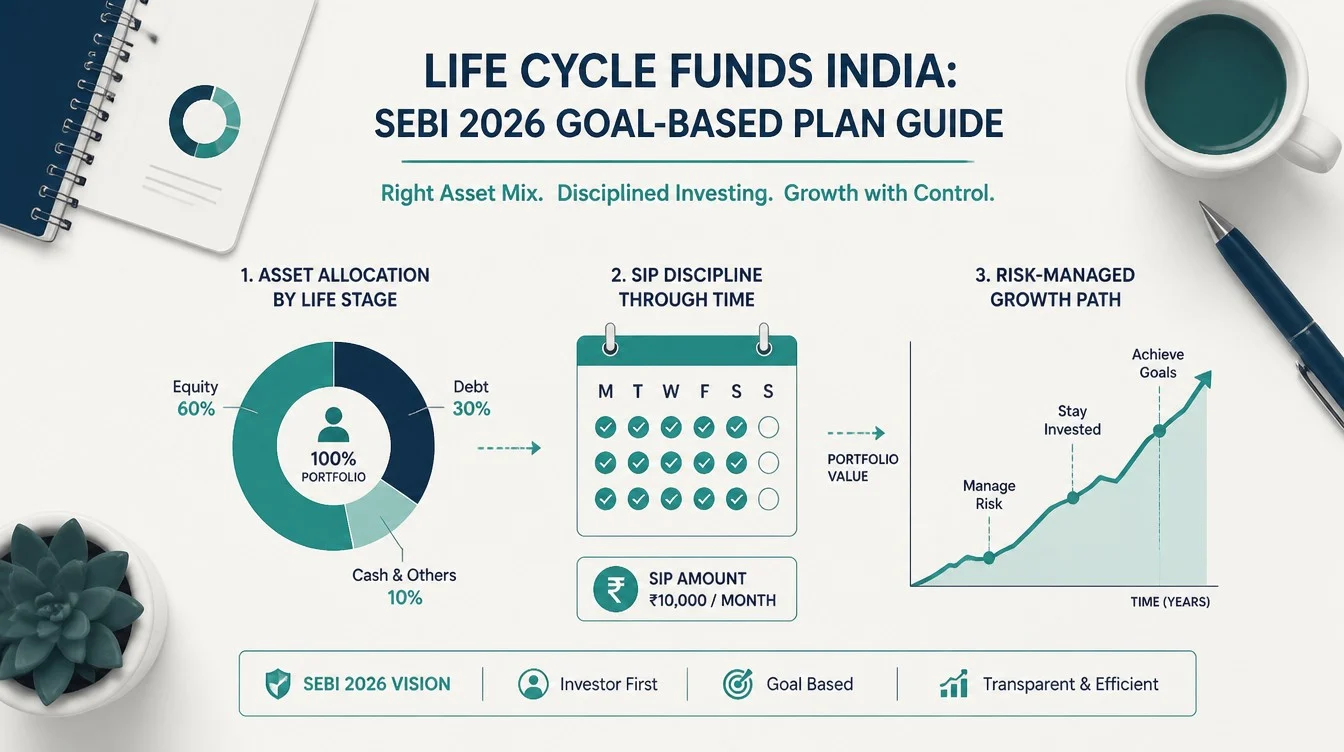
Consider Rohan, age 30, who starts a Rs.10,000 monthly SIP in a “2050 Life Cycle Fund” in May 2026. His target retirement year is 2050. The illustration that follows is structural, not a return projection; market-linked instruments carry market risk and past performance is not indicative of future results.
The first decade (2026 to 2036)
The fund’s allocation sits in the high-equity portion of the glide path, around 80% equity, 15% debt, 5% gold. Rohan’s SIP rides the volatility of the equity market across two or three cycles. He does not look at the NAV daily; he reviews the annual report once a year to confirm the fund stayed on its glide path.
The middle decade (2036 to 2046)
The fund automatically de-risks from approximately 75% equity to approximately 40% equity across this decade. Rohan continues his SIP. The drawdown profile of his portfolio compresses because debt exposure rises. He does not need to time the de-risking; the SID does it for him.
The final years (2046 to 2050)
The fund’s equity allocation drops to around 25% by the maturity year, with the bulk in debt. Rohan, now 54, plans his retirement drawdown. He can stagger redemptions across the last two years to manage capital-gains tax, since the fund continues to operate after maturity as a conservative debt-leaning scheme. He is not forced to exit on the maturity date.
Costs, Tracking, and What to Read in the SID
Like every mutual fund category, life cycle funds carry recurring expenses. The expense ratio is governed by SEBI’s broader 2026 framework, which moves to the Base Expense Ratio (BER) format with statutory levies disclosed separately. A reader comparing two life cycle funds across AMCs should look at the BER, the fund-of-fund layering cost (if applicable), and the explicit glide-path schedule.
What to check in the SID
- The full glide-path table for every year from launch to maturity, not just the launch-year allocation.
- The rebalancing band, that is, the tolerance around the prescribed allocation before forced rebalancing kicks in.
- The treatment of dividends and capital-gain distributions, including whether the fund is growth-only or has IDCW (Income Distribution cum Capital Withdrawal) variants.
- The exit-load schedule and the carve-outs (some AMCs may waive the exit load on redemptions for medical or other defined emergencies).
- The benchmark used to assess the fund’s performance versus the glide path.
Tracking error and the glide path
A well-managed life cycle fund stays close to its glide path. Tracking-error metrics are not the same as for an index fund; they measure how closely the actual allocation hugs the prescribed schedule across each rebalancing cycle. An investor can request this metric in the AMC’s quarterly factsheet, where AMCs make it available.
Common Mistakes Investors Will Make With Life Cycle Funds
The category is new, and a few predictable mistakes will appear in the first two years. Each one can be avoided with a short pause before the SIP click.
Mistake 1: Picking the year that sounds nice
An investor in 2026 might pick a “2050 Life Cycle Fund” because the year is twenty-four years away and feels long. The right approach is to pick the year that matches the actual goal date, not a round number. If retirement is at 58 in 2052, the right fund is the 2050 or 2055 variant, whichever is closer to 2052 and matches the desired risk profile in the last five years.
Mistake 2: Treating it as a substitute for emergency funds
A life cycle fund is a goal-bound long-horizon instrument with a front-end three-year exit load. It is not a substitute for a six-month emergency corpus held in liquid funds or a sweep-in fixed deposit. Investors should retain their emergency layer before considering a life cycle SIP.
Mistake 3: Running five life cycle funds at once
The category is designed to be a single-scheme solution per goal. Stacking three life cycle funds across years (2040, 2045, 2050) defeats the simplicity. If multiple goals exist (retirement at 2050, child’s college at 2040), then having one fund per goal is reasonable. Running three funds for the same retirement goal because each “looked good” is overlap by another name.
Mistake 4: Exiting at the maturity year by reflex
The fund continues to run after the maturity year. There is no contractual reason to redeem the full corpus on day one of the maturity year. A retiree can run a Systematic Withdrawal Plan (SWP) from the fund across the early years of retirement to smooth out tax incidence and sequence-of-return risk.
Life Cycle Funds in the Broader 2026 Mutual Fund Overhaul
The introduction of life cycle funds did not happen in isolation. SEBI’s 2026 framework also reset the cost rulebook, the overlap rulebook, and the disclosure rulebook for the entire mutual-fund industry. Life cycle funds inherit all of these structural changes from the day they are launched. The BER format applies, the brokerage caps apply, and the overlap disclosure obligations apply.
The “do less” portfolio
A long-standing principle in personal finance is that the simpler portfolio that actually gets reviewed beats the elaborate portfolio that gets neglected. Life cycle funds are SEBI’s attempt to give Indian retail investors a simple default that does not require quarterly attention. The category sits alongside index funds and balanced advantage funds as a “do less” option for long-horizon investors.
What to watch over the next 24 months
The early years of any new category produce a wide spread in implementation quality across AMCs. Some life cycle funds will have well-designed glide paths, low costs, and tight tracking. Others will have higher costs or less granular glide paths. A patient investor can wait six to twelve months after launch to see how the early entrants implement the framework, then choose. The category will likely consolidate around two or three preferred designs as data accumulates.
Frequently Asked Questions
Are life cycle funds in India safer than equity mutual funds?
Not in the short term. In the early years of the glide path, a life cycle fund is predominantly equity and carries the same market risk as any equity mutual fund. The safety claim, if any, comes from the automatic de-risking close to the maturity year, which reduces sequence-of-return risk for an investor with a fixed goal year. Market-linked instruments carry market risk in every year.
Can I switch from my existing equity SIPs to a life cycle fund without tax impact?
Switching mutual funds is a redemption followed by a fresh purchase under Indian tax law. The redemption can trigger short-term or long-term capital-gains tax depending on holding period. A switch is not tax-neutral. Many investors prefer to leave existing units in place, stop fresh SIPs into the older schemes, and direct new SIPs into the chosen life cycle fund.
What happens if I redeem a life cycle fund before three years?
SEBI’s prescribed exit load applies: 3% in Year 1, 2% in Year 2, 1% in Year 3, zero thereafter. The exit load reduces the redemption amount before capital-gains tax is calculated. Short-term redemptions are also less tax-efficient because gains within twelve months attract short-term equity capital-gains tax during the equity-oriented years of the glide path.
How is a life cycle fund different from a balanced advantage fund?
A balanced advantage fund uses a discretionary model (often valuation-based) to flex between equity and debt at any time, based on the fund manager’s signals. A life cycle fund follows a pre-set glide path published in the SID, with no discretionary tactical shifts. Balanced advantage is rules-and-judgement; life cycle is rules-only.
Should I pick a life cycle fund or a Nifty 500 index fund for retirement?
The two solve different problems. A Nifty 500 index fund offers low-cost broad equity exposure but does not de-risk as retirement approaches; the investor must rebalance manually. A life cycle fund automates the de-risking but charges a higher expense than a pure index fund. A blended approach (a Nifty 500 index fund early on, plus a life cycle fund or shifting to one closer to the goal) is a reasonable middle path for an investor willing to do a little manual work.
Related guides on this topic are coming to learnfinedge.com soon.