

Every no-claim bonus health insurance brochure in India highlights the No-Claim Bonus (NCB) on the front page, often with a headline number such as “up to 200 percent cumulative bonus”. The structure underneath that number varies dramatically across insurers, and the fine print on what happens when a claim is filed varies even more. The result is that two policies advertising the same NCB headline can deliver very different real-world cover growth over a five-year stretch.
This guide breaks down how health insurance ncb india structures actually work in 2026, walks through a five-year illustration that compares cumulative bonus versus reset bonus formats, and shows which products preserve the bonus on small claims and which strip it overnight. By the end, you will be able to read a brochure NCB clause with the same skepticism you bring to a mutual-fund return chart.
If you have ever switched insurers mid-stream and lost five years of accumulated bonus in the process, this is the article that explains why and how to avoid it next time. The NCB is real money, and it deserves the same scrutiny as the headline sum insured.

What No-Claim Bonus Health Insurance Actually Gives You
A No-Claim Bonus, also called a cumulative bonus or wellness bonus depending on the insurer’s naming convention, is an increment to the sum insured awarded each policy year in which no claim is paid. The increment is expressed as a percentage of the base sum insured and accumulates year on year subject to a per-policy cap.
How the increment is applied
Most Indian health insurers award the NCB either as additional sum insured (most common) or as a premium discount (rarer). The additional-sum-insured format is more valuable for the policyholder because it directly increases the financial protection. A 50 percent NCB on a Rs.10,00,000 (10 lakh) base policy converts the effective cover for that year to Rs.15,00,000 (15 lakh), at no additional premium.
Where the cap lands
Caps vary widely. The most common cap is 100 percent of the base sum insured (typically reached after five or ten claim-free years), but several insurers offer caps up to 200 percent and a few sub-segments offer up to 1000 percent in specialised products. The trade-off is usually higher base premium for higher-cap NCB, so the headline cap matters less than the rate of accrual and the reset rules.
Why the NCB is not “free”
Insurers price the long-term NCB structure into the base premium. A policy with a generous accrual schedule and a forgiving reset clause typically carries a marginally higher base premium than a comparable policy with a minimal NCB. The NCB is best thought of as a built-in cover-growth mechanism that the policyholder pays for via base premium, not as a giveaway.
The Two Main Structures: Cumulative Bonus And Reset Bonus
The two structures dominate the Indian market and behave very differently when a claim is made. Confusing one for the other at purchase time is the single most common mis-selling error in retail health insurance.
Cumulative bonus
The cumulative-bonus structure accrues the bonus year on year and resets it (fully or partially) when a claim is made. A typical accrual is 50 percent of base sum insured per claim-free year, capped at 100 percent. After two claim-free years on a Rs.10,00,000 (10 lakh) base, the cover effectively becomes Rs.20,00,000 (20 lakh) for the third year. If a claim is paid in year three, the bonus typically resets at the same rate it accrued (50 percent per year), so the bonus would drop to 50 percent the next year.
Reset bonus
The reset-bonus structure, sometimes called “no-claim bonus protect” or “super NCB”, retains all or most of the accumulated bonus even after a claim. Most reset-bonus designs lose only one slab on a claim (for example, dropping from 100 percent to 80 percent), while the cumulative-bonus design might drop from 100 percent to 50 percent on the same claim. The reset-bonus is structurally more valuable for households expecting periodic small claims.
Why the difference compounds
The difference between the two structures is small in any single year but compounds across the life of the policy. A household with one moderate claim every three years on a 50/50 cumulative structure usually never gets above the 50 to 100 percent NCB band. The same household on a reset-bonus design with one-slab erosion can drift into the 150 to 200 percent band over a decade. On a Rs.10,00,000 (10 lakh) base, that is a Rs.10,00,000 swing in effective cover at the moment when a large claim might land.
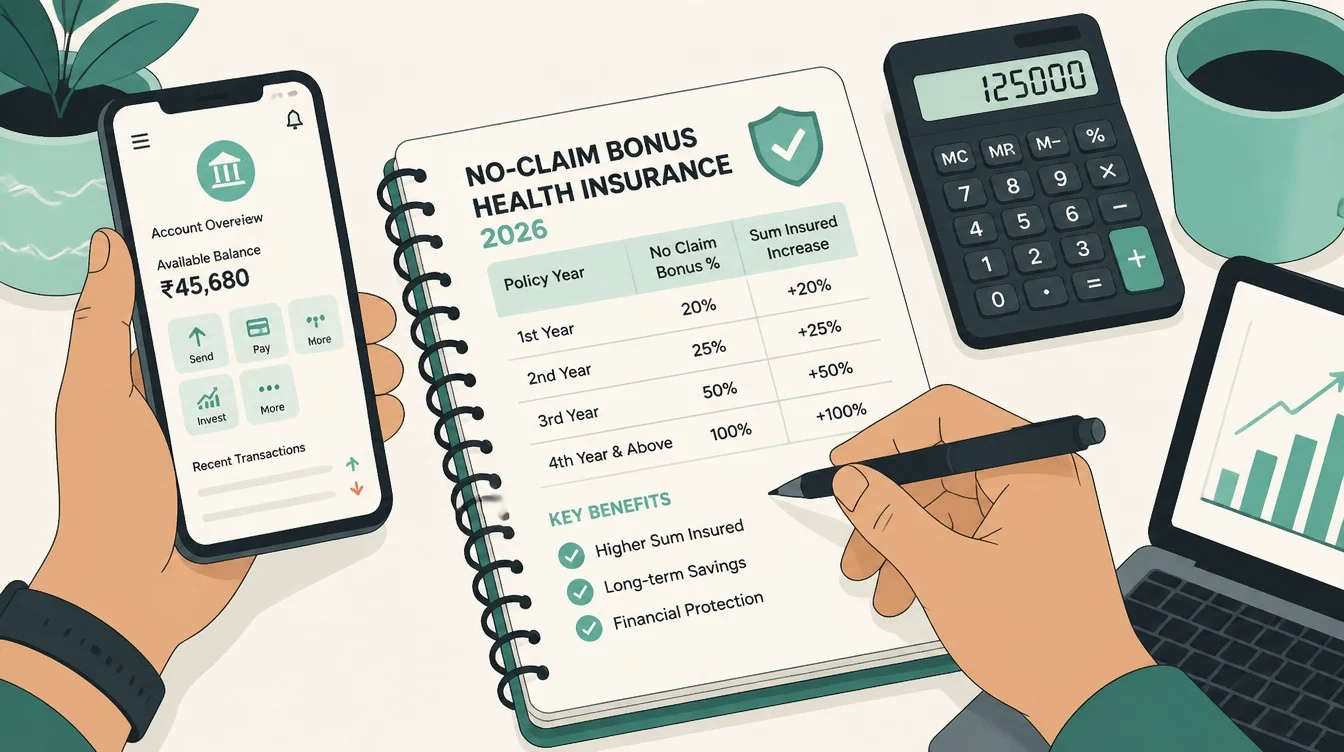
Five-Year Illustration: Same Base, Two Structures, One Claim Event
The clearest way to see the difference is to walk both structures through five years on identical assumptions: Rs.10,00,000 (10 lakh) base sum insured, NCB accrual of 50 percent per claim-free year up to a 100 percent cap, and one claim of Rs.1,50,000 (1.5 lakh) paid in year four. The numbers are illustrative.
| Policy Year | Event | Cumulative-Bonus Effective Cover | Reset-Bonus (NCB Protect) Effective Cover |
|---|---|---|---|
| 1 | Claim-free | Rs.10,00,000 (base year) | Rs.10,00,000 (base year) |
| 2 | Claim-free, +50% NCB | Rs.15,00,000 | Rs.15,00,000 |
| 3 | Claim-free, +50% NCB | Rs.20,00,000 (cap reached) | Rs.20,00,000 (cap reached) |
| 4 | Claim of Rs.1.5 lakh paid | Rs.20,00,000 used | Rs.20,00,000 used |
| 5 | Reset/erosion effect | Rs.15,00,000 (NCB drops 50%) | Rs.19,00,000 (one-slab erosion) |
What the year-five row means in practice
If a second claim lands in year five, the cumulative-bonus policyholder has Rs.5,00,000 less effective cover than the reset-bonus policyholder. For routine hospitalisations this gap is not catastrophic, but for a major event such as a cardiac surgery or an oncology admission, it can be the difference between full coverage and a Rs.4 to 5 lakh out-of-pocket gap.
What about a true “preserve” clause
Some insurers go further with a “claim-doesn’t-affect-bonus” clause that retains the full NCB even after a claim, subject to an annual claim-size threshold (typically claims under Rs.50,000). This is the strongest design from a buyer perspective and is typically offered as a rider or as part of a premium-tier product. It is genuinely valuable for chronic-disease households with multiple small reimbursements per year.
Why the cap matters less than the slope
Buyers often anchor on the headline cap (“200 percent NCB”) without checking the slope. A 200 percent cap that takes 10 claim-free years to reach is rarely accessed by a real household. A 100 percent cap that the household actually reaches within four claim-free years is more useful. Always read accrual rate, cap, and reset rule together.
What Counts As A “Claim” For NCB Purposes
The definition of a claim for NCB-erosion purposes is policy-specific and often more forgiving than buyers assume. Several events that look like claims do not trigger NCB erosion under most modern policy wordings in 2026.
- Day-care procedures fully paid by an OPD rider: If the claim is paid out of an OPD rider’s separate corpus rather than the base sum insured, NCB on the base usually remains intact.
- Preventive health check-up benefits: Annual diagnostic packages included in the policy do not count as claims.
- Maternity benefits paid from a maternity sub-limit: If the policy carries a separate maternity sub-corpus, drawing on it typically does not erode the main NCB.
- Wellness rewards and lifestyle credits: Cashback-style wellness benefits do not count as claims.
- Claims paid by a top-up policy: If the loss exceeds the base sum insured and the excess is paid by a separately purchased top-up policy, the base policy’s NCB is usually unaffected as long as the base limit was not breached on the base side.
What does count, almost always
Standard hospitalisation claims paid from the base sum insured, pre- and post-hospitalisation expenses reimbursed from the base, and most ambulance benefits paid from the base count as claims for NCB erosion under cumulative-bonus designs. The erosion happens at next-policy-renewal, not immediately at claim payment.
Where the wording becomes load-bearing
Two policies with the same headline NCB can treat the same Rs.40,000 claim very differently if one runs an “any claim erodes NCB” clause and the other runs a “claims above Rs.50,000 erode NCB” clause. Reading the exact wording on small-claim impact is therefore worth the ten minutes it takes during purchase.

NCB On Family Floater Policies
Family-floater NCB structures introduce an additional layer of complexity because the policy covers multiple lives and a claim on any one life affects the family-wide NCB. The architecture of erosion in a floater matters more than in an individual policy because there are simply more events that can trigger a claim.
Floater NCB on individual claims
Most floater policies erode the entire floater NCB on any claim, regardless of which family member used the cover. This is structurally more aggressive than the individual-policy version because four covered lives effectively share one NCB pool, and any one of the four can erode it.
The “individual NCB within floater” design
A small number of products track NCB at the individual-life level within a floater, eroding only the individual claimant’s bonus. These are rarer and usually priced at a higher base premium, but for families with one frequently hospitalised senior they deliver materially better long-term economics.
Senior-citizen impact
If a senior parent on a floater is likely to use the cover more frequently, an alternative architecture is to keep the senior on a standalone individual policy (with an appropriate cover and senior-specific waiting-period management) and the rest of the family on a separate floater. The premiums add up, but the NCB on the rest of the family stays intact across the senior’s claims.
NCB Portability: What You Keep, What You Lose
IRDAI’s portability framework allows policyholders to migrate from one insurer to another while preserving continuity benefits, including the NCB. The framework is real and used widely, but the operational details often surprise first-time porters.
What ports cleanly
Continuity on waiting periods (pre-existing-disease, specific-disease, and general waiting periods) ports cleanly under IRDAI rules. Accumulated NCB also ports, expressed as additional sum insured on the new policy. If the porting buyer was at 100 percent NCB on a Rs.10,00,000 (10 lakh) policy with the old insurer, the new insurer typically issues a Rs.10,00,000 base with a Rs.10,00,000 NCB carryover.
What does not port
Some product-specific features do not port across insurers because the new insurer’s product simply does not have an analogous feature. NCB caps differ; if the old policy had a 200 percent cap that the buyer was approaching, and the new policy has a 100 percent cap, the new policy’s cap binds going forward. Sub-limits, room-rent terms, and disease-specific waiting periods are determined by the new policy’s wording.
Timing the port
Portability requests have to be initiated at least 45 days before the existing policy’s renewal date, with the new insurer’s application form, the existing policy schedule, and the latest claim history. Missing the 45-day window pushes the port to the next renewal cycle. Plan the timeline backward from the renewal date with comfortable buffer; brokers can help but the buyer remains responsible for the timing.
The “lose the NCB” mistake
Buyers who lapse the existing policy and then buy a fresh policy from a new insurer lose all continuity benefits, including the NCB and any waiting-period credit. This is one of the most expensive mistakes in retail health insurance and almost always reflects bad timing or bad advice. Always port, never lapse and re-buy.

How To Choose An NCB Structure For Your Household
The right NCB design depends on family composition, expected claim frequency, and the alternative use of the premium delta. The five-question framework below typically converges to a clear answer.
- How likely is a claim in any given year? A young, healthy individual buyer is in a low-frequency band and benefits least from reset-bonus structures because the bonus rarely erodes anyway.
- Is the policy a floater with seniors or chronic-disease lives? If yes, reset-bonus or individual-NCB-within-floater designs earn their premium delta over a five-year horizon.
- What is the headline accrual rate? Prefer 50 percent per year over 25 percent per year if the cap is the same, because the slope reaches the cap sooner.
- What is the small-claim threshold? Designs that ignore claims under Rs.50,000 for NCB purposes are valuable for chronic-disease households with frequent reimbursements.
- How wide is the network depth at the locations you actually use? NCB structure matters only if the underlying policy is usable; an excellent NCB on a network-thin insurer is poor consolation.
The premium delta calculation
Compare the annual premium delta between cumulative-bonus and reset-bonus variants of the same insurer’s plan. If the reset variant is Rs.2,000 more per year on a Rs.18,000 base, the lifetime delta over 20 years is roughly Rs.40,000. The break-even is one event where reset-bonus saves more than Rs.40,000 in additional cover during a large claim. For most families with at least one senior on the floater, this break-even is comfortably crossed.
When to skip the upgrade
For a 28-year-old single buyer with no chronic conditions on a Rs.10,00,000 (10 lakh) individual policy, the additional premium for reset-bonus is usually not the highest-return upgrade. The same incremental rupee buys more value as a higher base sum insured or a wider hospital network upgrade. As life stage shifts, this calculus also shifts.
Common Mistakes With NCB Decisions
The NCB clause is one of the least-read sections of a policy document, and the most common purchase-time mistakes share a small set of root causes.
- Anchoring on the headline cap. A 200 percent cap with a 25-percent annual accrual rate is usually weaker in practice than a 100 percent cap with a 50-percent annual accrual rate.
- Assuming any claim erodes the entire NCB. Many 2026 designs erode by only one slab on a claim, and a few preserve the bonus entirely on small claims.
- Lapsing an existing policy to “start fresh” with a new insurer. This destroys waiting-period continuity and the NCB. Always port; never lapse.
- Buying a top-up without considering NCB interaction. A top-up policy can absorb large claims without eroding the base policy’s NCB, which is a structural argument for layering top-ups onto a high-quality base.
- Treating wellness rewards as NCB. Wellness cashbacks are separate from NCB and have different terms. Conflating them leads to surprise at renewal.
The “reset to zero” misunderstanding
Many older policy wordings, and a few legacy products still in force, do reset the NCB to zero on any claim. Modern designs almost universally taper rather than reset to zero, but legacy policy wordings should be read carefully. If your policy is more than five years old without rebrand, request the latest wording from the insurer to check.
The “two policies, two NCBs” question
Households holding two policies (often a corporate floater plus a personal floater) sometimes file claims on the corporate policy first to preserve the personal NCB. This is a reasonable strategy as long as the corporate policy’s terms are competitive on the relevant condition; otherwise the deduction on the corporate side may end up costing more than the preserved NCB saves.
Frequently Asked Questions
What happens to my No-Claim Bonus if I file a claim?
The impact depends on the policy’s NCB structure. Cumulative-bonus designs typically reduce the NCB by the same rate at which it accrued (often 50 percent per year). Reset-bonus or NCB-protect designs reduce the NCB by only one slab on a claim or preserve it entirely on small claims. Read the policy wording, not the marketing headline.
Does the No-Claim Bonus apply to the additional cover or the base sum insured?
The NCB is added on top of the base sum insured as additional cover. A Rs.10,00,000 (10 lakh) base with a 50 percent NCB delivers a Rs.15,00,000 (15 lakh) effective cover for that year, with the additional Rs.5,00,000 available alongside the base.
Can I keep my No-Claim Bonus if I switch insurers?
Yes, under IRDAI portability rules, accumulated NCB can be carried over to a new insurer as additional sum insured, subject to the new policy’s cap and product terms. Initiate the port at least 45 days before the existing policy’s renewal date. Never lapse and re-buy; that loses the NCB and all other continuity benefits.
Is a higher No-Claim Bonus cap always better?
Not always. A higher cap with a slow accrual rate may never be reached in a real household’s claim pattern. A 100 percent cap reached in four claim-free years is often more useful than a 200 percent cap that needs ten claim-free years.
Does the No-Claim Bonus erode on day-care or OPD claims paid from a separate rider?
Usually no. If the claim is paid out of an OPD rider’s separate corpus or an attached health-card balance, the base policy’s NCB typically remains intact. The wording should be read explicitly to confirm; treat the answer as policy-specific.
Related guides on health-insurance porting, family-floater design, and top-up cover structures are forthcoming on LearnFineEdge and will be linked here once published.