
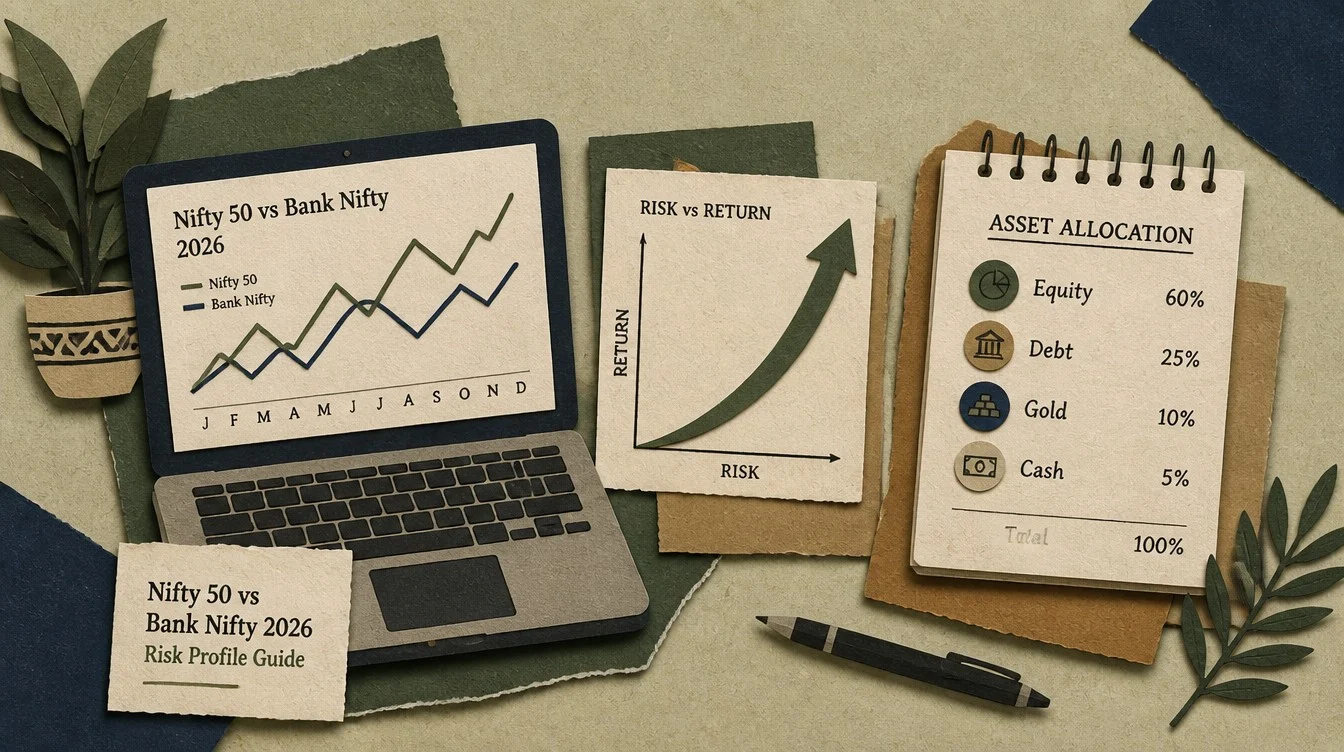
The Nifty 50 Bank Nifty comparison for 2026 India is no longer just about returns. After the SEBI April 2026 framework reshaped F&O lot sizes, retired Bank Nifty weeklies, and forced position-sizing discipline through the cash margin rule, the choice between the broad market and the banking sectoral index now affects every leg of an Indian retail strategy: cash exposure, options liquidity, and risk appetite.
This guide walks through the structural differences (Nifty 50’s 50 diversified names against Bank Nifty’s banking concentration), the volatility comparison, the option liquidity story post-2026, and the risk-profile framework that helps a salaried Indian investor decide which index actually belongs in their portfolio.
Standard caveat up front: this article discusses cash and derivatives exposure. F&O carries leveraged risk and is unsuitable for most retail investors; the cash exposures (ETFs, index funds, SIPs) are the safer paths for most readers.

Nifty 50 Bank Nifty: What The Two Indices Represent
Both indices share the NSE platform and the broad Indian equity opportunity, but they are structurally very different products.
Nifty 50: The Broad-Market Benchmark
The Nifty 50 is a free-float, market-cap weighted index of 50 large-cap companies across about 13 sectors: financial services, IT, FMCG, oil and gas, automobiles, consumer goods, healthcare, metals, telecom, and others. Each component sector has weight roughly proportional to its market presence.
Bank Nifty (Nifty Bank): The Sectoral Bet
The Bank Nifty, formally Nifty Bank, is a sectoral index that tracks 12 to 14 of the most liquid large-cap Indian banks (private and public sector). It is, by construction, an undiversified bet on the Indian banking sector.
The Recent Index Rule Changes On Bank Nifty
SEBI tightened the Nifty Bank construction in 2025-26. The cap on the top constituent’s weight came down from 33% to 20%; the combined weight of the top three constituents was capped at 45% (from 62%); and the minimum stock count moved from 12 to 14. These changes reduced single-name concentration but did not change the fundamental sectoral nature of the index.
Volatility: Bank Nifty Moves More
The cleanest single number that separates the two indices is volatility. Across most observed windows, Bank Nifty’s annualised volatility runs noticeably higher than Nifty 50’s, and its beta to the broad market sits around 1.2.
Why Bank Nifty Is More Volatile
Banks are highly leveraged businesses with sensitivity to interest rates, credit cycles, RBI policy, asset quality reporting cycles, and macro liquidity conditions. Each of those is a separate source of volatility, and they all hit the same index at the same time. Nifty 50, by contrast, has IT and consumer staples that often move opposite to banks during certain cycles, dampening the aggregate move.
The Practical Effect On Intraday And Weekly Moves
On an average trading day, Bank Nifty’s range as a percentage of the index level is typically 1.3 to 1.5 times Nifty 50’s range. On RBI policy days, banking earnings days, and global financial-event days, the multiple can be larger. Traders who switched from Bank Nifty weeklies to monthly Bank Nifty after the SEBI cut found that the absolute rupee P&L swings remained large even on the slower contract.
Correlation, Not Identity
The two indices have a high but imperfect correlation, often around 0.85 to 0.90. They move in the same direction most days, but the magnitude differs. A 1% move in Nifty 50 typically corresponds to a 1.1% to 1.3% move in Bank Nifty, and on event days the relationship can become looser.

Sector Concentration: A Pure Banking Bet Vs A Diversified One
Bank Nifty’s defining feature is that every constituent is in the same sector. This concentration is a feature for traders who want a pure banking exposure and a bug for investors who want diversified equity exposure.
What Happens In A Banking Stress Event
A regulatory action on a single large bank, an asset-quality scare in the public sector banking pocket, or a sharp rise in NPAs across the sector can move Bank Nifty 3-5% in a day with no compensating offset. Nifty 50 in the same scenario typically moves 1-2% because non-banking sectors absorb part of the shock.
What Happens In A Banking Tailwind
Conversely, a sharp RBI rate cut, a strong quarterly earnings cycle, or a credit-growth pickup can push Bank Nifty up 4-6% in a session, while Nifty 50 captures only the banking weight in its 50-stock pie. For traders with a banking-specific view, Bank Nifty is the higher-leverage expression of that view.
The Concentration Number In Practical Terms
Even after SEBI’s 2025-26 cap of 20% on the top single constituent and 45% on the top three combined, a Bank Nifty position remains effectively a bet on three to four large banks. For a salaried Indian investor without a specific banking view, this concentration is usually too narrow.
Options Liquidity After The 2026 Rule Change
The single biggest structural change between the two indices in 2026 is options liquidity. Nifty has weekly and monthly options; Bank Nifty has monthly options only.
Nifty: Deep Weekly And Monthly Books
With Nifty retaining its weekly contract on NSE, the at-the-money options book on Nifty is the deepest in the Indian market. Bid-ask spreads are tight even for far-OTM strikes, and the chain extends meaningfully in both directions. For any retail trader running an active options strategy, Nifty offers the cleanest execution environment.
Bank Nifty: Monthly Only, Lower Daily Volume
Bank Nifty’s monthly contract is still a real product, but the daily turnover is materially lower than the pre-2024 weekly era. Bid-ask spreads on at-the-money Bank Nifty monthly options are wider than on Nifty weekly options, and far-OTM strikes can be illiquid. Strategies requiring quick entry and exit work less well here.
The Liquidity Premium
The execution cost difference between Nifty and Bank Nifty options has widened since the 2024 rule. For a multi-leg strategy that crosses bid-ask spreads several times, the difference can amount to 0.5% to 1% of position size per round-trip. Over a year of active trading, this is a meaningful drag.
The Two Indices Side By Side
The table below summarises the structural and behavioural differences for a 2026 Indian investor.
| Attribute | Nifty 50 | Bank Nifty |
|---|---|---|
| Constituents | 50 stocks across about 13 sectors | 12-14 large banks |
| Sector exposure | Diversified | Banking only |
| Annualised volatility | Lower (broad-market beta 1) | Higher (beta around 1.2) |
| Weekly options | Yes (Tuesday expiry on NSE) | No, discontinued from November 2024 |
| Monthly options | Yes, deep book | Yes, lower volume than pre-2024 |
| Typical use case | Long-term cash exposure, hedging | Tactical sectoral bet, banking-specific view |
| Long-term return profile | Broad-market index returns | Banking sector beta with concentration risk |
| Suitability for SIP | Yes, default broad-market vehicle | Only as a satellite, never as core |
Long-Term Returns: A Realistic Comparison
Both indices have delivered broadly similar long-term returns across various five-year and ten-year windows, but the path to those returns has been very different.
The Smoother Nifty Path
Nifty 50’s path is typically smoother. The diversification across sectors and the lower beta mean that drawdowns during sector-specific shocks are more contained. For an SIP investor with a 7-10 year horizon, the smoother path matters because it improves behavioural durability (the investor is less likely to stop the SIP at a bad time).
The Bumpier Bank Nifty Path
Bank Nifty’s path is bumpier. Drawdowns of 15-25% during banking-sector stress episodes are not unusual, even when the broader market drops only 10-15%. The recovery often outpaces Nifty when the sector turns, but the in-between volatility is uncomfortable for most retail investors.
Past Performance Is Not A Forecast
Five-year and ten-year return numbers in published index fact sheets are historical observations, not predictions. The standard disclaimer applies: past returns are not indicative of future returns. Market-linked instruments carry market risk; what an index has done in the past is no promise that it will repeat in the next cycle.

The Risk-Profile Framework: Which Suits You
The cleanest way to choose between the two indices is to map the choice to risk profile and use case, not to recent return charts.
Conservative, Long-Horizon Investor
A salaried saver with a 7-15 year horizon, focused on SIP-driven wealth creation, building toward a retirement goal or a child’s education, should default to Nifty 50 (or a broader index such as Nifty 500). Bank Nifty as the primary equity vehicle introduces concentration risk that does not pay for itself across most realistic outcome paths.
Balanced Investor With A Banking View
An investor who maintains a broad-market SIP as the core (60-80% of equity allocation) and wants a tactical satellite (10-20%) for a specific banking-sector view can take Bank Nifty exposure via a Nifty Bank ETF or Nifty Bank index fund. This is a defensible structure as long as the satellite stays small.
Active Trader With Suitability Clearance
An active F&O trader who has cleared the SEBI suitability test, holds working capital above Rs.5,00,000, and has a documented edge can use Nifty weekly and monthly options as the primary instrument and Bank Nifty monthly options for banking-specific event trades. The tactical Bank Nifty exposure should be a small fraction of book size, not the default product.
How Each Index Fits Into A Household Portfolio
For a typical Indian household balance sheet, the two indices occupy different layers.
Nifty 50 As Core Equity
A Nifty 50 index fund or ETF can sit as a meaningful slice of the household equity sleeve. Expense ratios in the 0.05% to 0.20% range, deep liquidity in the underlying ETF market, and predictable broad-market behaviour make it the textbook core holding for a salaried Indian saver.
Bank Nifty As Tactical Satellite
A Bank Nifty exposure, if taken, belongs in the satellite layer. A 10-15% allocation to Nifty Bank within the equity sleeve can express a banking tailwind view. Beyond that, the concentration risk dominates the diversification benefit of the rest of the portfolio.
The Default For SIP Investors
For pure SIP investors, the conservative default is to skip Bank Nifty entirely and stick to broad-market index funds. Tactical sectoral SIPs into banking-only funds rarely outperform broad-market SIPs across full cycles, after costs.
Worked Example: An Investor Choosing Between The Two
Consider Sneha, a 32-year-old marketing professional in Bengaluru with Rs.8,00,000 in equity SIP allocation already running into a Nifty 50 index fund, and Rs.2,00,000 of additional capital available for the year.
The Sensible Allocation
If Sneha’s goal is long-term wealth creation with no strong sector view, the conservative path is to add the Rs.2,00,000 to her existing Nifty 50 SIP. The compounding effect of consistent broad-market exposure outweighs the marginal upside of a sectoral satellite.
The Tactical Variation
If Sneha has a specific reading on banking (rate cuts ahead, improving asset quality across the sector, supportive credit cycle), she might add Rs.50,000 to a Nifty Bank ETF as a tactical satellite. The remaining Rs.1,50,000 goes to the Nifty 50 core. The satellite represents about 6% of her total equity, which is a defensible level for a sector bet.
What Not To Do
What Sneha should not do is treat Bank Nifty as the higher-return version of Nifty and tilt the bulk of her future SIP toward it. The historical higher beta does not translate into a structural alpha; over a full cycle, the smoother Nifty 50 path typically delivers comparable returns with better behavioural durability.
Common Misreads When Choosing Between The Two
Three patterns of mistake show up regularly when retail investors compare the two indices.
Misread 1: “Bank Nifty Gives Higher Returns”
Bank Nifty’s historical returns have been comparable to, not categorically higher than, Nifty 50’s. The higher volatility does not, on average, produce higher long-term returns; it produces a bumpier path. Confusing volatility with return is one of the most common retail errors.
Misread 2: “Bank Nifty Options Are Cheaper”
After the 2024 rule retired Bank Nifty weeklies, the absolute premium per lot on Bank Nifty monthly options is comparable to or higher than Nifty weekly equivalents on a per-unit-of-notional basis. The “cheap weekly punt” use case no longer exists; the surviving Bank Nifty monthly options are not a low-ticket product.
Misread 3: “Bank Nifty Is A Cleaner Hedge For My Bank Stocks”
Hedging individual bank stocks with Bank Nifty has a basis risk that often surprises retail traders. A single bank’s idiosyncratic move (a regulatory action, an earnings miss) is not absorbed by a Nifty Bank index hedge in the same way that a market-wide move is. For idiosyncratic stock risk, single-stock options remain the more precise hedge, subject to the new lot-size and cash margin rules.
Outlook For Both Indices In FY 2026-27
Both indices remain core products on the Indian exchange ecosystem, but their roles have shifted under the 2026 framework.
Nifty 50: The Quiet Beneficiary
The reshaping of weekly options, the SIP momentum, and the migration of retail capital toward broad-market index funds have all benefited the Nifty 50 ecosystem. ETF AUM on Nifty 50 has continued its multi-year climb through FY 2025-26.
Bank Nifty: A Specialist Product Now
Bank Nifty has become a more specialist product. Its monthly options are real and tradable, but the casual retail volume that defined the weekly era is gone. The participants who remain are typically more capitalised and more focused on the sector.
The Sensible Default For Most Indian Retail
For the median Indian salaried saver, the practical answer is straightforward. Default to Nifty 50 (or broader market) cash exposure through index funds and ETFs. Treat Bank Nifty as a small, optional satellite. Use F&O on either index only after clearing the suitability test and only with working capital above the levels the lot-size rule demands.
Frequently Asked Questions
What is the main difference between Nifty 50 and Bank Nifty?
The Nifty 50 vs Bank Nifty 2026 India comparison comes down to diversification. Nifty 50 is a broad-market index of 50 large-cap stocks across about 13 sectors. Bank Nifty (Nifty Bank) is a sectoral index of 12 to 14 banks only. Nifty 50 is the default broad-market benchmark; Bank Nifty is a concentrated bet on the Indian banking sector.
Which index is more volatile?
Bank Nifty is materially more volatile than Nifty 50, with beta to the broad market around 1.2 and a typical daily range that runs 1.3 to 1.5 times Nifty’s. The volatility comes from the sectoral concentration in a leverage-heavy industry that is sensitive to interest rates, credit cycles, and RBI policy.
Are Bank Nifty weekly options still available?
No. Bank Nifty weekly options were discontinued from November 20, 2024 under SEBI’s rule restricting weekly contracts to one benchmark per exchange. The Bank Nifty monthly contract continues, with lower daily volumes than the pre-2024 weekly era and wider bid-ask spreads on far-OTM strikes.
Which index is better for a long-term SIP?
For most long-term SIP investors, Nifty 50 is the better default. Its diversification produces a smoother path, which improves behavioural durability over a 7-15 year horizon. Bank Nifty as the primary equity vehicle is rarely defensible for a long-term saver; if used, it belongs in a small satellite allocation alongside a broad-market core.
Can I use Bank Nifty options to hedge individual bank stock positions?
Only partially. Bank Nifty has basis risk relative to any single bank stock, because the index averages across 12 to 14 names. An idiosyncratic move in one bank (regulatory action, earnings surprise) will not be neutralised by a Nifty Bank hedge in the same way that a market-wide move will. For stock-specific hedging, single-stock options remain the more precise instrument, subject to the 2026 lot-size and cash margin rules.
Related LearnFineEdge guides on the broader SEBI 2026 framework, weekly options changes, the F&O suitability test, and broad-market index investing are forthcoming.