


NPS Tier 1 vs Tier 2 India: Difference and Which Account to Use
The NPS tier 1 vs tier 2 distinction in India is fundamental for anyone opening or using an NPS account. Tier 1 is the main pension account with tax benefits and withdrawal restrictions. Tier 2 is a voluntary savings account with no lock-in but no tax benefits (for most subscribers). Understanding the exact differences helps you use NPS optimally for both retirement savings and tax planning.
NPS Tier 1: The Core Pension Account
NPS Tier 1 is the primary account that defines NPS. It is mandatory to open Tier 1 before opening Tier 2. Key characteristics:
- Tax benefits: Contributions qualify for the 80CCD(1) deduction (within the Rs 1.5 lakh 80C ceiling) and 80CCD(1B) (an additional Rs 50,000 exclusively for NPS).
- Lock-in: Until age 60, with limited partial withdrawals for specific purposes after 3 years.
- Withdrawal at 60: 60% lump sum (tax-free), 40% compulsory annuity (taxable).
- Minimum contribution: Rs 500 per year to keep the account active; Rs 1,000 minimum opening contribution.
- Investment options: Active choice (specify equity %, debt %, alternative %) or auto choice (lifecycle fund that auto-reduces equity with age).
- Fund managers: Choose from PFRDA-registered fund managers – SBI, LIC, HDFC, ICICI, Kotak, Axis, UTI, and Birla.
NPS Tier 2: The Voluntary Savings Account
NPS Tier 2 is an add-on voluntary savings account that can be opened only if you have a Tier 1 account. Key characteristics:
- No lock-in: Withdraw any amount at any time without restriction.
- No exit penalty: No charges for partial or full withdrawal.
- No tax benefits for non-government subscribers: Private sector employees and self-employed individuals receive no 80C or 80CCD deduction on Tier 2 contributions. Withdrawals are taxable as capital gains or income depending on asset class.
- Tax benefit for government employees: Central government employees can claim an 80C deduction on Tier 2 contributions with a 3-year lock-in. This is a government-employee exclusive benefit not available to the private sector or the self-employed.
- Same investment options: Same fund managers, same equity/debt/alternate asset classes as Tier 1.
- Lower minimum: Rs 250 minimum contribution; no minimum annual contribution requirement.

Tier 1 vs Tier 2: Side-by-Side Comparison
| Feature | NPS Tier 1 | NPS Tier 2 |
|---|---|---|
| Tax deduction on contribution | Yes (80CCD(1) + 80CCD(1B)) | No (except government employees) |
| Lock-in period | Until age 60 | None |
| Withdrawal flexibility | Limited (partial after 3 years, specific purposes) | Full flexibility, any time |
| Tax on withdrawal | 60% tax-free; 40% annuity (taxable) | Capital gains (taxed like debt fund) |
| Minimum annual | Rs 500 (to keep active) | No minimum |
| Fund manager fees | 0.09% (very low) | 0.09% (same) |
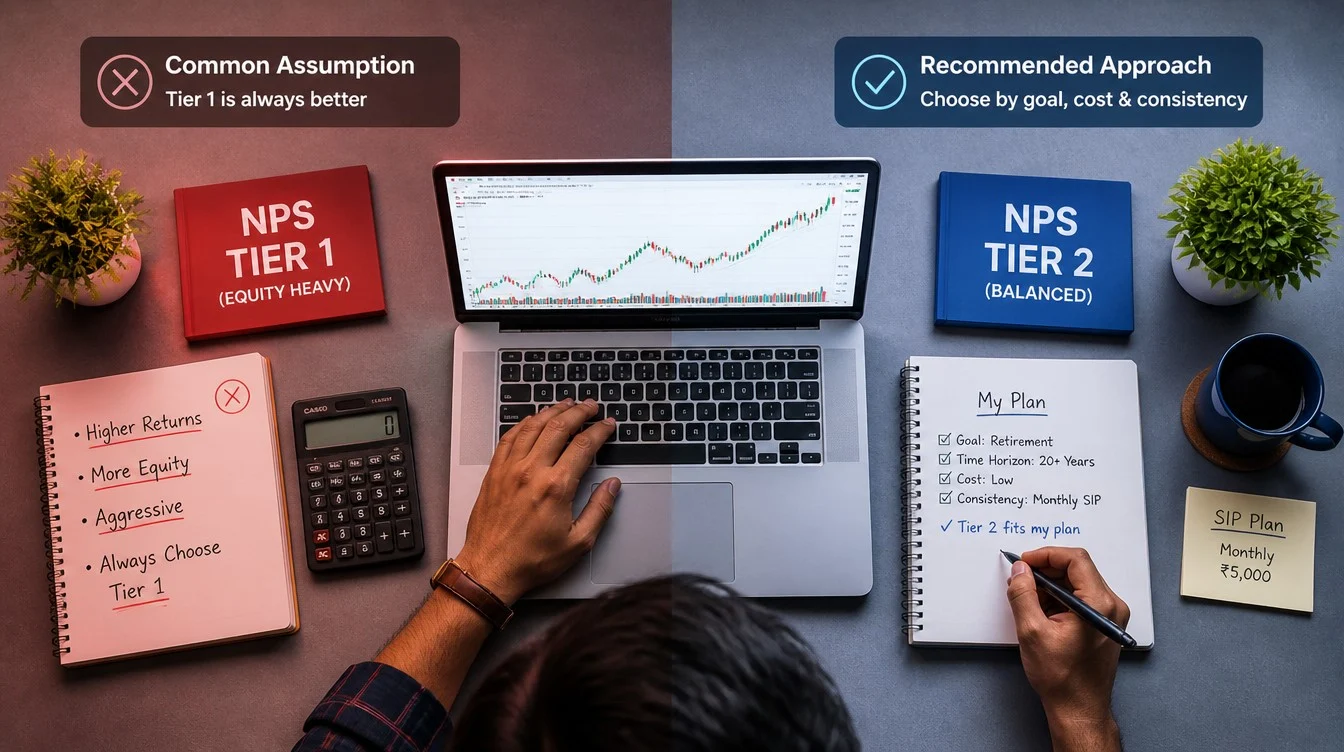
Many people misunderstand the NPS Tier 2 account as a “tax-saving” account for all. For private sector employees and the self-employed, Tier 2 is essentially a low-cost mutual fund with free withdrawals. It is useful for short-term savings with market exposure but has no unique tax advantage over direct mutual funds. The NPS Vatsalya scheme follows Tier 1 rules for minors.
When to Use NPS Tier 2
Tier 2 makes sense in specific situations:
- Government employees claiming 80C on Tier 2: The 3-year lock-in Tier 2 with an 80C benefit is effectively an ELSS equivalent for government employees. Use it if you want equity exposure with a tax deduction and you are a central government employee.
- Short-term savings with equity allocation (private sector): If you want to park money in NPS-managed equity funds without locking it in Tier 1, Tier 2 is an option. However, for most private investors, a direct equity mutual fund through SEBI-regulated AMCs is better (more transparency and better regulation).
- You want NPS equity exposure before the retirement lock-in: Some investors max out Tier 1 for tax benefits and use Tier 2 for additional market-linked growth that can be accessed before 60.
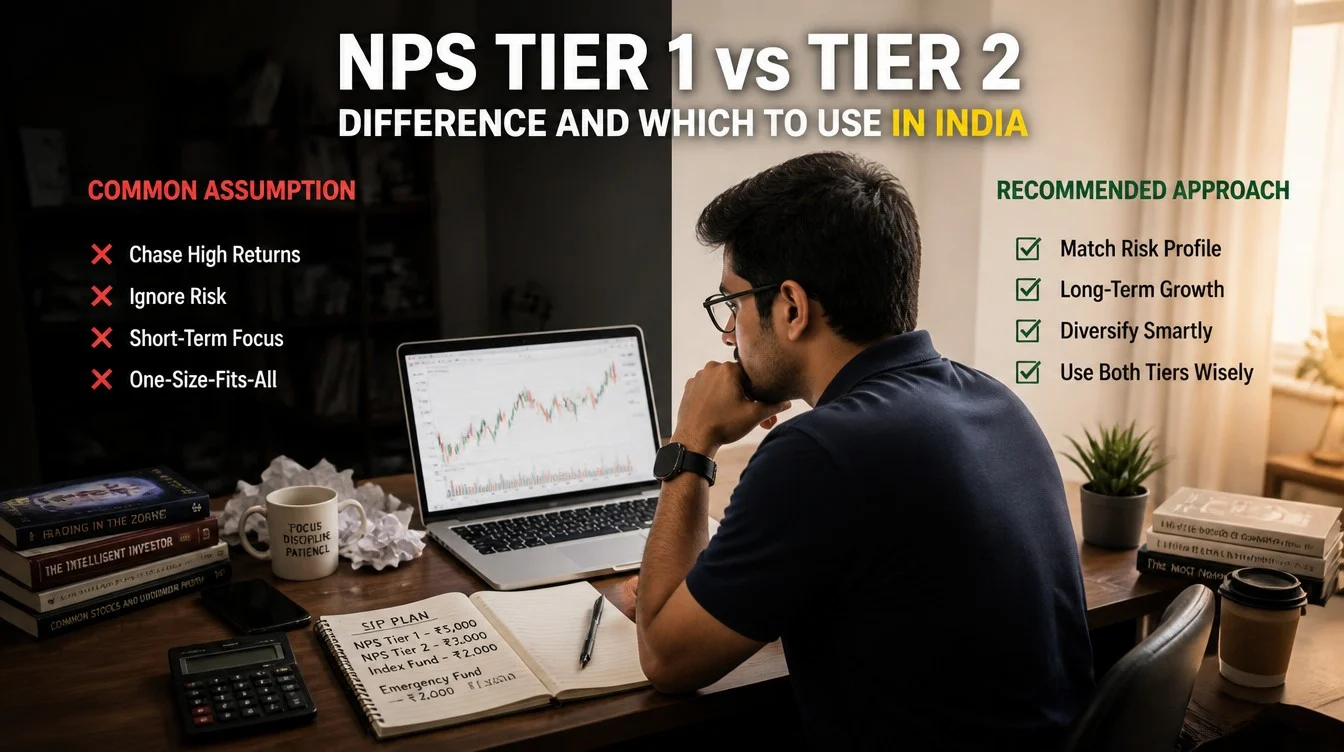
For most private sector employees, the priority is first maxing out Tier 1 (for tax benefits and retirement) and then using regular mutual funds for flexible savings. Tier 2 fills a niche that regular mutual funds can also fill – without the benefit of tax exemption on contributions. SIP in equity mutual funds is a more transparent alternative to NPS Tier 2 for flexible goal-based investing.
How to Open NPS Tier 2
To open Tier 2, you must first have an active Tier 1 account with a PRAN (Permanent Retirement Account Number). After opening Tier 1:
- Log in to the CRA (Central Recordkeeping Agency) portal (cra-nsdl.com or karvy-cra.com) using your PRAN and password.
- Navigate to “Open Tier 2 Account” in your account dashboard.
- Choose the fund manager and allocation (you can have different allocations in Tier 1 and Tier 2).
- Make the minimum initial contribution (Rs 250 or more).
- The Tier 2 account is linked to your PRAN. Contributions and withdrawals are managed through the same CRA portal.
NPS Charges: Tier 1 and Tier 2
NPS has some of the lowest investment charges in India.
- Fund management fee: 0.09% per year for both Tier 1 and Tier 2 – among the lowest of any investment product globally.
- CRA charges: Annual maintenance charge (approximately Rs 65-100 per year) per CRA. Plus transaction charges (Rs 4-20 per transaction depending on CRA).
- Point of Presence (PoP) charges: 0.25% on contributions if subscribing through a PoP (bank, post office, agent). Maximum Rs 25,000 per PoP transaction. eNPS direct subscriptions avoid PoP charges.
Opening NPS through the eNPS portal (enps.nsdl.com) avoids PoP charges and is the most cost-effective route for most individual subscribers.
Frequently Asked Questions
Can I withdraw my NPS Tier 2 amount any time without tax?
You can withdraw Tier 2 any time without restriction, but it is not tax-free. Tier 2 withdrawals are treated as capital gains for the equity and debt portions of the investment. Short-term (under 3 years) gains are taxed at a slab rate. Long-term (over 3 years) gains are taxed as debt LTCG at 12.5%. There is no equity LTCG treatment (1-year holding) for NPS Tier 2; it is taxed like a debt fund, regardless of equity allocation. This is a disadvantage compared to direct equity mutual funds where LTCG applies after 1 year.
Should I contribute more to NPS Tier 1 or to PPF if I have extra savings?
After maxing the 80CCD(1B) Rs 50,000 exclusive NPS deduction in Tier 1, you must choose between NPS Tier 1 and PPF for the next Rs 100,000 for 80C (combined with other 80C investments). NPS offers higher return potential (equity) but a mandatory annuity of 40% at exit. PPF offers guaranteed EEE treatment but lower returns. For investors under 40 with a long horizon, NPS equity allocation generates more wealth. As investors approach the age of 50-55, the value of PPF’s certainty increases. A split (50% NPS Tier 1, 50% PPF within 80C) is a balanced approach.
What happens to NPS Tier 2 if the account holder dies?
NPS Tier 2 balance is paid to the nominee without any lock-in restrictions. The nominee receives the full Tier 2 balance. Any Tier 1 balance in the case of death before age 60 is fully available to the nominee as a lump sum (the 40% annuity requirement does not apply in the event of death). This makes NPS more favourable than many perceive when considering mortality risk.
Can NRIs open NPS Tier 2?
NRIs can open NPS Tier 1 accounts. Whether Tier 2 is available to NRIs depends on PFRDA guidelines and may be restricted for some categories of NRIs. NRIs should verify current PFRDA rules before attempting to open Tier 2. NRI NPS contributions cannot be made from NRE accounts for Tier 2 (unlike Tier 1, where NRE account contributions are allowed with FEMA compliance).
Can I change the fund manager or asset allocation in Tier 2?
Yes. Tier 2 allows fund manager changes and asset allocation changes similar to Tier 1. One free switch per year is allowed for a fund manager change. Asset allocation can be changed more frequently for a small transaction fee. These changes are not taxable events in Tier 2 – switching within the NPS system is treated as a transfer, not a redemption, for tax purposes.
Related Articles
- NPS Vatsalya Scheme: Complete Guide
- New Tax Regime vs Old Tax Regime 2026
- SIP vs Lumpsum: 20-Year Backtest