


Gold Investment India: Complete Guide to Physical, ETF, SGB and Digital Gold
Gold has been the most consistently owned asset class by Indian households for centuries, yet most investors still hold it in sub-optimal forms – physical jewelry with high making charges, or digital gold on phone apps that carry hidden costs. The question is not whether to invest in gold but how: physical bars and coins, Gold ETFs, Sovereign Gold Bonds (SGBs), or digital gold each have distinct cost structures, return profiles, and liquidity characteristics. This complete gold investment india guide gives you the full comparison and a practical framework for choosing the right form for your goals.
Why Gold Belongs in an Indian Investor’s Portfolio
Gold plays a specific role in a portfolio that equity and debt cannot replicate. It is a store of value that has maintained purchasing power over centuries across civilizations. More practically for Indian investors, gold has three measurable portfolio benefits that justify a structural allocation.
Inflation Protection
Gold has historically maintained its purchasing power over long periods. When the rupee loses value to inflation, gold prices (denominated in rupees) rise to reflect that loss. An investor holding gold through high-inflation periods preserves real wealth in a way that fixed deposits at below-inflation rates cannot.
Currency Hedge
The domestic gold price reflects the international gold price converted at the current USD/INR exchange rate. When the rupee depreciates (which it does structurally by 3-4% annually against the dollar due to inflation differentials), gold prices in rupees rise even if international gold prices are flat. This makes gold a natural hedge against long-run rupee depreciation.
Portfolio Diversification
Gold has a low or negative correlation with Indian equity markets over most time periods. When equity markets fall sharply (as in 2008, 2020, and during geopolitical events), gold tends to hold its value or appreciate. Holding 10-15% of a portfolio in gold historically reduces maximum drawdown without proportionally reducing long-run returns. Together with REITs for real estate exposure, gold provides two distinct diversification layers beyond equity and debt in a complete portfolio.
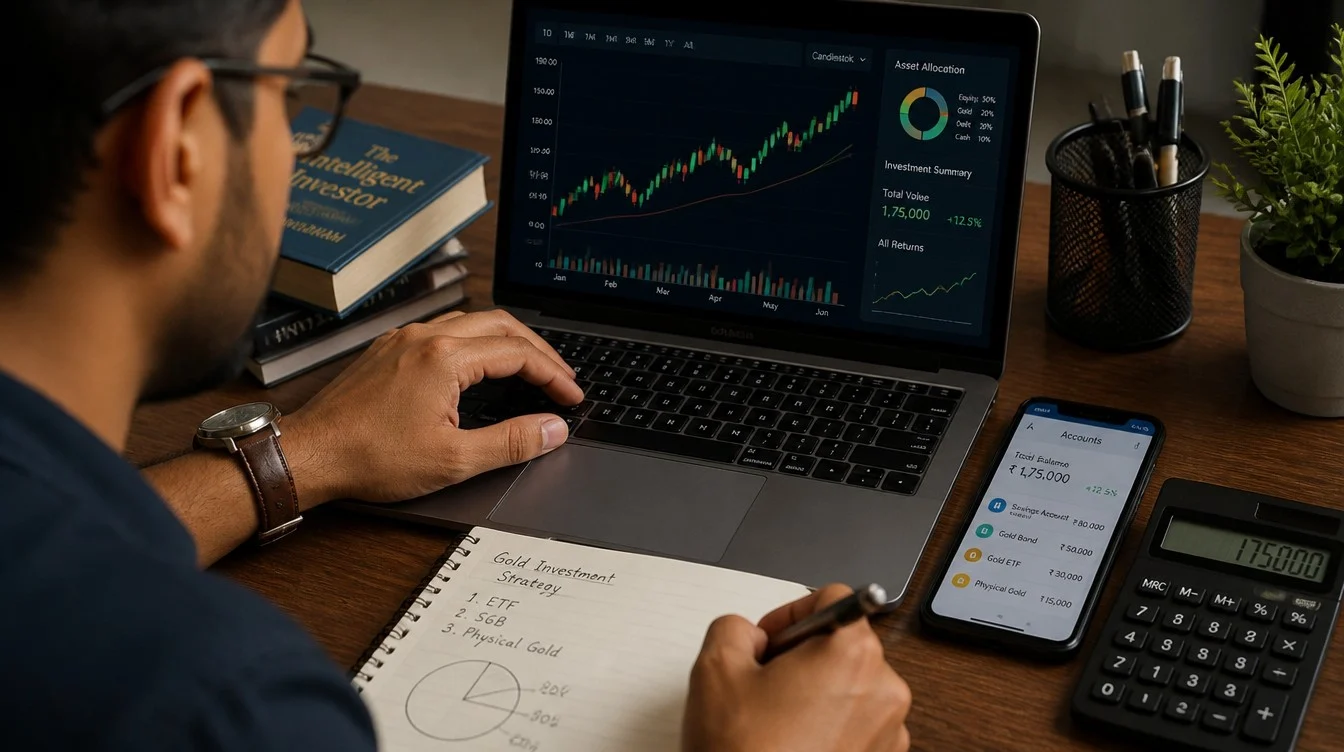
Physical Gold: Bars, Coins, and Jewelry
Physical gold is the oldest and most familiar form of gold investment in India. It comes in three forms: jewelry, coins, and bars. Each has different cost and utility profiles.
Jewelry: High Making Charges, Consumption Value
Gold jewelry combines investment value with ornamental use. The problem for pure investment purposes is the making charge: 5-25% of the gold value depending on the piece’s complexity and retailer. When you sell jewelry, buyers (jewelers, moneylenders) typically pay only the prevailing gold rate without making charges. The making charge is a permanent, non-recoverable cost. Unless jewelry serves a genuine ornamental or cultural purpose, it is among the most expensive ways to hold gold for investment.
Gold Bars and Coins: Purer Investment Form
Hallmarked 24-karat gold bars (99.9% purity) and coins from reputable dealers or banks are a purer investment form. Premium over market price is typically 1-3% for standard bars and coins (lower than jewelry making charges). Storage requires either a safe deposit box (bank locker rental: Rs 1,000-5,000 per year) or a home safe with insurance cost. Selling physical gold requires finding a buyer at fair market price – reputable jewelers and gold traders typically offer fair rates for hallmarked bars.
Costs of Physical Gold Ownership
The total cost of physical gold ownership includes: purchase premium (1-5%), storage (0.1-0.5% of gold value annually for a safe deposit locker), insurance (0.2-0.5% annually for home storage), and transaction cost when selling (typically spread of 0.5-1%). Over a 10-year holding period, total physical gold ownership costs of 2-4% cumulative (after the first-year purchase premium) make it competitive with Gold ETF expense ratios, but the illiquidity and inconvenience are meaningful drawbacks.
Gold ETFs: Exchange-Traded Convenience
Gold ETFs hold physical gold in SEBI-regulated vaults and issue exchange-traded units representing 1 gram of gold each. They solve the storage and purity problems of physical gold while offering exchange liquidity. Key features:
- No physical storage or insurance required
- Purity guaranteed by AMC (99.5%)
- Exchange liquidity: sell within minutes during market hours
- Expense ratio: 0.50-0.65% per annum (ongoing cost)
- No making charges
- Minimum purchase: 1 unit (approximately 1 gram, Rs 6,000-7,000)
Gold ETF capital gains are taxed at STCG (20% under 1 year) or LTCG (12.5% over 1 year) rates for units purchased after July 23, 2024. The tax treatment is now aligned with equity, making long-term Gold ETF holdings more tax-efficient than they were under the pre-2024 debt fund tax rules that applied to gold funds previously.
Sovereign Gold Bonds: Best Long-Term Returns
Sovereign Gold Bonds (SGBs) are government securities issued by the RBI, offering gold price returns plus 2.5% annual interest on the issue price, with completely tax-free capital gains at 8-year maturity. They are the highest-return form of gold investment for investors who can commit to the tenure.
SGB Advantages
The 2.5% annual interest adds approximately Rs 21,000 on a Rs 1 lakh investment over 8 years. Combined with the zero expense ratio (compared to 0.55% on Gold ETFs), SGBs outperform Gold ETFs by approximately 3% per annum before tax on a long-term basis. The capital gains tax exemption at maturity is a further boost, particularly for investors in the 30% tax bracket.
SGB Limitations
SGBs are illiquid before the 5-year exit window. Secondary market trading is possible but spreads are wide. SGBs are issued in specific tranches throughout the year – you cannot buy them on demand like a Gold ETF. Maximum purchase is 4 kg per financial year per person. The detailed three-way comparison of digital gold, SGB, and Gold ETF quantifies the return difference across scenarios and investment horizons.

Digital Gold: Convenience vs Cost
Digital gold platforms (Paytm, PhonePe, SafeGold, MMTC-PAMP) allow gold purchases starting from Rs 1, with the gold held in vaults on your behalf. The convenience of micro-purchases makes it accessible, but the cost structure is opaque and typically higher than regulated instruments.
Digital gold charges include a spread (difference between buying and selling price, typically 2-3%), storage fee (0.5-0.75% per annum on some platforms), and GST at 3% on purchase. Total effective cost is significantly higher than Gold ETFs or SGBs. For purchases under Rs 1,000-2,000 where Gold ETFs are impractical (minimum unit price), digital gold can be a starter option, but for any meaningful investment amount, Gold ETFs or SGBs are superior. Digital gold platforms are not SEBI-regulated, which adds a regulatory risk dimension absent from ETFs and SGBs.
Gold Mutual Funds: Alternative to ETF via FOF
Gold saving funds (fund of funds investing in Gold ETFs) allow SIP investment in gold without a demat account. They have slightly higher expense ratios than direct Gold ETFs (0.10-0.20% additional layer of expenses) but offer the convenience of automated SIP from a bank account without exchange trading mechanics. For investors who want monthly gold SIPs and do not have a demat account, gold saving funds are a reasonable alternative.
Gold Investment Comparison: All Forms
| Form | Purity | Liquidity | Annual Cost | Additional Return | Tax |
|---|---|---|---|---|---|
| Jewelry | 22kt typically | Limited; making charge lost | 0.3-1% (storage) | None | Slab rate on gains |
| Coins/Bars | 24kt (99.9%) | Moderate; need trusted buyer | 0.3-0.7% (storage) | None | Slab rate on gains |
| Gold ETF | 99.5% (SEBI regulated) | High; exchange traded | 0.50-0.65% expense ratio | None | LTCG 12.5% (over 1 yr) |
| SGB | Equivalent to 24kt | Low (before 5-yr exit) | Zero | 2.5% p.a. interest | Capital gains tax-free at maturity |
| Digital Gold | 24kt (varies by platform) | Moderate; platform dependent | 0.5-0.75% storage + spread | None | Slab rate on gains |
| Gold Saving Fund | 99.5% (via ETF) | T+1 to T+3 | 0.70-0.90% total | None | Same as Gold ETF |
How Much Gold Should You Hold?
The standard guidance for gold allocation in a diversified Indian portfolio is 5-15% of investable assets. Below 5%, the diversification benefit is too small to matter. Above 20%, gold’s lack of productive yield begins to drag on long-term compounding versus equity. The right allocation within this range depends on your risk tolerance, time horizon, and specific goals.
A simple allocation framework: 10% of a growth-oriented portfolio (5-7 year+ horizon) in a combination of SGBs (held to maturity for maximum return) and Gold ETFs (for liquidity reserve). The SGBs represent the long-term committed allocation; the Gold ETFs represent the portion accessible without waiting for the 5-year exit window. For investors building wealth through SIPs, a small regular gold purchase through a gold saving fund alongside equity SIPs maintains a consistent allocation through market cycles.
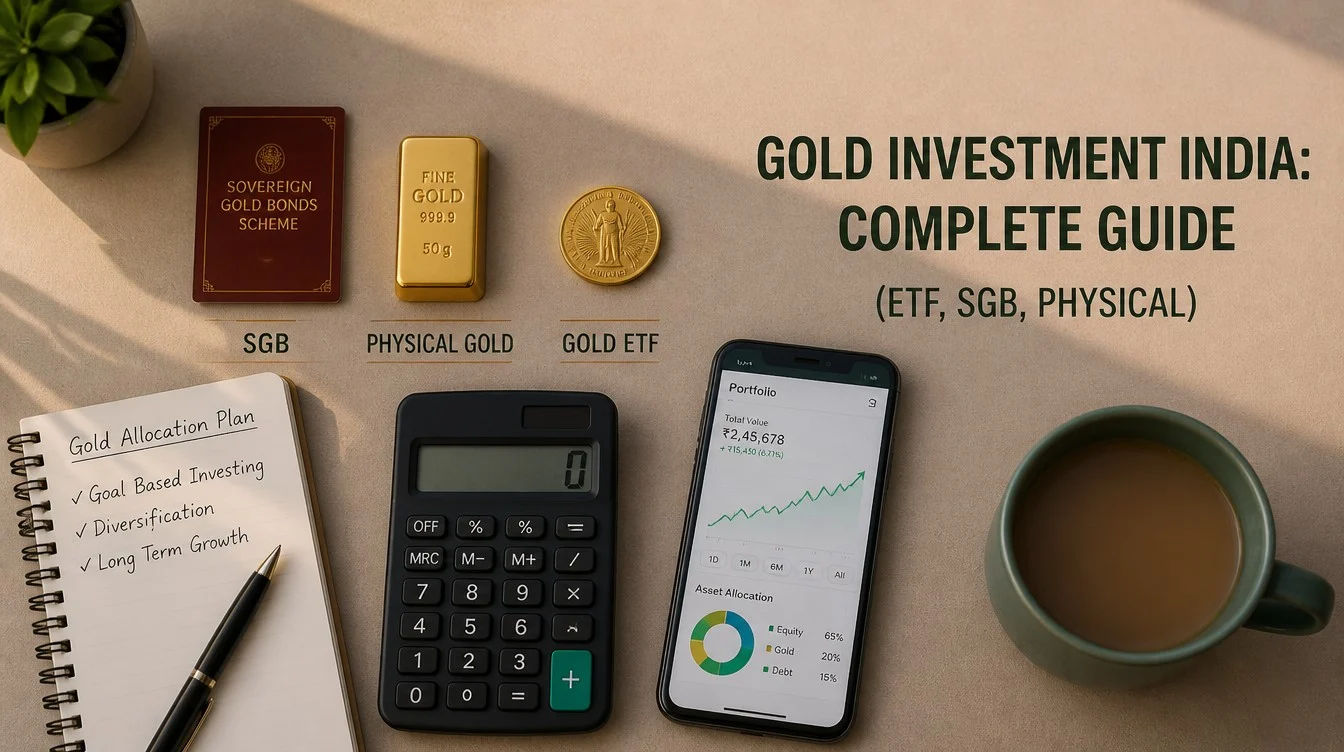
Advanced Gold Strategies: Loans, Leasing, and Jewelry Monetization
Beyond simple buy-and-hold gold investment, several mechanisms allow Indian investors to extract economic value from gold holdings without selling them.
Gold Loans: Using Gold as Collateral
Banks and gold loan NBFCs (Muthoot Finance, Manappuram Finance) offer loans against physical gold pledged as collateral. Loan-to-value ratios are typically 65-75% of the gold’s market value. Interest rates range from 7% to 18% depending on the lender, loan tenure, and LTV. Gold loans are useful for short-term liquidity needs (6-12 months) when you want to retain gold ownership but need cash. The gold is returned when the loan is repaid. Interest paid on gold loans for business purposes may be tax-deductible; personal loans are not.
The risk of gold loans is that if you cannot repay, the lender auctions the pledged gold to recover the loan. For investors using gold as a long-term wealth store, taking gold loans during temporary cash crunches can be a cost-effective alternative to selling gold and repurchasing later at (potentially higher) prices.
Gold Monetization Scheme
The Government of India’s Gold Monetization Scheme (GMS) allows individuals and institutions to deposit physical gold (minimum 10 grams) with banks for a fixed term (1-15 years) and earn interest on the gold deposited (0.25-2.50% per annum depending on tenure). The gold is melted and purified on deposit, so this scheme is not suitable for jewelry with sentimental value. At maturity, investors can receive either gold or cash equivalent. The scheme is designed to mobilize India’s estimated household gold stock of 25,000 tonnes.
For investors holding idle gold in bank lockers with no plan to use it, the GMS offers a way to earn interest on an otherwise non-yielding asset. The scheme is useful for large, pure gold holdings (bars, coins) that are purely investment-oriented without ornamental function.
Digital Pledge Platforms
Some fintech platforms allow investors to pledge digital gold or Gold ETF units as collateral for short-term loans or to use as margin for trading accounts. This provides liquidity without converting the gold holding to cash. These platforms are relatively new and should be evaluated for regulatory status, counterparty risk, and terms before use. SEBI-regulated Gold ETFs pledged with established broker platforms carry lower counterparty risk than digital gold pledges on unregulated fintech apps.
Building a Complete Gold Allocation: A Step-by-Step Framework
Here is a practical, actionable framework for building and maintaining a gold allocation in an Indian retail investor’s portfolio.
Step 1: Decide Total Gold Allocation
Target 5-15% of investable assets in gold. For a Rs 20 lakh portfolio, this means Rs 1 lakh to Rs 3 lakh in gold. Most investors are comfortable at 10% (Rs 2 lakh in the example).
Step 2: Split Between SGB and Gold ETF
Allocate 70% to SGBs (held for 8-year returns) and 30% to Gold ETFs (for liquidity). In the example: Rs 1.4 lakh in SGBs and Rs 60,000 in Gold ETFs. Buy SGBs during each annual tranche opening. Hold Gold ETFs in a direct plan demat account.
Step 3: SGB Purchase Discipline
Set a calendar reminder for each RBI SGB tranche opening (announced 1-2 weeks before). Apply online through your bank or broker for the Rs 50/gram online discount. Purchase a fixed quantity each tranche rather than trying to time based on gold price views.
Step 4: Gold ETF SIP for Monthly Accumulation
If you prefer monthly contribution to gold, set up a SIP in a gold saving fund (fund of funds) through a direct plan mutual fund platform. Start with Rs 500-1,000 per month. This builds the Gold ETF/gold saving fund allocation over time without needing to make exchange purchases each month.
Step 5: Annual Rebalancing
Once a year, review your gold allocation as a percentage of total portfolio. If equity has surged and gold has fallen to 6% of portfolio, add to gold. If gold has risen to 18% due to a gold price surge, sell some Gold ETFs and redirect proceeds to equity or debt. Annual rebalancing enforces buy-low-sell-high discipline systematically. Systematic rebalancing removes the emotional difficulty of selling gold after it has risen (which feels counterintuitive) and buying more after it has fallen (which also feels uncomfortable).
Common Mistakes in Gold Investing India
Knowing the pitfalls prevents the most common and costly errors in gold investment.
Treating jewelry as investment: Gold jewelry serves cultural and ornamental purposes, but the 10-25% making charges mean you need gold prices to rise by that amount before you break even on an investment basis. Separate ornamental gold (held for cultural value) from investment gold (held in ETF or SGB form) mentally and in your portfolio accounting.
Concentrating entirely in physical gold: Physical gold carries theft, fire, and storage risks that diversified financial instruments avoid. Insuring and storing large quantities of physical gold is expensive and logistically inconvenient. For amounts above Rs 1-2 lakh, financial gold instruments (ETF, SGB) are safer and more cost-effective.
Holding too much gold in digital gold platforms: Digital gold platforms are not regulated by SEBI and carry platform risk (the operator could face regulatory action, technical failure, or financial distress). For amounts above Rs 10,000-20,000, shift to SEBI-regulated Gold ETFs. Keep digital gold for micro-purchases only.
Not buying SGBs during available tranches: Each SGB tranche is open for only 5 days. Investors who miss tranches because they were not monitoring miss the 8-year compounding of 2.5% interest and tax-free capital gains. Set a reminder system – subscribe to RBI notifications or your bank’s SGB alerts to never miss a tranche.
Over-allocating to gold during price peaks: Gold tends to attract investor attention and inflows after a major price surge (as in 2020). Buying heavily at cycle peaks (as with any asset class) produces disappointing returns. Systematic allocation regardless of price through SIPs or annual SGB purchases removes the peak-chasing temptation.
Gold Investment Strategy for Different Goals
For Emergency Reserve (Gold Component)
If you want gold as part of your emergency reserve (some investors prefer gold’s liquidity in extreme scenarios), Gold ETFs are the only appropriate form. SGBs cannot be accessed quickly; physical gold requires finding a buyer. Keep this portion small (2-3% of emergency corpus) and in liquid Gold ETFs.
For Long-Term Wealth Accumulation
SGBs held to maturity deliver the best return: gold price appreciation + 2.5% interest + no expense ratio + tax-free capital gains at maturity. Buy each available SGB tranche within the Rs 4 kg annual limit (most investors need far less). For amounts beyond what SGBs cover, Gold ETFs in direct plan are the next best option.
For Portfolio Hedging
Gold ETFs serve the hedging purpose most effectively because they can be bought and sold instantly to rebalance the portfolio. When equity surges and gold allocation falls below target, buy more Gold ETF. When equity crashes and gold allocation rises above target (as gold rises), sell some Gold ETF and buy equity. This rebalancing discipline captures the counter-cyclical nature of gold’s portfolio role. The discipline to sell gold after it has risen and buy equity after it has fallen requires overcoming strong behavioural tendencies – systematic rebalancing removes this discretionary challenge.
Gold Price Drivers: What Moves Gold in India?
Understanding what drives gold prices helps you interpret market movements without panicking or over-optimizing. Gold prices in India are determined by two components: the international spot gold price (quoted in USD per troy ounce) and the USD/INR exchange rate. Both factors contribute to rupee-denominated gold returns.
International Gold Price Drivers
Global gold prices are influenced by several macro factors that are worth understanding even for domestic investors. US real interest rates (Treasury yields minus inflation) are the strongest single predictor of gold prices: when US real rates fall (either because nominal rates fall or inflation rises), gold becomes more attractive as a zero-yield asset versus rate-bearing bonds. This is why gold surged during the 2020 pandemic (near-zero rates, high inflation expectations) and fell during the 2022-2023 rate hike cycle (rising real rates made bonds more attractive).
Geopolitical risk is a second driver: gold benefits from “flight to safety” flows when global risk perception rises (Russia-Ukraine conflict, Israel-Gaza tensions, US-China trade wars). Central bank gold purchases are a third, longer-term driver: emerging market central banks (China, India, Turkey, Russia) have been systematically adding gold to their reserves since 2015, creating a structural demand floor below spot prices.
Rupee Depreciation: The India-Specific Return Enhancer
For Indian investors, rupee depreciation adds a consistent tailwind to gold returns. Between 2003 and 2023, the Indian rupee depreciated from approximately Rs 45/USD to Rs 84/USD – a 87% depreciation. This means an Indian investor holding gold during this period received not just international gold price appreciation but also currency-related returns. A 5% global gold price appreciation in a year when the rupee falls 4% against the dollar produces a 9% INR return on the gold holding.
This currency return is not guaranteed in any single year – the rupee can appreciate against the dollar in specific years (as it did in 2017-2018). But the structural trend over decades is consistent depreciation, making gold a natural long-run currency hedge for Indian investors. Long-term financial independence calculations for Indian investors should account for rupee depreciation as a risk that gold partially mitigates in a diversified portfolio.
Timing Gold Investment: Does It Matter?
The honest answer is that timing gold investment matters less than most investors assume, and systematic investment removes the timing question entirely. Gold price cycles are long (5-10 years), and entry price relative to the cycle matters for near-term returns but smooths out over 10+ year holding periods.
The Case Against Timing
Investors who tried to time gold’s run-up from 2003 to 2012 (a 500%+ INR return over the decade) typically underperformed compared to systematic buyers because gold prices rose with few major entry-point opportunities. Those who waited for a “correction” after 2012 (when gold fell globally from its peak) waited 6-7 years before the next major rally in 2019-2020. The cost of waiting – in foregone returns and the psychological toll of watching gold rise without you – typically exceeds any benefit from better entry pricing.
Systematic Investment: The Recommended Approach
Annual SGB purchases (each time a tranche is issued) or monthly gold saving fund SIPs are the most practical approach for retail investors. Systematic buying averages entry prices across market cycles and removes the decision fatigue of waiting for the “right” entry. The 2.5% annual interest on SGBs provides a guaranteed return component that partially compensates for suboptimal timing even in years when gold prices are flat or slightly negative. The documented advantage of systematic investment over lumpsum timing applies to gold as much as to equity.
Gold and Inflation: The Historical Record in India
The most frequently cited reason to hold gold is inflation protection. How well has gold actually protected Indian investors from inflation historically? The data is supportive but nuanced.
Over 20-year periods, gold has broadly maintained purchasing power in India. From 2003 to 2023, Indian CPI inflation averaged approximately 6-7% per annum, while gold prices in INR terms rose at approximately 10-12% per annum compound – generating a 3-5% real return above inflation. This real return is lower than Indian equities (which have delivered 12-15% compound over similar periods) but positive and consistent, unlike fixed deposits in high-inflation environments that often yield negative real returns.
The limitation of gold as an inflation hedge is timing: gold may fall in periods of rising inflation (2013-2014 in India) because global factors (US rate hikes, falling commodity prices) dominated. The inflation hedge works best over 5-10 year periods, not year-by-year. Investors who need an asset that maintains purchasing power over 3-6 month periods should use inflation-linked bonds (IIBs) or floating rate instruments, not gold. For 5+ year protection against structural inflation, gold has a good track record in Indian data.
Gold as an Inheritance Asset: Cultural and Financial Dimensions
In the Indian context, gold carries significant cultural weight as a traditional wealth transfer asset across generations. Families hold gold as a store of value that bridges economic disruptions, can be used as collateral for loans during emergencies, and passes easily to heirs. These cultural factors are legitimate reasons to hold some physical gold beyond pure financial optimization.
For the inheritance dimension, physical gold (bars, coins) and SGBs both serve the purpose. SGBs can be transferred or inherited (nominees receive the redemption amount at maturity). Physical gold is the most portable and private form of wealth transfer, though it carries storage and security considerations. Gold ETFs and digital gold can be inherited through the usual financial account succession process (nomination, transmission).
Balancing the cultural preference for physical gold with the financial optimization of SGBs and Gold ETFs is a reasonable practical approach: hold a small amount in hallmarked physical gold for cultural purposes and the bulk of the gold allocation in SGBs and Gold ETFs for financial efficiency. This hybrid approach satisfies both dimensions without sacrificing too much on financial returns. Government savings instruments like NPS and PPF can complement the gold allocation in a complete intergenerational wealth-building strategy.
Frequently Asked Questions
Which form of gold investment is best in India?
For investors with an 8-year horizon and no near-term liquidity need: Sovereign Gold Bonds (SGBs) are best due to 2.5% annual interest, zero expense ratio, and tax-free capital gains at maturity. For investors needing liquidity or flexibility: Gold ETFs from established AMCs (HDFC, Nippon India, ICICI Prudential) are best. Physical gold in the form of jewelry has the highest effective cost due to making charges and is not recommended for pure investment purposes. Digital gold is convenient for micro-amounts but should not be used for significant investments.
Is gold a good investment in India in 2025?
Gold has returned approximately 10-12% compound annual returns in INR terms over the past 20 years in India, reflecting both international gold price appreciation and rupee depreciation. Whether it is a good investment in any specific year depends on gold prices, inflation, and currency dynamics at that point. As a long-term portfolio allocation of 5-15%, gold has consistently provided diversification and inflation protection. Timing gold market entry is difficult; systematic investment through gold saving fund SIPs or annual SGB purchases removes the timing question.
What is the minimum investment in gold ETF India?
One unit of a Gold ETF represents approximately 1 gram of gold, priced at approximately Rs 6,000-7,000 at current gold prices. This is the minimum purchase via exchange. For demat-free gold investing, gold saving funds (fund of funds investing in Gold ETFs) accept SIP investments starting from Rs 500 per month, making gold accessible for systematic small-amount investors.
How is gold investment taxed in India?
Gold ETFs and gold saving funds are now classified as equity funds for capital gains tax (post-July 23, 2024 budget clarification): LTCG at 12.5% after 1 year, STCG at 20% under 1 year. Physical gold gains are taxed at the investor’s slab rate. Sovereign Gold Bond capital gains at 8-year maturity are completely tax-free. SGB interest (2.5% per annum) is taxable at the slab rate when received.
Should I invest in SGB or Gold ETF in India?
If you can commit to 8 years, SGBs deliver better total returns due to 2.5% annual interest, zero expense ratio, and tax-free capital gains at maturity. If you need liquidity before 5 years or want to invest in small monthly amounts via SIP, Gold ETFs (or gold saving funds) are more appropriate. Many investors hold both: SGBs for the long-term committed allocation and Gold ETFs for the liquid component.
Related Articles
- Digital Gold vs Sovereign Gold Bond vs Gold ETF: Full Comparison
- SIP vs Lumpsum: 20-Year Backtest Results
- REIT Investment India: Complete Guide