

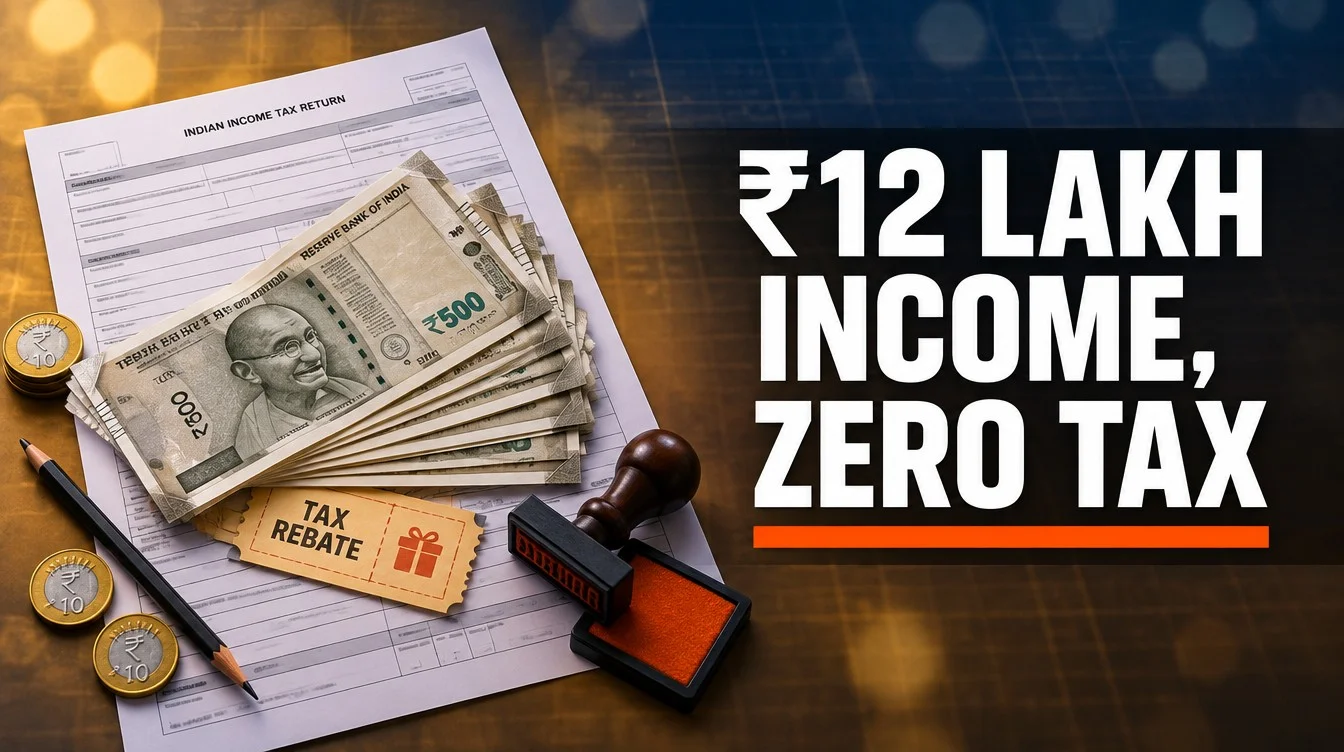
If your total income lands near Rs.1,200,000 (12 lakh) this year and you still expect a tax bill, the Section 87A rebate rules in India for FY 2025-26 may surprise you. Under the new tax regime, a salaried taxpayer can legally pay zero income tax on income up to Rs.12 lakh and up to Rs.12,75,000 (12.75 lakh) once the standard deduction is taken into account. This is not a loophole or a scheme you buy. It is a straight rebate the government hands back after tax is computed on the slabs.
Yet the details can be confusing. Where does the tax-free ceiling actually lie? What happens if you earn one rupee more than the threshold? This guide walks through the arithmetic step by step, shows a marginal-relief worked example, and compares how the rebate behaves under the old regime versus the new one.

What the Section 87A Rebate India Actually Does
Section 87A is a rebate written into the Income Tax Act. A deduction reduces your taxable income before tax is calculated; a rebate reduces the tax itself after the slab maths are done.
Think of it as a coupon applied at checkout. The store first rings up the full price, which includes your slab tax; the coupon then reduces that total, and if the coupon value exceeds the bill, the bill becomes zero.
Who can claim the rebate
The rebate is available only to resident individuals. Non-resident Indians, Hindu Undivided Families, firms, and companies cannot claim Section 87A. It applies to salaried, self-employed, and pensioner residents alike, as long as total income stays within the qualifying limit.
New regime versus old regime ceilings
The rebate exists in both tax regimes, but the numbers differ sharply. Under the old regime, it was capped at Rs.12,500 and applied only to total income up to Rs.500,000 (5 lakh). Under the new regime for FY 2025-26, it rises to Rs 60,000 with the ceiling at Rs 1,200,000. That gap is why the new regime now dominates the tax-free conversation.
How the Rs.60,000 Rebate Makes Rs.12 Lakh Tax-Free
To see why Rs.12 lakh becomes tax-free, calculate the slab tax first, then apply the rebate. The new regime slabs for FY 2025-26 tax the income across several bands, not at one flat rate.
The slab-by-slab calculation
The tax on exactly Rs.1,200,000 under the new regime, before any rebate, is
- Rs.0 to Rs.400,000: nil
- Rs.400,001 to Rs.800,000 at 5 cent: Rs.20,000
- Rs.800,001 to Rs.1,200,000 at 10 percent: Rs.40,000
- Total slab tax: Rs.60,000
The slab tax on Rs.12 lakh comes to exactly Rs.60,000, and the new-regime Section 87A rebate is also Rs.60,000. The rebate cancels the tax on the rupee, which is why income up to Rs.12 lakh is effectively tax-free by deliberate design.
Why cess does not spoil the result
A health and education cess of 4 percent applies only to the tax payable after the rebate. Because the rebate drives the tax to zero, there is no base for cess to attach to, so the final liability stays at zero. This sequence echoes the wider shift covered in the Union Budget 2025 tax changes that lifted the rebate ceiling.
Standard Deduction Taking Salaried Income to Rs.12.75 Lakh
The Rs 12 lakh figure is a total-income number, meaning income after deductions. Salaried taxpayers get one extra layer that lifts their gross ceiling.
How the standard deduction works
The new regime allows a standard deduction of Rs.75,000 from salary income. This is automatic and needs no proof or investment. It is subtracted from gross salary before total income is measured against the Rs.12 lakh rebate line.
So a salaried person on a gross salary of Rs.1,275,000 (12.75 lakh) subtracts Rs.75,000 and arrives at a total income of Rs.1,200,000, which qualifies for the full rebate. In practice, this is why the salaried headline is Rs.12.75 lakh rather than Rs.12 lakh.
A quick worked example
Consider Priya, a salaried professional in Pune with a gross annual salary of Rs 1,275,000:
- Gross salary: Rs.1,275,000
- Less standard deduction: Rs.75,000
- Total income: 1,200,000
- Slab tax on Rs.1,200,000: Rs.60,000
- Less Section 87 A rebate: Rs.60,000
- Tax payable: Rs 0
Priya still has to file a return even though her tax is nil, because filing is what records the rebate claim. The income tax return filing guide for India covers zero-tax cases too.
Marginal Relief Just Above Rs.12 Lakh: A Worked Example
What happens if you earn just one rupee more than Rs.12 lakh? Without a safeguard, a taxpayer at Rs.1,210,000 would owe far more than someone at Rs.1,200,000. The law solves this issue with marginal relief.
The direct answer
Marginal relief ensures the tax you pay on income slightly above Rs.12 lakh never exceeds the amount by which your income crosses Rs.12 lakh. At Rs.1,210,000, income crosses the line by Rs.10,000, so tax after marginal relief cannot exceed roughly Rs.10,000 rather than the full slab tax of about Rs.61,500.
Walking through Rs.1,210,000
For a total income of Rs.1,210,000:
- Slab tax on Rs.1,210,000: about Rs.61,500 (the extra Rs.10,000 falls in the 15 percent band)
- Income above Rs.12 lakh: Rs.10,000
- Marginal relief caps tax at the excess, so tax payable is limited to Rs.10,000
The relief phases out as income rises. Once the normal slab tax falls below the excess over Rs 12 lakh, it no longer helps, and you pay the regular slab tax. The break-even point sits just above Rs.1,275,000 of total income.
Why this matters for bonuses
A year-end bonus that nudges you from Rs.12 lakh to Rs.12.5 lakh will not cost you the full slab tax on the extra amount, thanks to marginal relief. That prevents you from refusing a raise due to a mistaken fear of a cliff.

Old Versus New Regime Rebate Difference
The rebate is the biggest reason most salaried taxpayers now default to the new regime, and a side-by-side comparison makes the gap obvious.
Rebate comparison table
| Feature | Old regime | New regime (FY 2025-26) |
|---|---|---|
| Maximum Section 87A rebate | Rs.12,500 | Rs.60,000 |
| Income ceiling for rebate | Rs 500,000 | Rs 1,200,000 |
| Standard deduction (salaried) | Rs.50,000 | Rs.75,000 |
| Effective tax-free salary | Rs 550,000 | Rs.1,275,000 |
| Marginal relief above ceiling | Not applicable | Yes, above Rs 12 lakh |
When the old regime can still win
The old regime is not dead. Taxpayers with large deductions, such as home-loan interest, a full Rs.150,000 (1.5 lakh) under Section 80C, and health insurance premiums may still pay less under the old regime despite the smaller rebate. Running both numbers is the only reliable way to choose, and the cheat sheet comparing the old and new tax regimes lays out every decision point.
Common Mistakes When Claiming the Section 87A Rebate India
Even a well-designed rebate gets fumbled in practice. A few recurring errors cost people money or invite notices.
Mistakes to avoid
- Assuming the Rs.12 lakh limit is gross salary rather than total income after the standard deduction.
- It is important to remember that special-rate incomes are excluded from the rebate calculation, meaning capital gains do not enjoy the same shelter.
- Believing a nil-tax return means no return is needed. Filing is still required to record the rebate.
- Picking the wrong regime because the rebate looked attractive in isolation, without comparing total liability.
The capital-gains exclusion
The rebate does not apply to income taxed at special rates, such as long-term capital gains on equity or gains from virtual digital assets. That slice is taxed separately, and the rebate cannot wipe it out. Market-linked instruments carry market risk, and their gains follow their own rules; the same holds for crypto, explained in the crypto tax India guide.

Steps to Make the Most of the Section 87A Rebate India
Turning the rebate into a real zero-tax outcome takes a little planning, and these steps help you keep the numbers in your favour.
A practical checklist
- Add up your gross salary and any other income for FY 2025-26.
- Subtract the Rs.75,000 standard deduction if you are salaried.
- Check whether your total income lands at or below Rs.1,200,000.
- If you are slightly above, model the marginal-relief cap before assuming a large tax bill.
- Cross-check the income and TDS figures the department already has for you.
- Please file your return to formally claim the rebate, even if your tax is nil.
Before filing, reconcile your salary, interest, and TDS against the statements the department holds, as explained in the guide to using AIS and TIS when filing. Catching a mismatch early avoids rework.
Frequently Asked Questions
Is income up to Rs.12 lakh completely tax-free for everyone?
No. The Rs.12 lakh tax-free position applies only under the new regime and only to income taxed at normal slab rates. Special-rate income such as capital gains is excluded, and the claimant must be a resident individual.
Does the standard deduction actually raise the limit to Rs.12.75 lakh?
Yes, for salaried taxpayers and pensioners. The new regime standard deduction of Rs.75,000 is subtracted from gross salary, so Rs.1,275,000 becomes a total income of Rs.1,200,000, which qualifies for the full rebate.
What is marginal relief in simple terms?
Marginal relief caps the tax on income just above Rs 12 lakh so it never exceeds the amount by which income crosses the threshold. It stops a small income increase from triggering a large tax bill.
Can I claim the Section 87A rebate under the old regime?
Yes, but the old-regime rebate is only Rs. 12,500 and only for total income up to Rs. 5 lakh. The larger Rs.60,000 rebate and Rs.12 lakh ceiling exist only under the new regime for FY 2025-26.
Do I still need to file a return if my tax is zero after the rebate?
Yes. Filing is how you formally claim the rebate and record your income. A nil final tax does not remove the obligation, and filing also lets you claim any refund of TDS already deducted.