


Sovereign Gold Bond Scheme India: Returns, Tax and How to Buy
The sovereign gold bond scheme india is the most return-efficient way for Indian investors to hold gold. Issued by the Reserve Bank of India on behalf of the Government of India, SGBs give you gold price returns plus 2.5% annual interest, with capital gains completely tax-free at 8-year maturity. No storage cost, no purity risk, no making charges. This guide covers everything you need to know: how SGBs work, returns calculation, tax treatment, how to buy, early exit options, and whether SGBs are right for your situation.
What Is the Sovereign Gold Bond Scheme?
Sovereign Gold Bonds are government securities denominated in grams of gold. Each bond unit represents 1 gram of gold. The bonds are issued by the RBI in tranches (batches) throughout the financial year, typically 6-8 tranches. Each tranche is open for subscription for 5 days. The issue price is based on the simple average of the closing price of gold (999 purity) for the preceding 3 business days, published by the India Bullion and Jewellers Association (IBJA).
Investors who apply online through banks, post offices, NSE/BSE, or designated brokers receive a Rs 50 per gram discount on the issue price. This makes online SGB purchases slightly cheaper than buying equivalent physical gold or Gold ETFs at market price.
Interest Rate: 2.5% Per Annum
SGBs pay a fixed interest of 2.5% per annum on the nominal value (the issue price at the time of purchase). This interest is paid semi-annually – in April and October each year. The interest payment is fixed regardless of whether gold prices rise or fall. On a 1 gram SGB purchased at Rs 7,000 (example issue price), you receive Rs 175 per year (Rs 87.50 every 6 months) until maturity.
SGB Returns: How to Calculate Your Total Return
SGB total returns have three components: gold price appreciation, 2.5% annual interest, and tax treatment at exit.
| Component | Detail |
|---|---|
| Gold price return | Change in gold price between purchase and redemption date |
| Annual interest | 2.5% of issue price, paid semi-annually for 8 years |
| Online discount | Rs 50/gram reduction on issue price for online buyers |
| Capital gains tax | Zero at 8-year maturity; potentially taxable on early exit |
| Interest tax | Added to income; taxed at slab rate |
Example calculation: You buy 10 grams of SGB at Rs 7,000/gram (total Rs 70,000). Over 8 years, gold price rises to Rs 14,000/gram. Interest received: Rs 1,750 per year x 8 years = Rs 14,000 total (taxed at slab rate). Capital gain: Rs 70,000 (completely tax-free at maturity). Total redemption: Rs 1,40,000 principal + Rs 14,000 interest received. Net return calculation: 14,000 capital gain (100% tax-free) + 14,000 interest (taxable). Compare this to a Gold ETF: same Rs 70,000 invested, same gold price return, but 0.55% annual expense ratio (Rs 3,500 over 8 years foregone) and 12.5% LTCG tax on Rs 70,000 gain (Rs 8,750 tax). The SGB advantage is substantial. The complete three-way comparison of gold investment options quantifies this advantage across different scenarios.

How to Buy Sovereign Gold Bonds
SGBs can be purchased through the following channels during each tranche’s subscription window:
- Scheduled commercial banks: Most major banks (SBI, HDFC, ICICI, Axis, Kotak) accept SGB applications online and at branches. Online applicants receive the Rs 50/gram discount automatically.
- Post offices: All designated post offices accept SGB applications during the subscription window.
- NSE and BSE: Applications can be placed through the stock exchange portal during the subscription period.
- SEBI-registered brokers and agents: Most discount brokers (Zerodha, Groww, Upstox) accept SGB applications during tranches.
Steps to apply online through your bank: Log in to net banking, go to Investments or SGB section, select the current tranche, enter the number of grams you want to purchase, confirm payment. The bonds are credited to your demat account (if you have one) or held in the RBI’s bond ledger account against your PAN.
Subscription Limits
Minimum purchase: 1 gram. Maximum per financial year: 4 kg for individuals, 4 kg for Hindu Undivided Families (HUF), and 20 kg for trusts and similar entities. The limit applies across all tranches in a financial year combined, not per tranche.
SGB Maturity and Early Exit Options
The standard SGB tenure is 8 years. However, there are two exit routes before maturity.
Early Exit from Year 5 (Coupon Date Exit)
The RBI provides an early exit facility from the 5th year of the bond, exercisable on the coupon payment dates (typically April and October). To exit early, submit a request to your bank or broker before the coupon date. The redemption amount is calculated at the prevailing gold price on that date. Capital gains from early exit (between years 5-8) may be taxable – verify current tax rules with a tax advisor, as the exemption specifically applies to maturity at 8 years.
Secondary Market Exit
SGBs are listed on NSE and BSE and can be sold on the secondary market at any time after the mandatory holding period. However, secondary market liquidity is thin for most SGB series – typical daily volume is a few hundred to a few thousand grams. To sell on secondary market, you need your SGBs in demat form (not all SGB holders have demat-linked holdings). Secondary market exits often involve selling at a discount to the prevailing gold NAV due to liquidity constraints. This route is available but should be considered a last resort rather than a planned exit strategy. If you need liquidity within 3-5 years, Gold ETFs are more appropriate than SGBs because the secondary market for SGBs is unreliable.
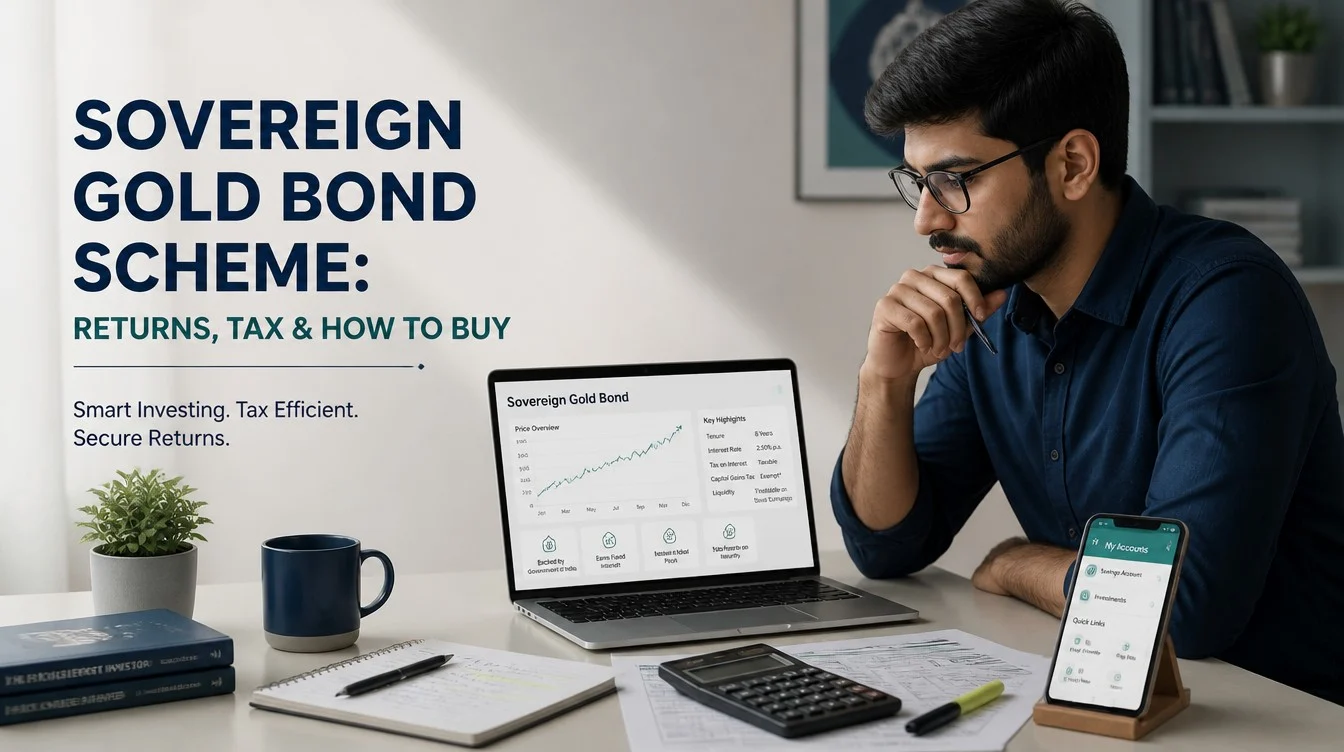
SGB Tax Treatment: The Key Advantage
The tax treatment of SGBs is the most compelling reason to choose them for long-term gold investment.
Capital Gains at 8-Year Maturity: Completely Tax-Free
When the RBI redeems your SGB at the 8-year maturity date, the entire capital gain is exempt from tax. This means if gold prices double over 8 years, the entire 100% price return is tax-free. For investors in the 30% tax bracket, this saves 12.5% LTCG tax on a potentially substantial gain compared to Gold ETF or physical gold. High-income investors evaluating SGB under new vs old tax regimes benefit equally from the capital gains exemption since it applies regardless of which income tax regime you are under.
Interest: Taxable at Slab Rate
The 2.5% annual interest is added to your income and taxed at your applicable slab rate. In the 30% bracket, this effectively reduces the net interest yield from 2.5% to 1.75% after tax. However, this is still additional return above gold price appreciation – a genuine outperformance versus Gold ETFs which pay no interest at all. The post-tax interest (1.75-2.5% depending on your bracket) combined with zero expense ratio still exceeds the negative impact of Gold ETF expense ratios (0.55%) by 2.3% per annum in the 30% bracket.
No TDS on Interest
Unlike FD interest, SGB interest is not subject to TDS deduction. The full 2.5% is paid to your bank account, and you self-declare it in your ITR. There is no automatic TDS that you need to recover through a refund claim.
Comparing SGB Tranches: Should You Wait for a Lower Price?
Each SGB tranche is priced at the prevailing gold market price. Investors sometimes ask whether they should wait for a “cheaper” tranche. This question misunderstands the instrument: the issue price reflects current market gold prices at the time of each tranche. A lower issue price simply means you are buying at a lower gold price – and would also mean you are entering at a lower point for gold appreciation. There is no inherent advantage to waiting for a later tranche over an earlier one, as both are priced at market rates.
The only exception: if you have a specific view that gold prices will fall in the near term before recovering, waiting allows you to buy at a lower issue price. But this is market timing, which most investors cannot execute reliably. The recommended approach is to subscribe to each available tranche within your annual allocation – systematic purchasing across multiple tranches averages your entry price across gold price levels over the year.
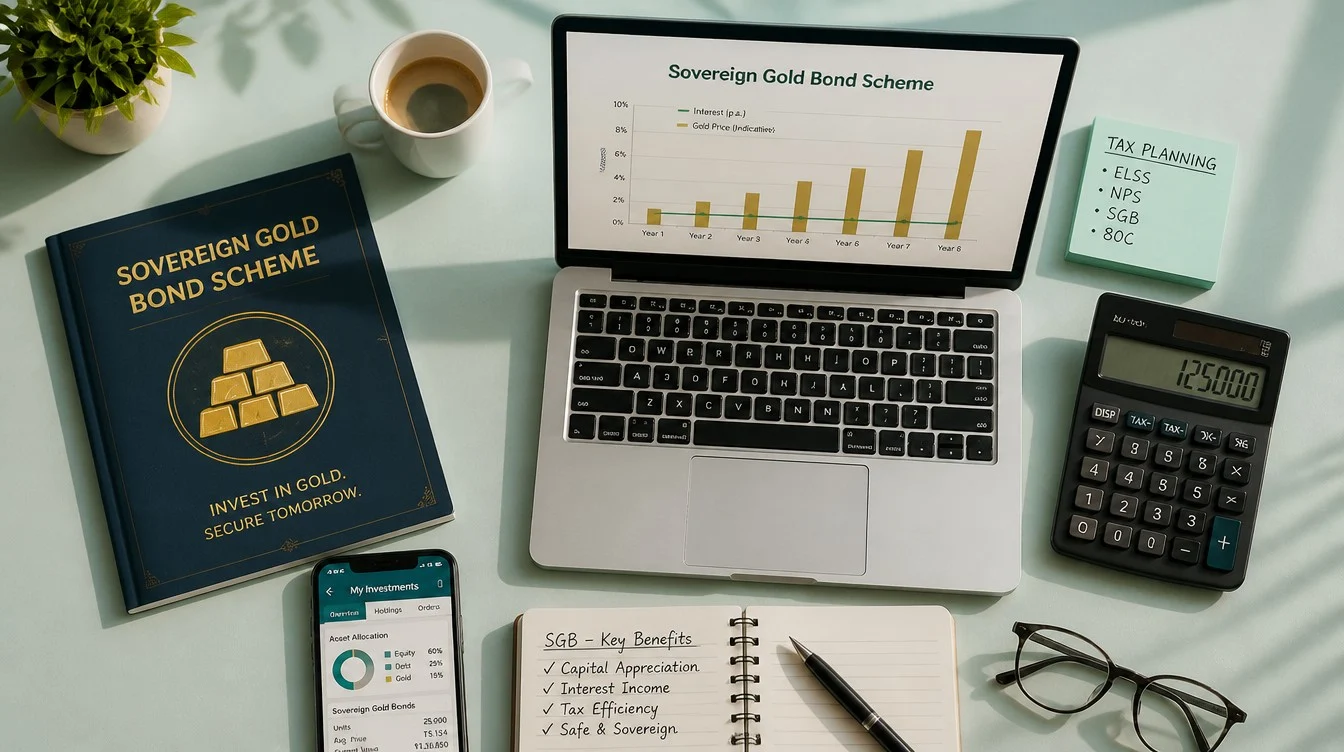
SGB vs Gold ETF vs Physical Gold: Quick Decision Guide
Use this framework to select the right gold instrument for your situation:
- Choose SGB if: You can commit to 8 years (or 5+ years with early exit option). You are in a 20-30% tax bracket where the capital gains tax exemption has maximum value. You want the highest total return from gold. You do not need instant liquidity.
- Choose Gold ETF if: Your horizon is under 5 years. You need the ability to liquidate quickly (emergency, rebalancing, opportunity deployment). You want to invest in small amounts monthly via SIP. SGBs are not currently available (between tranches).
- Choose physical gold if: You have cultural or ornamental requirements. You want wealth that is entirely outside the financial system (some investors value this for specific reasons). You are purchasing in small amounts for gifting (coins below Rs 10,000 for religious occasions). For wealth accumulation goals, SGBs and Gold ETFs outperform physical gold on a risk-adjusted, cost-adjusted basis.
Frequently Asked Questions
What is the current SGB interest rate in India?
The Sovereign Gold Bond interest rate is fixed at 2.5% per annum on the issue price. This rate has been maintained since the scheme’s launch in 2015 and applies to all SGB series regardless of when they were issued. The rate does not change with RBI policy rate changes. Interest is paid semi-annually in April and October each year until maturity.
How do I know when the next SGB tranche opens?
The RBI announces each SGB tranche opening approximately 1-2 weeks before the subscription period starts. Notifications are published on the RBI website, major financial news sites, and most banks’ investment portals. Set up alerts on your bank’s app or subscribe to RBI press release emails. Most major banks (SBI, HDFC, ICICI) also send SMS and email notifications to customers when a new SGB tranche opens.
Can I get a loan against Sovereign Gold Bonds?
Yes. SGBs can be used as collateral for loans from banks and financial institutions. The loan-to-value ratio follows RBI guidelines for gold loans (typically 65-75% of current gold value). This makes SGBs even more useful as a long-term holding – you can unlock liquidity through a loan without selling, avoiding the premature exit penalty and preserving the 8-year tax-free capital gains benefit.
What happens to my SGB if I die before maturity?
SGB nominees or legal heirs can claim the bonds. The nominee or heir can either continue holding the bonds to maturity (retaining the tax-free benefit) or redeem them early. For SGBs held in demat form, the transmission process follows standard demat account transmission procedures. For bonds held in RBI bond ledger account form, transmission is handled through the issuing bank or post office with appropriate documentation.
Is there a risk of SGB defaulting?
No. SGBs are sovereign debt instruments backed by the Government of India. There is zero credit risk. The government of India has never defaulted on a rupee-denominated domestic debt obligation. The only risks in SGBs are: gold price risk (if gold prices fall, your principal value falls proportionally), interest rate risk (the 2.5% interest rate is fixed; if inflation exceeds this, real interest yield is negative), and liquidity risk (early exit is difficult before year 5).
Related Articles
- Digital Gold vs Sovereign Gold Bond vs Gold ETF
- New Tax Regime vs Old Tax Regime 2026
- SIP vs Lumpsum: 20-Year Backtest