

Factor ETFs India: Smart Beta Investing Explained for Indian Retail Investors
Between traditional passive index funds and expensive active mutual funds, factor etfs india occupy a distinctive middle ground. They track rules-based indices that tilt toward stocks with specific characteristics – momentum, value, quality, or low volatility – that have historically been associated with higher long-term returns than plain market-cap-weighted indices. This article explains how factor ETFs work, the evidence for each factor in Indian markets, the costs involved, and how to decide whether factor ETFs belong in your portfolio.
What Is Factor Investing and How Do Factor ETFs Work?
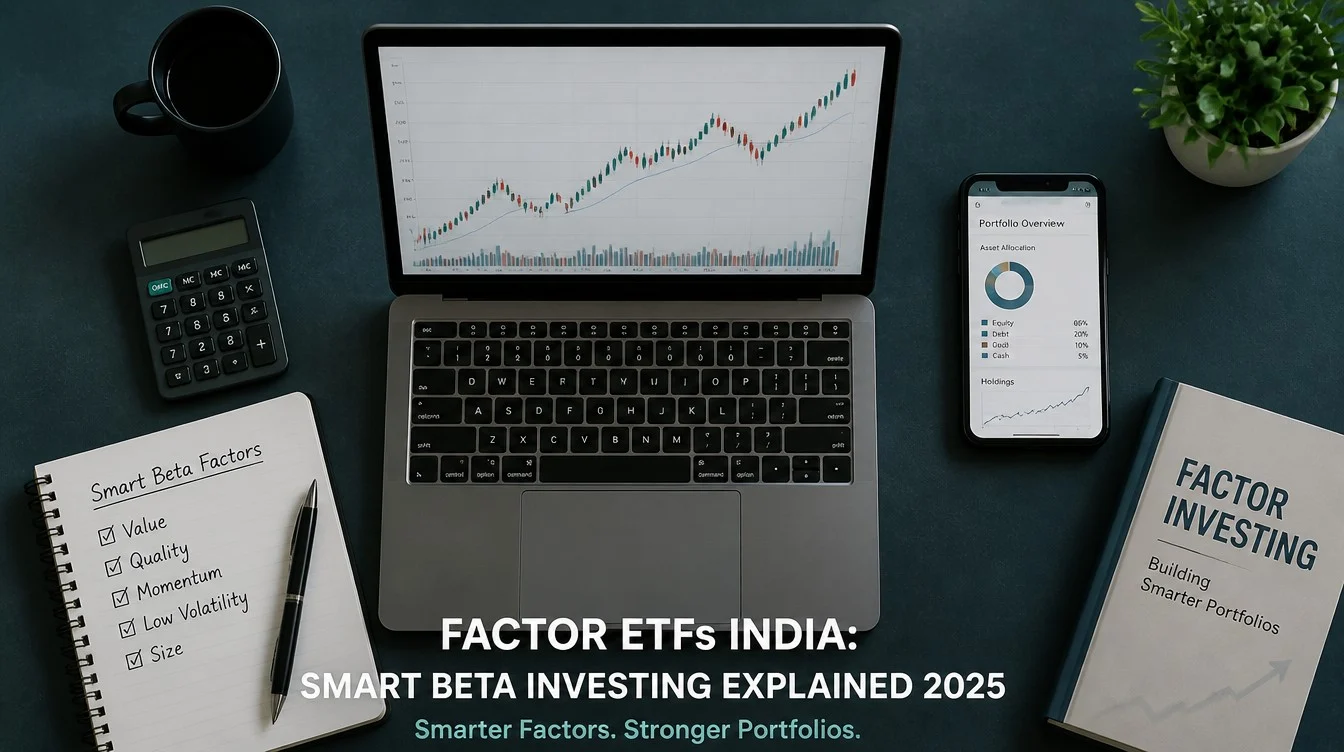
Factor investing is based on academic research showing that stocks sharing certain attributes have historically generated higher risk-adjusted returns than the broad market over long periods. The most well-supported factors in finance literature include value, momentum, quality, size (small-cap), and low volatility.
A factor ETF tracks an index that screens and weights stocks based on one of these factors rather than by market capitalisation. Instead of holding all Nifty 500 stocks at their market-cap weights, a momentum factor ETF holds only the recent outperformers (typically the top 30-50 stocks by 6-12 month return) at equal or factor-score weights. The index rebalances periodically (typically semi-annually) to replace stocks that no longer meet the factor criteria.
Why Do Factors Produce Higher Returns?
The academic explanations for factor premiums vary by factor. Value stocks (cheap companies by earnings or book value) outperform because investors systematically overpay for glamour stocks and underprice boring, cheap businesses. Momentum stocks outperform because markets underreact to information, and trends persist for 6-12 months before mean-reverting. Quality stocks outperform because highly profitable companies with strong balance sheets reinvest at high rates and compound earnings for longer. Low-volatility stocks outperform risk-adjusted benchmarks because investors overweigh lottery-like high-volatility stocks and undervalue boring, stable businesses.
The common thread is that factors involve some combination of behavioural bias and rational risk premium. The fact that factors have worked across multiple markets and decades provides evidence for their persistence, though past performance never guarantees future results.

Factor ETFs Available in India: A Category Overview
| Factor | What It Selects | Key India ETF Examples | Rebalance Frequency |
|---|---|---|---|
| Momentum | Top 30-50 stocks by 6-12 month price return | Nifty200 Momentum 30 ETF, UTI Nifty Momentum ETF | Semi-annual |
| Quality | High ROE, low debt, stable earnings growth | Nifty50 Quality 30 ETF, ICICI Pru Quality ETF | Annual |
| Value | Low P/E, P/B; high earnings yield | Nifty500 Value 50 ETF, HDFC Value Factor ETF | Semi-annual |
| Low Volatility | 50 lowest-volatility stocks in Nifty 100 | Nifty100 Low Volatility 30 ETF, ICICI LV ETF | Semi-annual |
| Alpha (Multi-Factor) | Combined factor screens | Nifty Alpha 50 ETF, Nippon Alpha ETF | Semi-annual |
Momentum ETFs India: The Most Popular Factor
Momentum ETFs have attracted the most investor attention and AUM in India’s factor ETF space. The Nifty200 Momentum 30 index selects the 30 highest-momentum stocks from the Nifty 200 based on a composite score of 6-month and 12-month returns. The index rebalances semi-annually, replacing stocks that have lost momentum with new leaders.
Momentum is one of the best-documented factors in Indian markets. Research on Indian equity data shows momentum portfolios have historically outperformed the Nifty 50 by 3-5% per annum over 10-year periods. However, momentum is also the most volatile factor – it underperforms sharply in trend reversals and market corrections (when recent winners suddenly become losers). The 2020 COVID crash and the 2022 growth stock correction were both painful periods for pure momentum strategies globally.
Momentum ETF Rebalancing Cost
Because momentum ETFs turn over their portfolios twice a year, they incur higher transaction costs and STT than a plain market-cap index ETF that barely changes its holdings. This transaction drag is partially offset by securities lending income but can reduce the net factor premium. Compare the tracking difference (not just expense ratio) of momentum ETFs to assess true total cost of ownership.

Quality ETFs: The Lower-Risk Factor
Quality ETFs select companies with high return on equity (ROE), low debt-to-equity ratios, and stable earnings growth. In Indian markets, quality companies have historically included large private banks, FMCG leaders, IT services firms, and specialty chemicals companies – businesses with durable competitive advantages and efficient capital allocation.
The quality factor tends to be defensive: quality stocks underperform in broad market rallies where cheap, speculative stocks surge, but hold up better in downturns. This makes quality ETFs suitable for risk-conscious investors who want equity exposure but with lower drawdown risk than pure market-cap or momentum exposure. For investors prone to panic selling during drawdowns, the lower volatility of quality ETFs may help maintain the discipline to stay invested.
Value ETFs: Contrarian Factor Investing
Value ETFs buy cheap stocks – companies trading at low multiples of earnings, book value, or cash flow relative to the market. In India, value ETFs have historically captured the recovery cycles of cyclical sectors (metals, energy, PSU banks) during economic upswings. The challenge with value investing is that cheap stocks are often cheap for good reasons, and avoiding value traps (companies that are cheap because they are permanently declining) requires the index construction methodology to filter out fundamental deterioration.
Pure value ETFs in India have had mixed performance records. They outperformed strongly in the 2020-2022 value recovery cycle but underperformed in the 2018-2019 growth-led market. Understanding how SEBI’s market structure regulations affect small and mid-cap value stocks helps contextualize value ETF performance cycles in India.
Are Factor ETFs Worth the Higher Cost?
Factor ETFs charge higher expense ratios than plain index ETFs. A Nifty50 momentum ETF might charge 0.15-0.50% versus 0.02-0.07% for a plain Nifty 50 ETF. For a factor ETF to justify this cost differential, it must outperform the market-cap index by more than the extra expense ratio plus transaction costs from higher turnover.
The evidence on whether factor ETFs deliver their historical premium in the Indian market on a going-forward basis is mixed. Academic backtests on Indian data show factor premiums, but live ETF performance since their launch (most Indian factor ETFs are 3-7 years old) has been more variable. Momentum has been the strongest performer; pure value has been inconsistent.
The most prudent approach is to use factor ETFs as a small part (10-15% of equity allocation) of a diversified portfolio anchored in broad market-cap index ETFs. A 70% Nifty 50 ETF + 20% Nifty Next 50 ETF + 10% momentum or quality ETF captures broad market exposure while tilting toward factors with long-run evidence of outperformance. Consistent long-term investment through market cycles matters more than any factor tilting – factor ETFs are an enhancement to a disciplined core strategy, not a substitute for one.
Common Mistakes in Factor ETF Investing
Factor ETF investors make specific errors that reduce realized returns relative to factor index returns.
Buying after a strong run: Momentum ETFs tend to attract inflows after outperforming, which is often near the peak of a momentum cycle. Entering after a 3-year outperformance period may mean buying at a point of maximum mean-reversion risk.
Switching factors based on recent performance: Switching from value to momentum after momentum has outperformed is classic performance chasing. Factor cycles are long (3-5 years) and rotating between factors based on 1-2 year performance destroys value by consistently buying high and selling low across factor cycles.
Ignoring total cost (tracking difference, not just expense ratio): Factor ETFs with high turnover (especially momentum) have significant transaction costs embedded in their tracking difference beyond the stated expense ratio. Compare 3-year cumulative tracking difference against the factor index, not just the annual expense ratio.
Frequently Asked Questions
What is a factor ETF in India?
A factor ETF tracks a rules-based index that selects stocks based on specific characteristics (factors) like momentum (recent price performance), quality (high profitability, low debt), value (cheap valuations), or low volatility (stable price history). These factors have historically been associated with excess returns over plain market-cap-weighted indices. Factor ETFs are listed on exchanges like shares and regulated by SEBI as mutual fund products.
Which factor ETF is best in India?
There is no universally “best” factor ETF – the right choice depends on your risk tolerance and investment horizon. Momentum ETFs have shown strong long-run returns in Indian data but with high short-term volatility. Quality ETFs offer defensive characteristics with lower drawdowns. The most popular by AUM in India are Nifty200 Momentum 30 ETFs from Nippon India and UTI. Check current expense ratios and 3-year tracking difference before selecting any factor ETF.
Are factor ETFs better than plain index ETFs?
Over long periods (10+ years), factor ETFs have historically outperformed plain market-cap index ETFs in academic data. In live performance since launch in India, results are more mixed. Factor ETFs are higher risk (more concentrated, higher turnover, factor underperformance cycles) and higher cost than plain index ETFs. They are appropriate as satellite allocations (10-15% of equity) alongside a core plain index ETF, not as replacements for plain index exposure.
What is the expense ratio of factor ETFs in India?
Factor ETFs in India typically charge expense ratios of 0.10-0.50% per annum, significantly higher than plain index ETFs (0.02-0.07%). The most popular momentum ETFs from Nippon India and UTI charge approximately 0.25-0.30% in direct plans. Quality and value ETFs vary by AMC. Always check the current expense ratio on the AMC’s factsheet, as these change over time.
Should I invest in factor ETFs through SIP?
SIP investing in factor ETFs is possible through broker recurring order features. From a theoretical standpoint, SIP investing in factor ETFs does not provide the same rupee cost averaging benefit as SIP in volatile equity ETFs because factor ETFs already have sector concentration. Lumpsum investing in factor ETFs after a factor underperformance cycle (when the factor is “cheap”) is often cited as the better approach by factor investing practitioners. However, identifying these entry points requires active monitoring that most retail investors cannot sustain.
Related Articles
- SIP vs Lumpsum: 20-Year Backtest Results
- 10 Investment Biases That Cost Indian Investors Money
- SEBI F&O New Rules: What Retail Traders Need to Know