
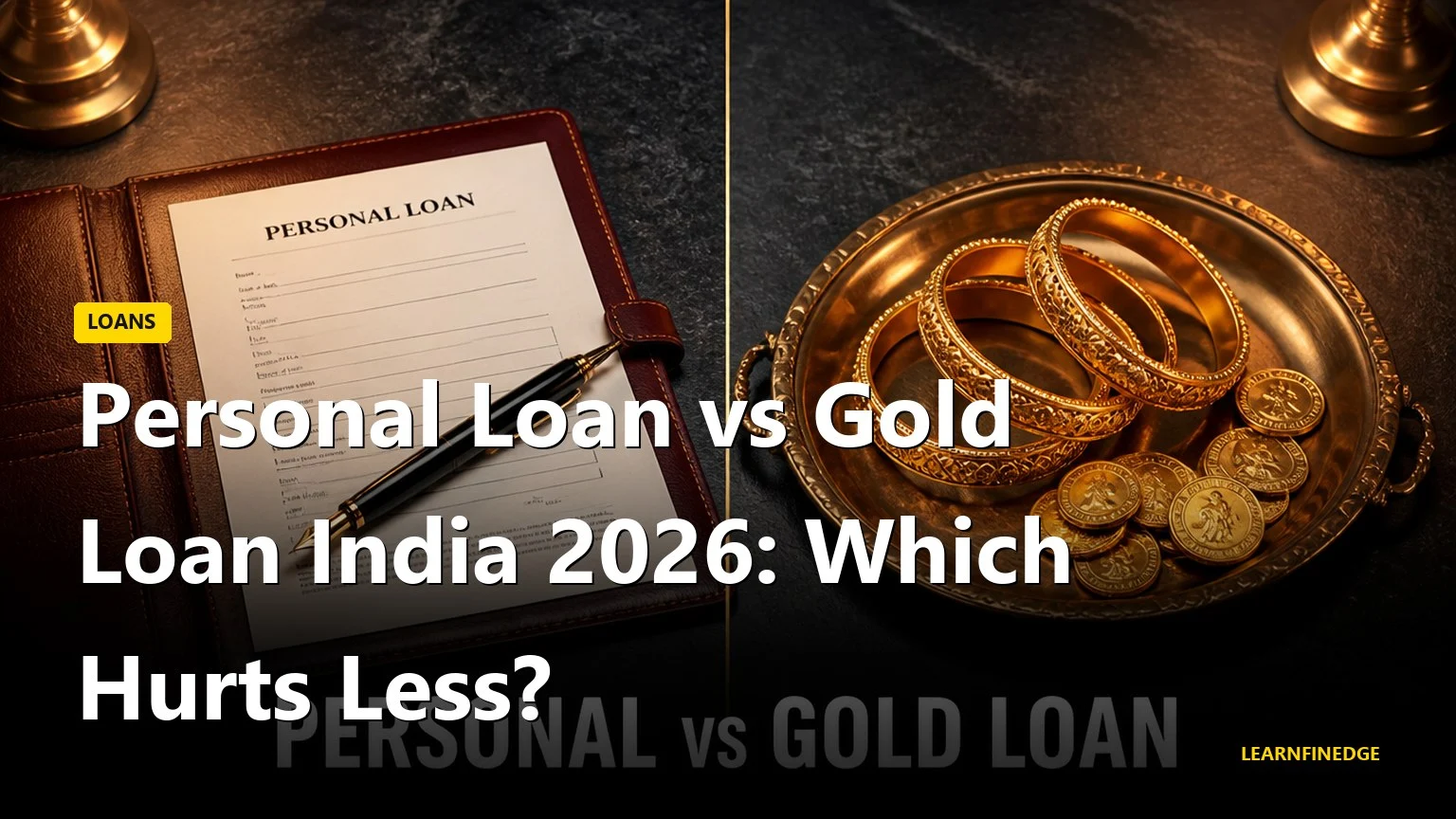
Vikram’s daughter got admission into a one-year postgraduate programme in Hyderabad. He needs Rs 3 lakh in the next ten days before the fee deadline. His bank’s relationship manager pinged him with a pre-approved personal loan offer at 13.5 percent. A gold loan branch in his colony quoted 9.25 percent against the family’s bangles. He almost picked the lower headline rate without doing the rest of the math. This guide on personal loans vs gold loans in India 2026 walks through what those two numbers actually mean once you load processing fees, foreclosure, tenure and credit-score impact on top of them and which one hurts less in the kind of small-to-medium urgent borrowing most Indian households actually face.

What each product really is
Personal loan: unsecured, paperwork-heavy, ego-friendly
A personal loan is an unsecured retail loan. The bank or NBFC lends purely on your income proof, your employer profile, your existing EMI burden and your credit history. There is no collateral. Disbursal is typically same-day for a pre-approved customer and 48 to 72 hours for a fresh borrower. Tenures range from 12 to 60 months, with most borrowers landing on 24 to 36 months.
The APR you see headlined as 11 to 18 percent for FY 2025-26 hides a wider band. For a salaried borrower at a top-tier private firm with a 780+ CIBIL, the offer can be 10.5 to 12 percent. For a contractor with a thin file, the same product can be quoted at 18 to 22 percent. The processing fee is typically 1.5 to 2.5 percent plus GST, deducted from the disbursed amount. Foreclosure charges, after the RBI’s June 2025 directive on individual borrowers, are now nil for floating-rate personal loans from regulated lenders, but fixed-rate personal loans still attract 2 to 4 percent of principal outstanding. The fine print on the new foreclosure rules is laid out in the loan foreclosure penalty note.
Gold loan: secured, fast, quiet
A gold loan is a secured loan against jewellery or coins of 18 to 22-carat purity. The lender values the gold at the prior thirty-day average price, applies a regulator-mandated loan-to-value ratio of up to 75 percent, and disburses the cash. Disbursal is often the same hour at a specialised NBFC branch and half a day at a bank.
Headline rates for FY 2025-26 run between 8.25 and 15 percent. Banks sit at the lower end of that band, gold-focused NBFCs sit at the upper end and charge for speed. The processing fee is much smaller, 0.25 to 1 percent, sometimes waived during festive campaigns. Foreclosure is free at most lenders if you wait out the first month; closing in the first 30 days can trigger a Rs 250 to Rs 500 flat fee. Tenure is shorter, typically 6 to 24 months, sometimes structured as a bullet repayment with interest paid monthly. The deeper rate-and-bank comparison is in the dedicated gold loan guide.
The five lenses that actually matter
Choosing solely based on the headline APR is the wrong approach. The right way is to put both options through five filters and let the worst of the three or five lose.
Lens 1: True cost of money over your repayment window
The number that matters is not the APR. It is the total outgo over the actual tenure you will run the loan for. A personal loan at 13.5 per cent for 24 months with a 2 percent processing fee on Rs 3 lakh costs Rs 343,690 in total payouts. A gold loan at 9.25 per cent for 24 months with a 0.5 percent processing fee on the same Rs 3 lakh costs Rs 329,200. The gold loan saves about Rs 14,500 over two years on the same principal. Worth knowing, not always worth changing your decision over.
Lens 2: Speed of disbursal
For a planned expense, both can hit your account within 48 hours. For a true emergency, the gold loan wins on speed because no income verification is needed. If you walk into a Muthoot or Manappuram branch with jewellery and ID, the cash is across the counter inside an hour. For a personal loan in the same scenario, even a pre-approved offer takes a working day to disburse.
Lens 3: CIBIL impact
A personal loan is a credit-history product. The enquiry pulls a hard credit check, which knocks the score by 3 to 8 points temporarily. Once disbursed, the loan adds an unsecured tradeline to your bureau report. On-time EMIs build credit history; missed EMIs do the opposite, hard. A gold loan, by contrast, is reported by most lenders but treated as secured, which has a lighter weight on score impact. The structural reasons why scores move are explained in the CIBIL score drop piece.
Lens 4: What happens if you cannot pay
This lens is the lens borrowers underweigh. On a personal loan default, the lender sends recovery agents, files for arbitration, lists you with the bureaus as 90 days past due, then 120, and then writes it off. Your CIBIL drops 60 to 150 points and stays scarred for seven years. There is no asset to lose, but the credit shadow is long.
On a gold loan default, the lender simply auctions the gold to recover its dues. RBI rules require a 14-day notice and a public auction, with any surplus refunded to you. CIBIL impact is real but lighter; the family heirloom risk is the heavy cost. For households that cannot stomach losing the gold, this is the wrong product to lean on.
Lens 5: Mental cost
A gold loan ties your asset to a debt. Some borrowers find it psychologically easier to repay because the bangles in the bank locker keep nagging them. Others find it stressful. A personal loan is invisible; that invisibility makes it easier to drift on. Know yourself.

The Rs 3 lakh, 24-month worked comparison
Stripping the marketing language away, here is the full math on Vikram’s choice. Both loans are for a Rs 3 lakh principal and 24-month tenure.
Personal loan, 13.5% APR, 2% processing fee
Monthly EMI: Rs 14,320. Total of 24 EMIs: Rs 343,690. Processing fee deducted upfront: Rs 6,000 plus GST of Rs 1,080, so Vikram actually receives Rs 292,920 in his account. Effective interest paid is roughly Rs 50,770. No foreclosure cost if the personal loan is floating-rate. Effective annualised cost, including the processing fee front-load, works out to about 16 percent.
Gold loan, 9.25% APR, 0.5% processing fee, 24-month structured
If structured as a regular EMI gold loan, the monthly EMI is Rs 13,720. Total of 24 EMIs: Rs 329,200. Processing fee: Rs 1,500 plus GST. Disbursal: Rs 298,230. Effective interest paid is roughly Rs 30,970. The effective annualised cost works out to about 10.5 percent.
The headline gap and the catch
The Rs 14,500 saving on the gold loan is real. The catch is the asset commitment. Vikram is pledging family bangles worth Rs 4 lakh against a Rs 3 lakh loan. If any of those bangles are tagged for a wedding within the next two years, the loan window is fine. If his daughter’s wedding is six months out and the same bangles are part of the plan, locking them up for two years is a calendar disaster, even at the lower rate.
When the personal loan actually wins
Large amount, weak gold holdings
The cap on gold loan size is your gold itself. At 75 percent LTV, a household needs Rs 6.66 lakh of gold to borrow Rs 5 lakh. Many urban salaried households do not hold that much physical gold. Either the family gold has been sold off, or it is split across in-laws, or it is in lockers the borrower cannot access in a week. In all those cases, the personal loan is the only path.
Stable income, long tenure
A 48- or 60-month tenure is awkward on a gold loan. Most gold lenders prefer short cycles. A 60-month, Rs 8 lakh personal loan for a home renovation or a medical procedure is structurally a personal loan call, not a gold loan call.
Building credit history
For a first-time borrower who eventually wants a home loan, an on-time personal loan adds two years of tradeline history and lifts the CIBIL ceiling. A gold loan does add a secured tradeline but with thinner weight. If credit-history building is a side goal, the personal loan compounds better.
You will need to break the loan early
A floating-rate personal loan can now be foreclosed at zero penalty for individual borrowers. If you expect a bonus, a maturity, or a real estate sale in the next nine months that will let you square the loan, the personal loan is the cleaner prepayment product.

When the gold loan actually wins
Short, urgent, small ticket
For a need of Rs 1 lakh to Rs 4 lakh for six to twelve months, a gold loan is structurally the right product. Faster, cheaper, lighter paperwork.
Weak credit history or thin file
A self-employed contractor with two years of business but no salary slips will get quoted 18 to 22 percent on a personal loan, if approved at all. The same person walks out with a 9.5 percent gold loan in 45 minutes because the gold does the credit vetting for the lender.
You want to protect your CIBIL ceiling
If your home loan application is going in in three months, every hard credit pull and unsecured tradeline matters. A gold loan does the cash job with less noise on the bureau report. The detail on what banks see when they pull your file is in the credit score boost playbook.
Cash flow that does not fit a fixed EMI
Gold loans support a structure called bullet repayment, where you pay only monthly interest and clear the principal at maturity. For a borrower whose income is lumpy, freelance retainers, a bonus-heavy salary, or contract milestones, the bullet structure is cash-flow friendlier than a flat personal loan EMI.
The hybrid play: a third option most filers miss
Households that hold gold and have a small unutilised credit line often find that the cheapest path is to neither pledge gold for the bulk of their requirement nor take a pure personal loan; instead, they can top up with a small personal loan or credit-card EMI for the rest. This keeps the LTV on gold conservative, leaves room for an emergency draw later, and avoids the high-APR drag of a maxed-out personal loan. The ’emergency funds versus personal loans’ note lays out the comparison to credit alternatives in true emergencies.

The choice tree, simplified
Need under Rs 3 lakh, repayable in 12 months, own gold, and want it quiet. Gold loan. Need above Rs 5 lakh, repayable over 36 months, salaried, building credit. Personal loan. Need under Rs 2 lakh, thin file, urgent. Gold loan. Need any amount but cannot stomach pledging family jewellery. Personal loan. Need any amount? Plan to pre-pay within nine months. Floating-rate personal loan, because foreclosure is free.
Whichever you pick, write down the EMI, the total outgo, and the closure date on a paper sheet stuck to your fridge before you sign. The product is not the trap. The drift between signing and the first missed EMI is.
Frequently asked questions
Is a gold loan always cheaper than a personal loan in India?
On headline APR, almost always yes, but on total cost, not always. A gold loan typically runs at 8 to 12 percent against 11 to 18 percent for a personal loan. The catch is tenure. Gold loans are short, often 6 to 24 months, while personal loans run up to 60 months. For a 60-month need, the gold loan is rarely a clean fit, and renewing it repeatedly stacks processing fees that eat the rate advantage. Factor in the LTV cap, foreclosure rules, and default risk too, since losing pledged jewellery is a real cost that the APR does not show.
Does a gold loan affect my CIBIL score?
Yes, but lightly. Most regulated gold loan lenders report the loan to credit bureaus as a secured retail loan. On-time EMIs build credit history at a modest pace. Missed EMIs and default do hurt the score, but generally less aggressively than an unsecured personal loan default of the same size. The bigger CIBIL win with gold loans is the lower hard-pull noise during application and the smaller weight on the unsecured-to-secured ratio that some lenders track. If a home loan application is in your nine-month plan, the gold loan is the lighter footprint of the two.
What is the foreclosure rule on personal loans after the RBI’s 2025 directive?
For individual borrowers on floating-rate personal loans from regulated lenders, foreclosure and prepayment charges are now nil. Fixed-rate personal loans still attract 2 to 4 percent of outstanding principal as a foreclosure charge, depending on the lender. Always ask the lender to confirm in writing whether the loan is floating or fixed before you sign, because that single distinction is the difference between a free exit and a five-figure exit. The mechanics and exceptions are detailed in the LFE loan foreclosure penalty guide.
Can I get a gold loan and a personal loan at the same time?
Yes. The two products are evaluated against different criteria. A gold loan goes against the pledged collateral and does not affect your personal-loan eligibility much. A personal loan goes against your income and credit profile. The combined EMI of both, however, should still sit inside the safe 40 to 50 percent of in-hand income range. Carrying both at peak EMI is mathematically fine but operationally fragile, because one income shock now has two repayment lines stalking it.
What happens if I default on my gold loan?
The lender sends a notice, usually 14 days, then conducts a public auction of the pledged gold under RBI guidelines. Sale proceeds cover the outstanding loan plus interest plus auction costs. Any surplus is refunded to you. Your CIBIL takes a hit, but typically less severe than an unsecured loan default of the same size. The non-monetary cost is real, family jewellery or heirloom pieces are gone for good. For households where the gold has emotional weight, this risk is the single biggest reason to think twice before choosing the cheaper-on-paper option.