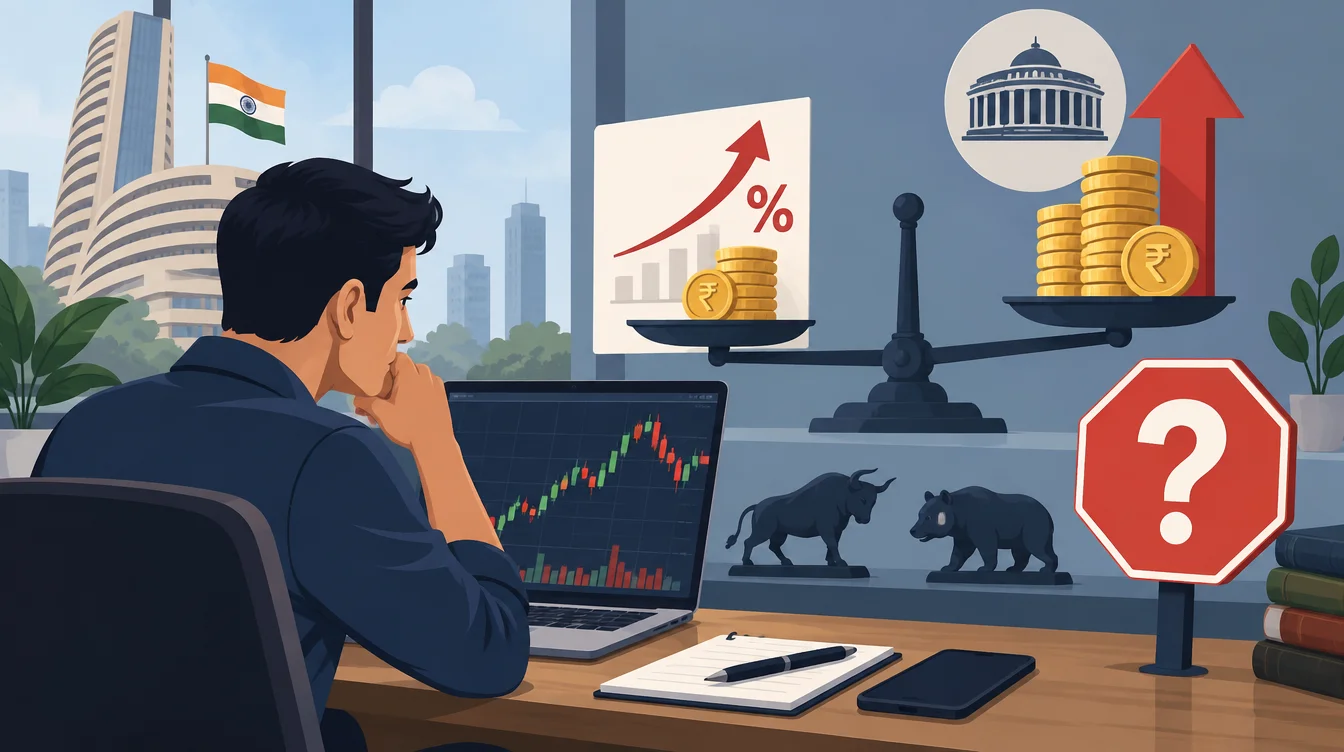

The Budget 2026 announcement of the STT hike in India sent a small shiver through trading desks. The Securities Transaction Tax is a levy you pay on almost every trade on an Indian stock exchange, and even a fraction of a percent change adds up fast when you trade often.
For a salaried reader who buys a few stocks or holds mutual funds through a SIP, the impact is close to nothing. For a frequent futures-and-options trader, the same change can quietly eat into a month of gains.
This guide explains what STT is, where it applies across delivery, intraday, and F&O, what changed in Budget 2026, and how to work out the real cost for your own trading style. Small per-trade costs compound just like returns, only in the wrong direction.
What the STT Hike India Means: The Basics
The Securities Transaction Tax is a tax collected automatically when you buy or sell securities listed on a recognised Indian exchange such as the NSE or BSE. Your broker deducts it at the point of the trade, so there is no separate return to file. Think of it as a toll booth on the market: the more times you pass through, the more you pay.
Why STT exists
STT was introduced to make tax collection on market transactions simple and hard to avoid, since it is deducted at source. A common rule of thumb in Indian personal finance is that a per-transaction cost hurts frequent activity far more than occasional activity.
How STT differs from capital gains tax
Capital gains tax applies only when you book a profit and depends on how long you held the asset. STT applies on the transaction itself, whether you made money or lost it, so you can pay STT on a losing trade.
Where the STT Hike Applies in India: Delivery, Intraday, and F&O
STT is not a single flat rate. It varies by the type of trade, and these buckets are the key to estimating your own bill.
Delivery and intraday trades
When you buy shares and hold them in your demat account, that is a delivery trade, and STT applies on both the buy and sell side. Intraday means you buy and sell the same stock on the same day without taking delivery, and STT is charged only on the sell leg, at a lower rate.
Futures and options
For derivatives, STT works differently again. On equity futures it is charged on the sell side, and on options on the sell-side premium, with separate treatment on exercise. Because F&O traders often place dozens of trades a day, the STT on F&O is where the pain concentrates. To follow how any budget measure feeds through the market, it helps to learn how to read the Union Budget of India first.
- Delivery equity: charged on both buy and sell.
- Intraday equity: charged on the sell side only.
- Equity futures: charged on the sell side.
- Equity options: charged on the sell-side premium, with separate treatment on exercise.
The 2026 Rate Change: What Budget 2026 Did
Budget 2026 raised STT on the highest-volume segments, continuing a policy direction that has already tightened the securities transaction tax 2026 landscape over recent budgets. The hike falls most heavily on derivatives, while delivery equity was left far less affected. Because exact rates can be revised between the budget speech and the final finance act, confirm the notified figures on the official income tax department or exchange circulars before you rely on them.
Why the government targets high churn
Regulators have repeatedly flagged that a large share of individual F&O traders lose money over time, and raising the cost on the most-traded segment is one lever to discourage churn. To see how a single budget line ripples into sectors, the broader picture of the budget impact on the stock market in India puts this change in context.
How Much Does the STT Hike India Cost an F&O Trader?
A worked-cost example
The figures below illustrate the mechanics, not any official rate. Suppose an active options trader sells options premiums worth Rs.2,000,000 (20 lakh) across a single trading day. STT on options is charged on the sell-side premium, so if the applicable rate were, say, 0.1 percent, the STT for that day would be roughly Rs.2,000.
Scale that across a full month. A trader active on 20 sessions at that volume would pay in the region of Rs.40,000 in STT alone, before broking, exchange fees, GST, and stamp duty. The exact figure depends on the notified rate and your real turnover, so treat it as a template, not a forecast. Discipline about such costs runs through the lessons from Poor Charlie’s Almanack for long-term investors, where avoiding friction is treated as a genuine source of return.
Comparing the cost by trader type
| Trader profile | Trades per month | STT burden | Effect of a hike |
|---|---|---|---|
| Buy-and-hold investor | 1 to 4 | Negligible | Barely noticeable |
| Occasional swing trader | 10 to 30 | Low | Small but visible |
| Active intraday trader | Hundreds | Moderate to high | Meaningful |
| Frequent F&O trader | Thousands | Very high | Can erase an edge |
Why Long-Term Investors Are Barely Affected by the STT Hike India
If you invest through SIPs, hold equity mutual funds, or buy a handful of stocks to keep for years, the STT hike is close to a non-event, because STT is a per-transaction cost and long-term investors transact rarely.
The math of infrequent trading
A buy-and-hold investor might place four or five trades in a year. Even if the delivery STT rate rose, the difference on a handful of trades is a rounding error against years of compounding, so the STT impact on returns for such an investor is almost immeasurably small.
Where mutual fund investors stand
Inside an equity mutual fund, the fund bears transaction costs, reflected in its expense structure. As an SIP investor you do not pay STT on each instalment the way an F&O trader pays on each contract, so your bigger long-run costs are the expense ratio and your own behaviour. Market-linked instruments still carry market risk, and past performance is not indicative of future results.
Advanced Angle: Fitting STT Into Total Trading Cost
The full cost stack
STT is never the whole story. Every trade also carries broking, exchange charges, GST, SEBI turnover fees, and stamp duty, and for a high-frequency strategy the combined drag can exceed the average edge per trade. That is why desks work to cut turnover.
- Calculate your average gross profit per trade.
- Add up broking, STT, GST, stamp duty, and exchange fees per trade.
- Subtract total cost from gross profit to find your net edge.
- If net edge is near zero or negative, the strategy is a cost machine, not a profit machine.
Valuation discipline over churn
A higher transaction tax quietly rewards patience, making a lower-turnover, valuation-driven approach more attractive on an after-cost basis. The frameworks in the Aswath Damodaran India valuation playbook for retail investors lean in exactly this direction.
Common Mistakes Traders Make Around STT
Ignoring costs when backtesting
Many traders backtest on gross prices, then lose money live because they never subtracted STT and the rest of the cost stack. Always test net of costs.
Confusing STT with capital gains tax
STT is not income tax on profits. You still owe capital gains tax on your net gains separately, and STT does not reduce that liability.
Overtrading to chase a lost edge
When costs rise, the worst response is to trade more to make it back, because that simply pays more STT. For a practical checklist of money moves after any budget, the guide on the Union Budget and personal finance is a good starting point.
Is the STT Hike India a Reason to Stop Trading?
No. The STT hike is a reason to measure your real edge, not to abandon the market. If a strategy only worked because you ignored transaction costs, it was never durable, and if it genuinely beats the full cost stack, a modest STT increase will not break it.
What to do this week
Pull your last three months of trade statements, add up every rupee of STT you actually paid, then compare that to your net profit. That ratio tells you, more bluntly than any article can, whether your trading frequency is working for you or against you.
For educational purposes only. This article is general information about personal finance and is not investment, tax, or legal advice. Past performance does not guarantee future returns. Mutual funds and market-linked instruments carry market risk; read the scheme-related documents carefully. Consult a SEBI-registered investment adviser or a qualified tax professional for guidance tailored to your situation.
Frequently Asked Questions
What is the STT hike in India in Budget 2026?
It is an increase in the Securities Transaction Tax announced in Budget 2026, falling mainly on high-volume segments such as futures and options while leaving delivery equity far less affected.
Does STT apply to mutual funds and SIPs?
You do not pay STT on each SIP instalment the way a trader pays it per contract. Costs inside an equity fund are borne by the fund and reflected in its expense structure, so SIP investors feel the hike very little.
Is STT charged even if I make a loss?
Yes. STT is charged on the transaction itself, not on your profit, so you can pay STT on a losing trade. That is one reason frequent trading costs more than it first appears.
Can I claim STT back or set it off against tax?
STT is a transaction cost, not an advance of income tax, and it does not reduce your capital gains tax liability. You still calculate and pay capital gains tax on your net gains separately.
Who is hurt most by the STT hike?
Frequent F&O and intraday traders, because they transact so often that a small per-trade increase compounds into a large monthly bill. F&O carries leveraged risk and is unsuitable for most retail investors even before tax costs.
Related Articles
- How to Read the Union Budget India: Beginner’s Guide for Investors
- Budget Impact on Stock Market India: Sectors That Win and Lose
- Union Budget and Personal Finance: 5 Things to Do After Budget