
Rakesh Jhunjhunwala Stock Picks: Titan, Tata Motors, and the Lessons Behind Them
Rakesh Jhunjhunwala built one of India’s largest equity fortunes not through a single spectacular call but through a series of high-conviction, long-duration investments in businesses he understood deeply. Studying his rakesh jhunjhunwala stock picks reveals the analytical framework behind each decision: the macro thesis, the business quality assessment, the valuation discipline, and the holding conviction that distinguished his approach from the short-term trading that characterises most retail investor behaviour. This article examines his major stock positions in detail and extracts the lessons applicable to Indian investors today.
Titan Company: The Defining Investment
Titan is the position that defines Jhunjhunwala’s investment legacy. He began accumulating shares around 2002-2003 at prices equivalent to Rs 3-6 per share (adjusted for subsequent splits) when the company was struggling with its Tanishq jewellery division and institutional investors had largely abandoned the stock.
The Three-Part Thesis
His thesis was not complex, but it required conviction in India’s structural growth story at a time when that conviction was far from consensus:
First, Titan’s watch business had a durable brand moat. The company had built genuine consumer recognition over 15 years with products that resonated across price points – from Sonata at the mass market to Titan Edge at the premium end. This brand had taken a decade and a half to build and could not be replicated quickly by a new entrant, providing structural protection for the existing revenue base.
Second, Tanishq had an enormous structural opportunity that the market was pricing as a problem. India’s jewellery market was and remains one of the world’s largest by volume, but in 2003 it was almost entirely unorganised – dominated by local goldsmiths with opaque pricing, variable purity standards, and no brand accountability. Tanishq’s branded, hallmarked, trust-based approach was positioned exactly right for the transition that India’s rising middle class would drive: from unorganised local purchases to branded retail where quality and pricing transparency were guaranteed. The market was pricing the current losses in Tanishq; Jhunjhunwala was pricing the terminal value of the market share Tanishq would eventually capture.
Third, Tata Group parentage provided governance certainty. Jhunjhunwala had absolute confidence that Titan’s minority shareholders would not be expropriated through related-party transactions or management extraction – a confidence grounded in the Tata Group’s historical track record, not naive hope. This governance quality meant he could hold the position through multi-year underperformance without the tail risk of a governance crisis destroying the underlying value.
The Holding Period and the Returns
He held Titan through the 2008 financial crisis (30%+ drawdown), through multiple gold price volatility episodes that impacted Tanishq inventory economics, through regulatory changes in jewellery hallmarking requirements, and through the COVID shutdowns of 2020 that temporarily closed Tanishq stores across India. At his death in August 2022, his Titan holding was worth approximately Rs 11,000 crore – roughly 2,000x his entry cost over 20 years. His complete investment framework treats position sizing and holding conviction as equally important as initial stock selection.

Tata Motors: The Contrarian Cyclical Play
Jhunjhunwala’s Tata Motors investment was structurally different from Titan – it was a contrarian call on a cyclically depressed business rather than a structural growth story.
The Thesis at the Trough
Around 2012-2014, Tata Motors was being written off by the market for two reasons: the India commercial vehicle cycle was in a severe downturn, and Jaguar Land Rover – acquired by Tata in 2008 – was facing concerns about whether it could sustain profitability in a cyclically uncertain global luxury auto market. The consensus view was that the JLR acquisition was a strategic mistake and that Tata Motors would struggle to service its acquisition debt.
Jhunjhunwala’s view was different. On the India business, he believed the commercial vehicle cycle – historically predictable in its 3-4 year oscillation – was at or near its trough and that the next cycle upswing would produce significant earnings recovery. On JLR, he believed the brand had genuine value that the market was underpricing: Jaguar’s design renaissance under Wolfgang Egger and Range Rover’s growing prestige in the Chinese luxury SUV market represented genuine competitive improvements that would produce sustained revenue growth when the global economy normalised.
He took a large position at prices that implied the market was pricing permanent impairment in both the India and JLR businesses. The thesis was partially right: the India commercial vehicle recovery played out as expected, and JLR performed strongly through 2015-2017 on China demand. The subsequent JLR challenges (Brexit uncertainty, diesel emissions regulation, China market slowdown from 2018) tested the investment, but the original entry at deeply distressed valuations provided sufficient cushion for a positive return across the full holding period.
What This Teaches About Cyclical Value Investing
The Tata Motors investment illustrates a different component of Jhunjhunwala’s playbook: identifying quality cyclicals at cycle troughs. Unlike Titan (where the thesis was entirely structural), Tata Motors required a cyclical recovery to generate returns. The analytical work was therefore different – less about terminal value and more about the amplitude and timing of the cycle recovery, the quality of the business at normalised conditions, and the entry price that provided margin of safety against a recovery that might take longer than expected. Confirmation bias is particularly dangerous in cyclical value investing – investors tend to see the cyclical headwinds as structural and miss the recovery opportunity that this mistake creates.
Crisil: The Financial Services Infrastructure Play
Jhunjhunwala held Crisil, India’s leading credit rating agency, as a long-duration position for many years. His thesis was structural: as Indian capital markets deepened – more debt issuances, more corporate bonds, more structured finance products – the volume of credit rating mandates would grow predictably, and Crisil’s duopoly position (alongside ICRA) would allow it to capture the economics of that growth with minimal incremental investment.
Crisil’s business model is inherently scalable: the infrastructure for conducting credit analysis is largely fixed, and adding each incremental rating mandate generates very high incremental margins. In financial services, this translates to structurally high return on equity that compounds intrinsic value rapidly. Crisil also benefited from its acquisition by S&P Global, which provided global research capabilities and cross-selling opportunities in India’s growing credit markets.
This position illustrates Jhunjhunwala’s preference for financial services businesses with structural market position, low capital intensity, and regulatory moats – businesses that benefit from India’s financial deepening without the credit cycle risks that affect banks and NBFCs directly.
Star Health and Akasa Air: Late-Career Conviction Calls
In the final years of his investing career, Jhunjhunwala made two high-profile investments that showed his continued willingness to back structural market opportunities with significant capital.
His large stake in Star Health Insurance was based on his conviction that India’s health insurance penetration – still very low relative to the population’s actual healthcare cost exposure – would grow dramatically over the following decade. Star Health’s independent agent distribution model and its brand strength in retail health insurance gave it structural advantages in capturing this growth. This was a thesis about underpenetration and structural market expansion, the same analytical template he had applied to Tanishq two decades earlier.
His co-founding of Akasa Air was his most directly entrepreneurial investment – he was not a passive minority shareholder but an active participant in building the business. His thesis was that India’s domestic aviation market was structurally underpenetrated: per capita air trips in India were far below the level that comparable economies at similar income stages had achieved, and the existing capacity was inadequate to serve the demand that would emerge as incomes rose and the cost of air travel relative to income declined. The Akasa investment was partially about equity returns and partially about Jhunjhunwala’s genuine belief that participating in India’s growth story was a personal obligation as well as a financial opportunity. Long-term capital formation through equity was, for Jhunjhunwala, both a wealth-building strategy and an expression of conviction in India’s economic future.
What These Picks Reveal About the Methodology
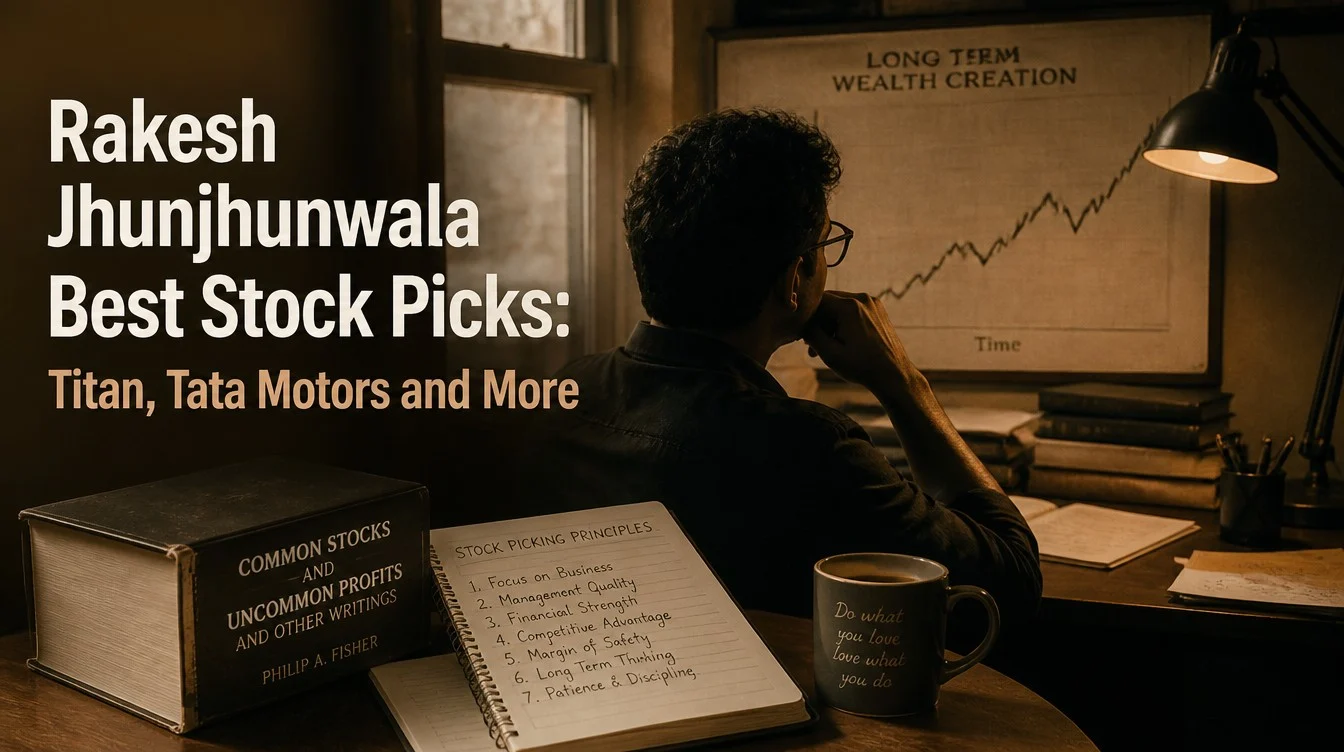
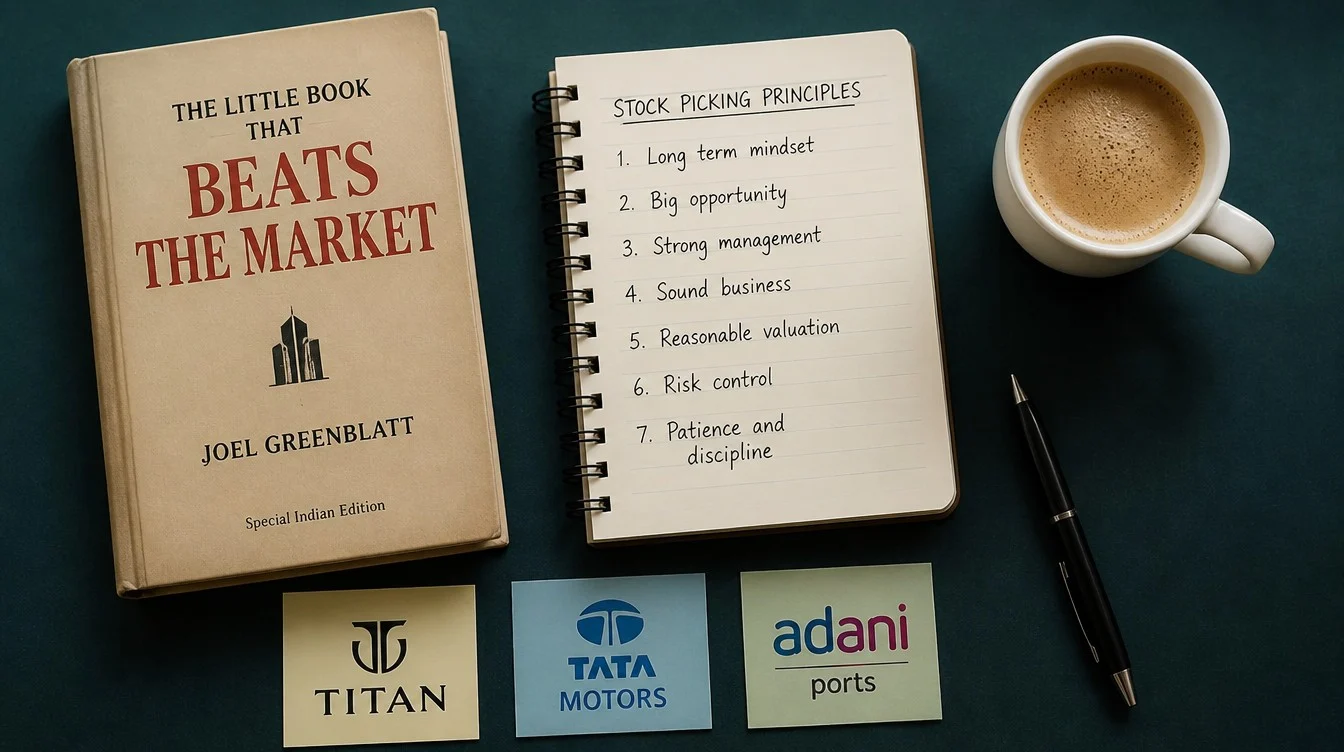
Across Titan, Tata Motors, Crisil, and his late-career positions, five themes recur consistently:
Structural market underpenetration. Every major position was in a business operating in a market that was structurally underpenetrated relative to its long-run potential – organised jewellery, luxury autos in China, credit rating depth, health insurance, aviation. The growth came from market expansion, not market share gain against an established competitor.
Timing entry at temporary distress. He did not pay for structural growth at full valuations. Titan was purchased at depressed prices due to Tanishq’s short-term losses; Tata Motors at cyclical trough valuations; Star Health at IPO prices that were later questioned. He consistently found entry points where short-term concerns were depressing prices below the long-run structural value.
Governance certainty as a prerequisite. Every large position was in a business with demonstrably trustworthy governance – Tata Group brands, S&P-acquired Crisil, the regulated Star Health insurance business. He did not take governance risk in his high-conviction holdings. The speculative positions in his portfolio might have weaker governance, but his core large positions were uniformly in businesses where minority shareholder protection was reliable.
Patience across multiple market cycles. His holding periods were measured in decades for core positions. This is not passive patience – it required active decision-making during multiple 30-50% drawdowns to not sell when the market was offering an exit. The discipline of inaction during drawdowns is, paradoxically, one of the hardest active decisions in long-term investing.
Concentration where conviction was highest. His portfolio returns came from his top 5 positions. He did not dilute his best ideas into a diversified portfolio that would generate index-like returns. Compounding mathematics work most powerfully when applied to genuinely great businesses held in large, concentrated positions – the mathematics that Jhunjhunwala demonstrated through his career are available to any investor willing to apply the same analytical discipline and holding conviction.
Frequently Asked Questions
What was Rakesh Jhunjhunwala’s biggest stock pick?
Titan Company is widely considered his biggest and most successful stock pick. He began accumulating shares around 2002-2003 at prices adjusted to approximately Rs 3-6 per share and held for approximately 20 years. By August 2022, the position was worth approximately Rs 11,000 crore – a return of roughly 2,000x on his cost basis, making it one of the most profitable long-term equity positions in Indian market history.
How did Jhunjhunwala pick stocks?
He combined macro conviction in India’s structural growth with bottoms-up analysis of individual business quality. His criteria included large and growing total addressable markets, sustainable competitive advantages, proven management integrity, and entry prices that provided meaningful margin of safety. He met management teams personally, studied competitive dynamics in detail, and held positions for years or decades when the fundamental thesis remained intact.
Did Jhunjhunwala always hold his stocks for a long time?
His core portfolio positions were held for very long periods – Titan for approximately 20 years, several other positions for 10+ years. However, he also ran a trading portfolio separately from his long-term investment portfolio and was known to take shorter-term positions in liquid large-cap stocks. He was explicit that trading and long-term investing were different activities that he managed with separate capital and separate criteria.
What happened to Jhunjhunwala’s stock picks after his death?
Jhunjhunwala died in August 2022. His estate, managed by his family, continued to hold the major positions. Titan continued performing well through 2022-2023 as its jewellery and watches businesses delivered strong earnings growth. Star Health faced some post-IPO volatility before stabilising. Akasa Air continued its fleet expansion and network growth as the airline sector recovered from COVID disruptions.
Can retail investors replicate Jhunjhunwala’s stock picks today?
The specific stocks he bought at the prices he paid are no longer available. But the methodology is replicable: look for businesses in structurally underpenetrated markets with durable competitive advantages, find entry points where short-term concerns are depressing prices below long-run structural value, verify governance quality rigorously, and hold with conviction through volatility when the fundamental thesis is intact. The inputs to this method are available to any retail investor willing to do the analytical work.
Related Articles
- Rakesh Jhunjhunwala Investment Strategy: How India’s Big Bull Built His Fortune
- Warren Buffett Investment Strategy: Value Investing for India
- SIP vs Lumpsum: What 20 Years of Compounding Looks Like